




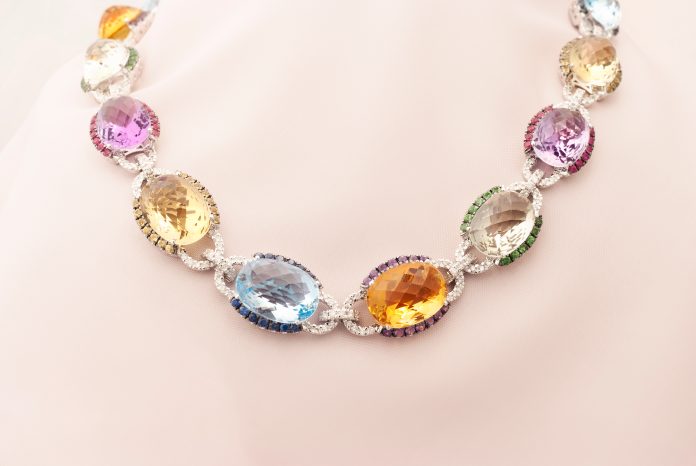

Birthstones by month: do you know yours? For centuries, humans have been fascinated by precious gems and have assigned special significance to each. The 12 zodiac gems laid the foundation for the modern Western list of birthstones.
In 1912, the Jewelers of America established an official list of birthstones by month that remains the standard today. Alternative lists also exist, and of course, you can always choose a gemstone that speaks to you personally.
January Birthstone: Garnet
Garnet has been first on the list of birthstones by month for January since at least the 15th century. With a Mohs Scale of Hardness of 6.5 to 7.5, it can be faceted into beautiful gemstones that wear well in jewelry. Since the term “garnet” actually refers to a group of nesosilicate gems, those born in this month can choose from a rainbow of colors.
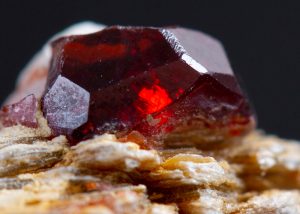
The most common members are red almandine, an iron-aluminum silicate; red pyrope, a magnesium-aluminum silicate; orange-yellow spessartine, a manganese-aluminum silicate; the yellow or green varieties of andradite, a calcium-iron silicate; predominately green grossular, a calcium-aluminum silicate; and rare, bright-green uvarovite, a calcium chromium silicate.
February Birthstone: Amethyst
From the 15th century to the present, amethyst has been the preferred stone of the birthstones by month for February. Amethyst belongs to a mineral family that can compete with garnet for diversity of color: quartz.
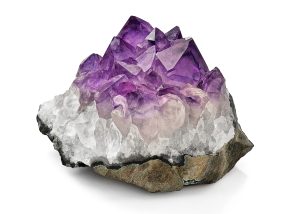
Pure quartz is colorless, as exemplified by Herkimer diamonds. The causes of amethyst’s shades of pale violet to rich purple are radiation and the inclusion of iron impurities and trace elements.
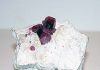
As a rule, amethyst crystals are short and stubby, and occur in large numbers, often filling a large vug a hollow petrified tree section, or lining the inside of a geode. Fine crystals that are large enough to produce a faceted gem of over 20 carats are rare.
March Birthstones by Month: Aquamarine
The current choice of a birthstone for March is aquamarine. Aquamarine is a variety of beryl (Mohs 7.5-8). Its name was derived from the fact that the beautiful, transparent, blue-green coloration of the gem resembles that of seawater. It can be found in translucent to transparent crystals that form in the hexagonal system. The six-sided crystals are often striated lengthwise.
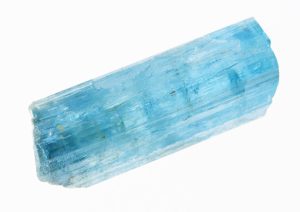
Aquamarine develops in metamorphic rocks and, more often, in pegmatites.
April Birthstone: Diamond
Before 1900, a person with an April birthday had two choices of birthstones by month: diamond or sapphire. During the 20th century, however, diamonds became the preferred stone.
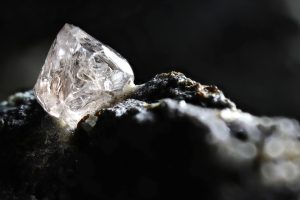
Diamond, a mineral consisting of pure carbon, heads the list of all gemstones for its beauty and hardness. A 10 on the Mohs Scale of Hardness, it is resistant to scratching and is an ideal gem to set in rings. Its hardness results from the arrangement of its atoms in cubes.
All diamonds have slightly rounded faces, and they’re so smooth they feel greasy to the touch. They can be colorless and water-clear to blue, pink, yellow, brown, green or black, and transparent or translucent. They shine with an adamantine luster when held to the light.
May Birthstone: Emerald
There were two choices for May’s birthstones for several hundred years: emerald and agate. The popularity of agate seems to have waned at the turn of the 20th century, so emerald is now the favorite. It’s the green member of the beryl family of gemstones. The color varies from bright green to pale green and, sometimes, darker shades of blue-green.
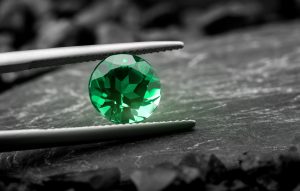
Fine emeralds have a velvety surface appearance and, in the better stones, an even distribution of color. One bad trait of emeralds is a tendency to have inclusions. It’s rare to find an emerald without some slight imperfection. This in no way deters from the beauty of this gemstone, though. It can also be one way of determining whether an emerald is a simulated gem or the real thing, as manmade stones have no imperfections.
June Birthstones by Month: Pearl, Moonstone & Alexandrite
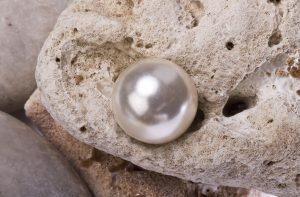
The contemporary choices for June are pearl, moonstone and alexandrite. Of course, a pearl is the organic product of marine bivalves and not a mineral.
Moonstone is a variety of feldspar that shows adularescence, or schiller, an optical effect that produces a milky luster with a bluish tinge that appears to move across the stone when it is tilted. The phenomenon is named after the feldspar variety adularia.
Alexandrite is a color-changing variety of chrysoberyl (beryllium aluminum oxide). This is a very rare and expensive gemstone. It has a hardness of 8.5, and its crystals are either tabular or prismatic. The distinction between alexandrite and chrysoberyl is simply color. A strange characteristic of alexandrite is that it is red, purple or violet when held under artificial light, but in daylight, it looks green.
July Birthstone: Ruby
Ruby is the standard birthstone for July. It is a corundum (aluminum oxide) gem that gets its color from the presence of chromium in its structure. An exceptionally hard mineral, corundum illustrates a hardness of nine on the Mohs scale. “Pigeon-blood” red is the preferred color for rubies, though they also occur in lighter shades, including pink. All other colors of corundum are called sapphires.
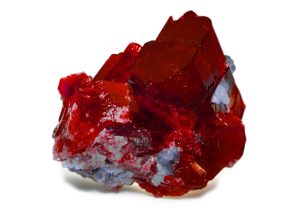
Ruby exhibits all the desirable properties of a jewelry stone: beauty, durability, optical properties, and rarity. Some rubies display a star or asterism when fashioned into a cabochon. This effect is caused by the reflection of light from numerous inclusions of minute, needle-like crystals of rutile. Corundum crystallizes in the hexagonal system with a tabular-barrel-shaped habit.
August Birthstones by Month: Peridot & Spinel
Current birthstones for August are peridot, the gem-quality form of olivine and spinel. Olivine makes up a large portion of the Earth’s mantle. Rocks containing olivine have been brought to the surface by volcanic action and actually blown out in the form of volcanic bombs. Masses of olivine have been found in meteorites, and the Apollo astronauts brought back basaltic rocks from the moon that contained olivine.
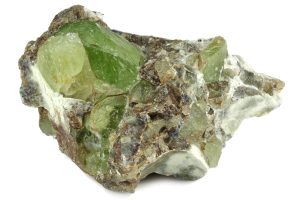
A popular jewelry stone, peridot has a hardness of 6.5-7 and can be transparent or translucent, with a vitreous luster. Its color shades from deep green to apple green, yellow-green or olive. It’s most often found in granular nodules, forming short, prismatic crystals in the orthorhombic system.
Spinel is the gem-quality member of the larger spinel group. Its hardness (Mohs 7.5-8.0) makes it ideal for jewelry use. Its spectrum of colors includes red, pink, purple, blue and lavender. In times past, red spinel was often mistaken for ruby. A notable example is the Black Prince’s Ruby, set in the royal crown of England.
September Birthstone: Sapphire
The birthstone for September is sapphire. This term refers to any corundum (aluminum oxide) gem that has any color other than red (ruby). Sapphires may be colorless, blue, green, yellow, orange, brown, pink, purple, gray, black, or multicolored. At Mohs 9, its hardness is second only to that of a diamond.
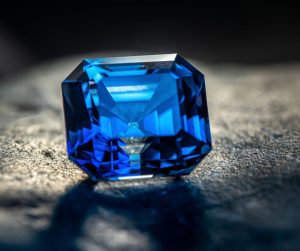
Heat treatment is sometimes used to give natural blue sapphires a deeper, more pleasing color. Natural star sapphires, which display the optical phenomenon of asterism, are very rare.
October Birthstones by Month: Opal & Tourmaline
Two birthstones by month options for October are opal and tourmaline. Opal is a magnificent gemstone with a play of color or “fire” in all colors of the spectrum. Spaces between the tiny spherules of silica that make up the gem diffract light into its spectral colors. Red, yellow, green and blue, in strong to pastel shades, flash from the stone when it is tilted.
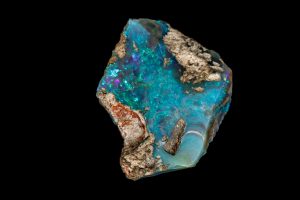
Opal occurs in common and precious types. Common opal does not display any reflective fire. It may have a honey-yellow, brown, gray or colorless body color that is milky and opaque. Opal (Mohs 5-6) is not a very hard gemstone.
Tourmaline, a silicate of boron, has a complicated chemical composition, in which a number of elements, including calcium, iron, sodium and aluminum, may combine. It has a Mohs hardness of 7-7.5.
It belongs to the trigonal crystal system and its habit is hemimorphic (a crystal having two ends of an axes unlike in its planes).
Because of the coloration of the individual stones, tourmaline has several names, including schorl (black), rubellite (red), indicolite (blue), and dravite (brown). Tricolor crystals are common. The popular watermelon variety has an outer layer of green around a red core.
November Birthstones by Month: Topaz & Citrine
The current birthstones by month for November are topaz and citrine. People tend to think of topaz, a silicate mineral with aluminum and fluorine, as a yellow stone, but heat-treating and color-enhancing adaptations have made blue the predominant color on the market. It is an allochromatic mineral, which means its color is caused by internal defects in the crystal and has a Mohs hardness of eight.
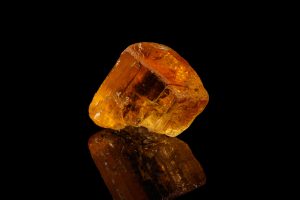
Citrine is the golden member of the quartz family (silicon dioxide). Though quartz in its many forms is one of the most abundant minerals on earth, fine, gem-grade crystals are not that common. Citrine is affordable and, when faceted, rivals more expensive gemstones in beauty.
December Birthstones by Month: Turquoise, Zircon & Tanzanite
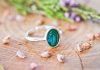
There are three birthstones by month for December: turquoise, blue zircon and tanzanite. Turquoise (hydrated copper aluminum phosphate) is an opaque, blue-to-green, massive gem material. It has a relatively low hardness of Mohs 5-6, so care must be taken with turquoise jewelry.
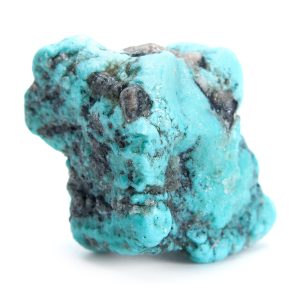
The rarest and most valuable variety is robin’s egg blue with black “spiderweb” veins of limonite. Fake turquoise, consisting of dyed howlite or magnesite, is common. Buyer beware.
Zircon (zirconium silicate) can be blue, black, red, brown, green, yellow, smoky, or water-clear. It has an adamantine luster much like that of a diamond, and it is often misidentified as such.
Tanzanite, the blue/purple variety of zoisite (basic calcium aluminum silicate), is a recently introduced birthstones by month alternative for December. Tanzanite crystals in shades of yellow to brown, green, pink, gray or blue are often heat-treated to produce a gemstone that is a beautiful and permanent blue.
Birthstones by Month: Questions and Answers
Q: What are the birthstones by month?
A: Birthstones by month are gemstones assigned to each month of the year, traditionally believed to bring good luck and reflect the personality traits of those born in that month. Modern lists are based on the Jewelers of America standard.
Q: Can I choose a different birthstone than my month’s traditional gem?
A: Yes! Many people select alternative or personal favorite gemstones instead of the traditional birthstone for their month. Some months even have multiple options, like June (pearl, moonstone, alexandrite) or December (turquoise, zircon, tanzanite).
Q: Are birthstones by month the same worldwide?
A: No. Western birthstone lists are the most common in the U.S. and Europe, but other countries may have different traditional or modern birthstone assignments.
Q: How do I care for my birthstone jewelry?
A: Care depends on the gemstone’s hardness. For example, diamonds and sapphires are very durable, while pearls and opals are softer and require gentle handling. Always store gems separately and avoid harsh chemicals.
Q: Do birthstones have special meanings or properties?
A: Many gemstones are believed to have metaphysical properties or symbolic meanings. For instance, garnet is associated with protection, amethyst with calm and clarity, and ruby with love and vitality.
Whether you follow tradition or choose a gemstone that speaks to you personally, birthstones by month offer a meaningful way to celebrate birthdays and special occasions. From garnet in January to turquoise, zircon, or tanzanite in December, each stone carries its own beauty, history, and symbolism. Exploring the full range of birthstones by month can inspire jewelry choices, deepen appreciation for gemstones, and even help you discover a personal favorite beyond your assigned month.
This story about birthstones by month previously appeared in Rock & Gem magazine. Click here to subscribe. Story by Kenneth H. Rohn







good