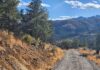

Peridot mining at Peridot Mesa in Arizona produces some of the world’s most important commercial peridot. Located on the San Carlos Apache Reservation just east of Globe, Arizona, Peridot Mesa contains vast quantities of small green grains of the gem formed from olivine. Although the material is generally small, the deposit is remarkable for its abundance and geological setting. It offers a fascinating look at how peridot forms, where it is found and why this green gem occurs not only on Earth but also in space.
Key Takeaways: Peridot Mining
- Peridot mining at Peridot Mesa in Arizona produces large quantities of small green peridot grains from basalt.
- Peridot is the gem-quality form of olivine, a mineral series dominated by the minerals forsterite and fayalite.
- The San Carlos Apache Reservation is one of the world’s most important sources of commercially sold peridot.
- Peridot also occurs in Earth’s mantle, volcanic rocks, Hawaiian black sands and certain meteorites.
- Pallasites contain gem-quality olivine, providing an unusual link between peridot found on Earth and material from space.
Olivine & Peridot
Peridot is the gem form of olivine, but what is really odd is that olivine is not a mineral. If you read Fleischer’s Glossary of Mineral Species, olivine is not listed. This is because the name is generally used for a solid-solution series of two minerals: fayalite and forsterite.
Pure forsterite is magnesium silicate, and fayalite is an iron silicate, but they rarely occur in pure form. This is because magnesium and iron are present in varying amounts in both species. Whichever of these two elements dominates in a mineral determines whether it is forsterite, with magnesium exceeding iron, or fayalite, the iron-rich species.
Olivine is the name assigned to this series, and if the mineral is gemmy, its identity is peridot. In the early days, the gem was known as topazos as it looks like yellow topaz. Another name for peridot is chrysolite, which means gold stone. No matter which name is applied, the stone’s color is always some green shade, which is influenced by traces of chromium or nickel. Peridot is one of the few gems found in only one color. True, peridot can range from bright yellow-green and low in iron to brownish-green and high in iron, so olivine is always green.
Evolution of Peridot Mining
Historically, the finest peridot gems were mined by the Egyptians on an Island in the Red Sea. In those early days, the green gems were easily mistaken for emeralds.
The Egyptians considered it the Gem of the Sun, and it is now the National Gem of Egypt. The Egyptians mined peridot at least 3,500 years ago on El Zabaragad Island, which in modern times is called St. John’s Island. The mining area was referred to as Peridot Hill.
The Egyptians also mined emeralds in the Littoral Zone area, the area between the Red Sea and the Nile River. Since the Egyptians lacked the skill to distinguish between two green stones from these two sources, some of Cleopatra’s emeralds could well be peridot gems. This confusion certainly existed with green gems in Europe, where ancient religious artifacts holding green gems from Egypt were all considered emeralds for centuries but are now proven in some cases to be Egyptian peridot.
It is interesting to note that at some time, perhaps during the Dark Ages, the location of Zabaragad Island was lost and was only known through legends. Finally, in 1905, the island was rediscovered, and its peridot mines were once again opened.
Peridot Mining at Peridot Mesa
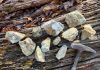
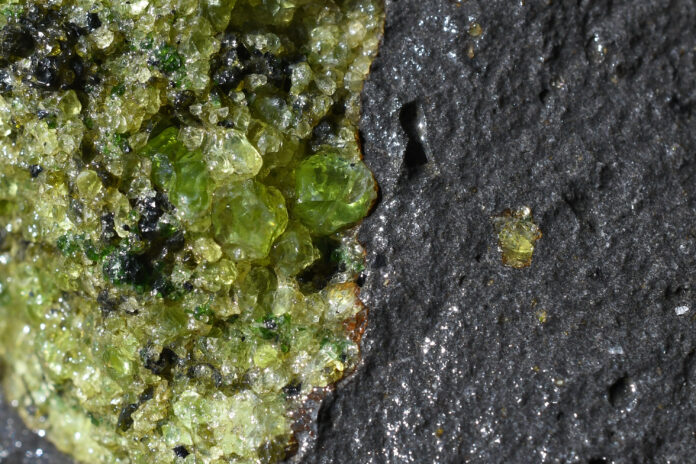
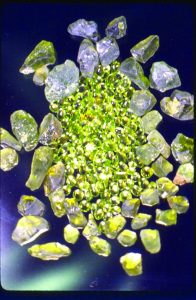
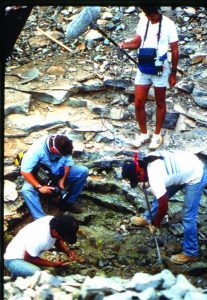
Today, the San Carlos, Arizona, peridot deposits supply most of the commercially sold and used peridot. Tribal members mine the peridot, which occurs as small green grains in the basalt. The entire volcanic structure called Peridot Mesa is mined exclusively by local residents. Peridot does occur elsewhere in Arizona, but the San Carlos Apache Indian Reservation is the leading source for peridot sold as rough and finished gems worldwide.
The work is not easy, as it has to be done by hand in order to break up the hard basalt where the peridot occurs. The workers use large hammers, sedges, chisels, and wedges to split and break up the solid rock and expose gas cavities filled with crystalline grains of peridot. The green grains often spill out of the opened pockets and are placed in buckets to be carried away for later sorting, washing, and preparing for sale.
The Geology of Peridot Mesa
Peridot Mesa’s geology is typically volcanic, mainly basaltic rock low in silica and high in magnesium with some iron, which is important for the formation of forsterite. The mineral also appears in volcanic bombs, large masses of molten lava ejected during an eruption that shoots into the air. These “bombs” cool as they fall to Earth, taking on a recognizable twisted, elongate egg shape in which peridot is sometimes found.
The green grains from Peridot Mesa are never as large as those found in Egypt and elsewhere. The area’s cut stones are most often in the one- to three-carat range, with a five-carat stone an exception. The Smithsonian boasts a cut green gem from the Peridot Mesa that weighs 35 carats, an amazing size for the region. This gem ranks as one of the best from Peridot Mesa.
Peridot Characteristics and Formation
Peridot is a remarkable gem. It forms in the orthorhombic crystal system with a hardness between 6.5 and 7 and has poor cleavage, which means it can be faceted. It has a vitreous luster, and because of its rarity, fine color, and relatively small size as a gem, peridot is considered a precious gem.
If we could reach the earth’s upper mantle beneath our granitic crust, we would find huge quantities of olivine rock. Scientists, using earthquake vibrations and artificially induced earthquakes of the Earth, show the upper mantle is made up mainly of olivine, likely mostly peridot. This prompts scientists to estimate that olivine is the most common rock on the Earth. Just imagine the size of some gemmy peridot masses in the Earth’s mantle. The mineral lends its name to an important mantle rock, peridotite, the rock where diamonds are found. These gems in peridotite originate in the lower mantle and are brought to the crust by volcanic action.
Where Peridot Is Found Above Ground
Above ground, olivine forms in many places on Earth in limited amounts. The famous black sands of Hawaii are well mixed with tiny green grains of peridot. None of the grains are large enough to facet, but this is evidence of how common such granular peridot can be. And while we have many places where olivine and peridot have been found in limited amounts, it may surprise you to know peridot is also found in space, and it’s gemmy!
Peridot in Space
The Earth sometimes is an audience to a comet that zooms into our solar system, curves around the sun, and heads back out into space. The solar wind causes these comets to develop long, sweeping tails that grow as the comet nears the sun. Scientific studies of these comets reveal the tails contain traces of peridot. Stony meteorites are another space rock with ties to peridot. Stony meteorites come in two general forms, carbonaceous chondrites and pallasites. Chondrites look like ordinary earthly stones and are eagerly sought by astronomers as they represent some of the more primitive meteorites to have formed. They contain organic compounds, which are very suggestive of life, and as such are studied carefully.
Some years ago, a carbonaceous chondrite broke into a thousand pieces and fell near Allende, Mexico. Arizona astronomers were particularly anxious to obtain pieces of this meteorite. Because it had landed so close to Arizona, serious efforts were made to collect it. Chuck Lewis, curator of Arizona State University’s meteorite collection, was lucky to be invited to help retrieve boxes of this important meteorite. The University boasts one of the great meteorite collections.
Peridot in Pallasites
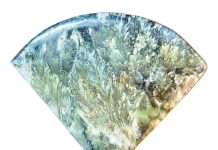
Pallasites are of interest here because they contain large grains of peridot olivine like the mantle. The peridot is locked in solid nickel-iron material suggestive of the Earth’s lower mantle-nickel-iron core. The olivine in pallasites is mostly gemmy, transparent peridot. Some brave soul even removed the large grains of peridot from a fallen pallasite and faceted tiny peridot gems from it.
FAQs About Peridot Mining
Where is peridot mined in Arizona?
Much of Arizona’s commercially important peridot comes from Peridot Mesa on the San Carlos Apache Reservation near Globe. Tribal members mine the gem from basalt by breaking apart the volcanic rock to expose pockets containing small green grains.
What is Peridot Mesa?
Peridot Mesa is a volcanic deposit on the San Carlos Apache Reservation in Arizona. It is known for abundant peridot-bearing basalt and is one of the world’s leading sources of commercially sold peridot.
How is peridot mined at Peridot Mesa?
Peridot at Peridot Mesa is mined by hand. Workers break apart hard basalt using tools such as hammers, chisels and wedges to expose gas cavities containing crystalline grains of peridot.
Why is Peridot Mesa important?
Peridot Mesa is important because it contains exceptionally large quantities of peridot, even though the individual grains and cut gems are generally small. The deposit supplies peridot used in rough and finished gems around the world.
Can peridot be found in meteorites?
Yes. Gem-quality olivine, which is the mineral material that forms peridot, occurs in pallasites. These unusual stony-iron meteorites contain olivine grains surrounded by nickel-iron metal.
Peridot Mining Connects Earth and Space
Peridot mining at Peridot Mesa reveals much more than a source of green gemstones. The deposit connects Arizona’s volcanic landscape to the olivine-rich rocks of Earth’s mantle and even to the material found in meteorites. Although Peridot Mesa’s gems are typically small, the sheer quantity of peridot found there makes the deposit remarkable. For collectors, a well-cut stone from this Arizona locality represents a fascinating piece of both the region’s volcanic history and the larger story of olivine throughout the solar system.
This story about peridot mining previously appeared in Rock & Gem magazine. Click here to subscribe. Story by Bob Jones…