
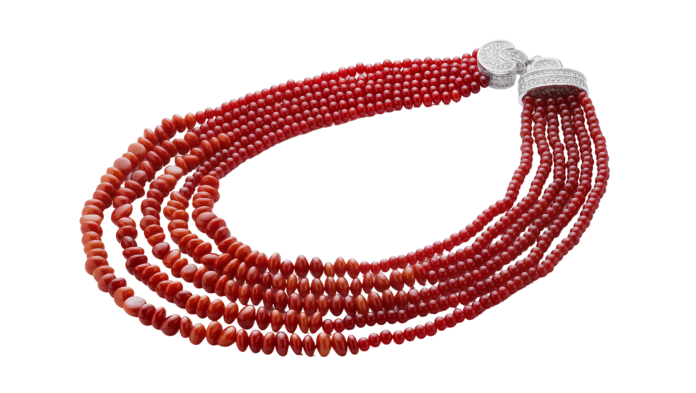
Red coral is among the iconic products of Italy, alongside Murano glass, limoncello, and handmade pasta. Precious red coral is known as red gold and the ruby of the sea. It is valued for its saturated red color, lustrous polish, and unusual marine origin. Its rich lore predates Roman times. And the qualifier “precious” is not pretentious. Today, a single pound of top-grade, rough red coral as taken from the sea sells for about $3,000.
But while red coral has a long and colorful past, its future is uncertain. Overharvesting has depleted many red coral colonies. The polyp that produces red coral is now an endangered species. Although many regulations now protect the Mediterranean’s red coral beds, illegal harvesting remains a threat. Compounding this problem is a flood of imitations that undermines the genuine red coral market.
Key Takeaways
- Red coral is a biogenic gem formed by marine polyps (Corallium rubrum), not a mineral in the traditional sense.
- It has been harvested and traded around the Mediterranean for thousands of years, especially in Italy.
- Its deep red color comes from natural carotenoid pigments, not metallic impurities.
- Overharvesting has severely reduced wild populations, making regulation and certification critical today.
- Imitations (glass, resin, dyed materials) are common and impact the global market for genuine coral.
- Red coral remains culturally significant in jewelry, mythology, and traditional Mediterranean craftsmanship.
How Red Coral Is Formed by Marine Polyps
Together with pearls, ammolite, jet, and amber, precious red coral is one of the best-known biogenic gems. These are gem-like materials derived from living organisms. Coral consists of the exoskeletons produced by tiny marine invertebrates called polyps. Polyp colonies extract calcium from seawater and transform it into aragonite. This is the orthorhombic form of calcium carbonate. They use this to build exoskeleton structures that grow from seafloor rocks.
The 6,000 coral species found around the world fall into two general groups: stony (hard) corals and soft corals. Stony-coral exoskeletons occur as stone-like masses and are the building blocks of the coral reefs found in tropical seas; soft corals do not form reefs but occur as individual branch- or fan-like growths.
Apart from the polyp genus Corallium, very few corals qualify as gem materials. Of the 30 Corallium species, Corallium rubrum—precious red coral—is by far the best. Precious red coral is found only in the Mediterranean Sea and a few adjacent areas of the Atlantic Ocean. It grows at depths of 10 to 400 feet. Because it favors dark or shaded environments, shallow occurrences are found only in caves, near walls or overhangs, and in fissures between rocks.
Red-coral exoskeletons appear as small, leafless bushes that can attain heights of about three feet. They grow at a rate of only four to six millimeters (roughly one-quarter inch) per year. Corallium rubrum exoskeletons consist of needle-like, intermeshed particles of orthorhombic calcium carbonate. These are colored by the same carotenoid pigments that impart reddish hues to lobster, shrimp and flamingos.
Red Coral in Greek Mythology and Ancient Beliefs
Greek mythology attributes the origin of red coral to the tale of Medusa and Perseus. After Medusa, a beautiful young woman, fell in love with the sea god Poseidon, the two foolishly made love on sacred ground belonging to the goddess Athena. Infuriated by such disrespect, Athena transformed Medusa into an ugly, snake-haired creature. She was so hideous that anyone who looked directly at her turned to stone.
Ordered by the king of gods, Zeus, to kill Medusa, the hero and monster-slayer Perseus succeeded by cleverly looking only at her reflection in his polished, bronze shield as he wielded his sword. After beheading Medusa, Perseus tossed her head into the sea. Her blood petrified the seaweed and turned it to red coral.
The ancient Greeks used red coral amulets to protect against all forms of evil. Mariners especially believed in red coral’s protective powers because it formed from the blood of the woman who loved Poseidon, their god of the sea. Even today, many Mediterranean fishermen attach a small branch of red coral to the masts of their boats to ward off storms.
Red coral is one of the gems of the Navaratna. This nine-jewel amulet represents astrological powers in the mythology of Buddhism, Jainism and Hinduism. The red coral represents the vibrant energy of the red planet Mars. It symbolizes the assertiveness and vitality needed to attain courage and strength. These are attributes that metaphysical practitioners today still recognize in red coral.
The Ancient Trade and Cultural History of Red Coral
Archaeologists have found red coral branches and beads in 6,000-year-old Late Neolithic graves across the Mediterranean region. By the 1st millennium B.C., a significant coral trade had developed between the Mediterranean and India. Most Mediterranean red coral was traded to India in return for spices and silks.
Because ancient Egyptians believed that red coral contained blood that would protect them in the afterlife, archaeologists often find red coral beads and branches in Egyptian tombs. Roman children wore pendants of red coral branches to protect them from danger. In medieval times, red coral was thought to promote physical healing and wellness, particularly with disorders of the blood and bone marrow. Because of its association with the blood of Christ, red coral is also a sacred relic in many Christian reliquaries of the Cross
During the early Renaissance, the belief in red coral’s child-protecting powers was evident in such classical paintings as Masaccio’s Madonna del Solettico and Piero della Francesco’s Madonna di Seligattia and Pala di Brera, which all depict the infant Jesus wearing a red coral pendant.
Torre del Greco and the Coral Craft Tradition
Until the late 1700s, Marseille, France, was the leading red coral trading center. In the unrest after the onset of the French Revolution in 1789, trade shifted to Torre del Greco near Naples, Italy. Here, large, shallow beds of red coral had been harvested for centuries.
In 1805, a factory was established in Torre del Greco to manufacture commercial quantities of red coral beads, carvings and cabochons. In 1878, the town added a school to teach coral-harvesting and coral-working skills. This marked the golden age of red coral production in the Mediterranean.
At that time, red coral was harvested with ingegno dredges. These were weighted timber cross arms wrapped with fishing net. Boats dragged them along the sea bottom to break and snare the coral. This method was productive, but inefficient, wasteful and environmentally devastating. Nevertheless, red coral became the mainstay of the local economy. Torre del Greco residents were known throughout Italy as corallitos, literally “coralers.” But Torre del Greco’s prosperity based on harvesting and working red coral ended when World War II destroyed the city at a time when the overharvested local coral beds were already largely depleted.
Sardinia’s Coral Riviera and Modern Harvesting
The focus of the red coral trade then shifted to Italy’s island of Sardinia, the Mediterranean’s second-largest island. Sardinia is known for its pristine beaches and rugged underwater topography of steep walls and caves. These provide the diminished light needed for red coral growth.
The Sardinian city of Alghero had been a major source of red coral since Roman times. Its earliest surviving records of coral production date to the 13th century C.E., when its rich coral beds attracted coral traders from as far away as Spain and Greece. When King of Aragon Peter IV granted Alghero a municipal charter in 1355, its coat of arms depicted a branch of red coral growing from a rocky sea bottom against a blue background.
This same coat of arms still represents Alghero today, while red-coral harvesting, along with the crafting, displaying and marketing of red-coral jewelry, remain vital to the local economy. Red coral is known in Alghero as “red gold” and the “ruby of the sea.” Promoted as the “Coral Riviera,” this port city of 12,000 residents attracts visitors from around the world. Its picturesque harbor is home to some 40 licensed coral divers and their boats and crews, while two dozen shops offer spectacular arrays of rough red coral and red-coral jewelry.
A popular attraction is the Museo del Corallo (Coral Museum). Exhibits depict the marine biology of coral, the history and economic importance of coral harvesting and the various methods of coral crafting. Displays include rough and worked red coral, along with aquariums filled with both skeletal red coral and growths of living Corallium rubrum.
The Future of Red Coral and Conservation Challenges
Today’s red coral industry faces two major problems. Centuries of overharvesting have decimated most of the Mediterranean’s red coral beds, especially those at shallow depths. Traditional ingegno coral dredging has been banned since the 1980s. The depleted shallow coral beds are only now beginning to recover.
Today, all Mediterranean nations strictly regulate red coral harvesting. But with prices of top-quality, rough red coral now approaching $200 per ounce, illegal harvesting, notably in the Mediterranean nations of Tunisia and Algeria, is rampant. Most illegally harvested red coral is smuggled into the coral-working areas of Italy.
Another problem confronting the red coral industry is fakes. Red coral is easily imitated with glass, plastic, resin, dyed bone, and dyed white coral. This abundance weakens the market for sustainably harvested, genuine red coral.
To counter imitations and illegally harvested red coral, the municipality of Alghero, together with local trade groups, has established the “Corallium rubrum ad Alghero” brand, a symbol imprinted onto red coral jewelry to certify its authenticity and confirm that it has been legally and ethically harvested and locally crafted.
Despite its long and colorful past, the story of precious red coral is now at a critical juncture that will determine its future. Although protective regulations are now in effect, illegal harvesting is still a problem. The only thing certain, at least for the present, is that precious red coral will remain an iconic and highly valued souvenir of Italy’s Mediterranean coast.
Red Coral Trade From Europe to the American Southwest
In the 1500s, Spanish explorers in the American Southwest met Native Americans wearing beads and pendants of turquoise and “coral.” They described the latter as orange-pink in color and coming from a sea to the west. They noted that it was inferior to their own Mediterranean precious red coral. Historians today suggest the “coral” reported by Spanish explorers was actually spiny oyster shell from the Gulf of Baja.
The Spanish subsequently introduced tube-shaped beads of Mediterranean red coral to the southwestern tribes. They valued the beads as highly as turquoise. But the supply of red coral ended in the 1820s with the collapse of Spain’s New World Empire.
In the 1880s, the Navajo, Hopi and several Pueblo tribes, now assigned to reservations, began making commercial quantities of turquoise-silver jewelry. At the same time, in Italy, the production of Mediterranean red coral was booming. Seeking new markets and recalling the old colonial Spanish coral trade in the American Southwest, Italian traders began selling red coral beads to New York importers who resold them to reservation trading posts in the Southwest.
Initially, trade was limited because red coral, classified as a precious gemstone, faced a steep import tariff. But in 1906, the federal government reduced the tariff from 50% to 10% for beads and even more for polished coral branches. Polished branch sections of Mediterranean red coral, now much more affordable, became a familiar component of southwestern “Indian” jewelry.
The use of Mediterranean precious red coral in southwestern silver-turquoise jewelry endures today. Also does the myth that the coral is regionally sourced from Mexico’s Gulf of Baja.
Frequently Asked Questions
What is red coral made of?
Red coral is composed of calcium carbonate (aragonite) produced by marine polyps that build branching skeletal structures.
Where is red coral found?
Most precious red coral (Corallium rubrum) is found in the Mediterranean Sea and nearby Atlantic waters, often at depths of 10–400 feet.
Why is red coral valuable?
It is valued for its rarity, historical significance, deep red coloration, and long-standing use in jewelry and cultural artifacts.
Is red coral endangered?
Many populations are threatened due to centuries of overharvesting, and modern harvesting is tightly regulated in most Mediterranean countries.
How can you tell real red coral from fake?
Authentic red coral has natural growth textures and a dense, slightly uneven surface, while fakes often appear overly smooth or uniform.
What is red coral used for today?
It is primarily used in fine jewelry, carvings, and cultural or religious objects, especially in Italy and parts of Asia.
Final Thoughts
Red coral sits at the intersection of geology, biology, and human history. From Mediterranean reefs to global trade networks, its story reflects both cultural value and environmental strain. Today, its future depends on sustainable harvesting, stronger enforcement against illegal trade, and growing awareness of authentic sourcing.
This story about precious red coral appeared in Rock & Gem magazine. Click here to subscribe. Story by Steve Voynick.