
Cave pearls are rare underground formations created when layers of calcite build around tiny particles inside limestone caves. Cave pearls are much like pearls formed by oysters. These geological treasures grow slowly over time into smooth, rounded spheres hidden within cave pools. Their beauty and scarcity have inspired fascination, folklore and scientific study. In places like Yemen’s legendary Well of Hell, local stories claim folkloric jinn that guard the mysterious sinkhole below.
What is a cave pearl? According to David Bunnell of the National Speleological Society (NSS), cave pearls are concretions of calcium salts formed in limestone caves and pools. They develop when mineral-rich water drips into a pool, loses carbon dioxide and deposits calcite around a nucleus. This can be a grain of sand, a fragment of bone, a stalactite, or one of the thin mineral films known as cave rafts. Over time, layer upon layer of calcite builds into a pearl-like formation. Some cave pearls also contain trace amounts of aluminum, apatite, iron, magnesium or quartz.
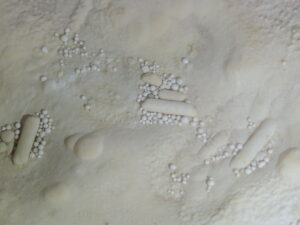
Cave pearls, also called oolites, Greek for “fish eggs.” They range in size from tiny grains to spheres as large as golf balls. While most are rounded, others may appear cylindrical or even cubical. According to the NSS, their shape is caused by uniform mineral growth rather than constant rotation from dripping water. A sphere naturally allows the greatest amount of mineral deposition with the least surface area, even when the original nucleus is irregularly shaped. Vibrations from dripping water can also keep cave pearls from cementing to the bottom of a pool, while excess calcite may form the delicate cups or nests that often surround them.
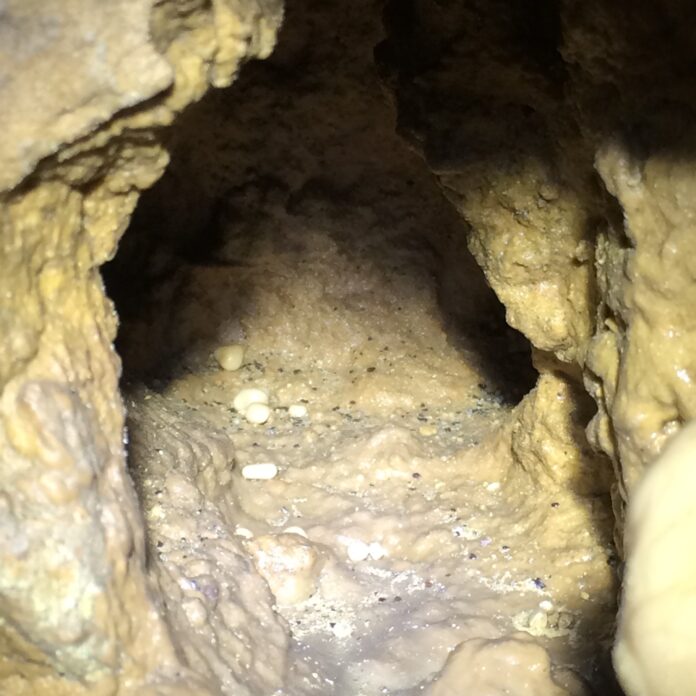
NPS Flickr/A. Ranking
Key Takeaways
- Cave pearls are rare calcite formations found in limestone caves and cave pools.
- They form when mineral-rich water deposits layers of calcite around a tiny nucleus such as sand, bone or rock fragments.
- Cave pearls are also called oolites, a term derived from the Greek phrase meaning “fish eggs.”
- Most cave pearls are spherical because that shape allows the most efficient mineral deposition.
- Famous cave pearl locations include Cave of the Mounds in Wisconsin, Carlsbad Caverns in New Mexico and Yemen’s Well of Hell.
- Cave pearls are protected in many caves because they are fragile and extremely slow to form.
Legends and Lore of Cave Pearls
Cave pearls can be hundreds of years old or more, but only gained this colloquialism in 1874, attributed to Victorian geologist Sir William Boyd Dawkins, author of Cave Hunting, Researches on the Evidence of Caves, published the same year.
“It is indeed no wonder that legends and poetical fancies should cluster round caves,” Dawkins wrote, “for the gloom of their recesses, and the shrill drip of the water from the roof, or the roar of subterranean waterfalls echoing through the passages, and the white bosses of stalagmite looming like statues through the darkness, offer ample materials for the use of a vivid imagination.”
Dawkins was correct, if not prescient, in recognizing how caves and their otherworldly treasures both attract and repel the curious.
One example is the natural limestone cave under Blue Mounds, Wisconsin, named the Cave of the Mounds. Another is a sinkhole in Al-Mahara, Yemen, called the Well of Barhout. It is better known and feared as the Well of Hell.
Cave Pearls in Yemen’s Well of Hell
“Local people believe the enormous pit is a prison for genies and a gateway to the underworld,” wrote Harry Baker for LiveScience.com in 2021, after cave explorers from Oman became the first to complete the harrowing descent to the bottom of the 367-foot deep sinkhole.
The Well of Hell is set in the middle of the desert, in the Al-Mahara province of eastern Yemen. Its nearly 100-feet wide maw had allowed amateur cave explorers to dangle alongside its stratified walls. A team of 10 explorers from the Omani Caves Exploration Team (OCET) used a pulley system to send eight members to the bottom. Two remained at the top.
They found the bottom of the sinkhole was more than triple the width of its opening. The hole itself passed through two distinct rock layers. A 200-foot porous and permeable top layer allows water to continue filtering down. At the next, less permeable layer, they saw four 150-foot-tall waterfalls.
“Passion drove us,” Mohammed al-Kindi, a geology professor at the German University of Technology and OCET team member, told the French news agency, AFP.
Exploring the Well of Hell’s Cave Pearls
The Oman News Agency said the cave had formed in sediments of limestone dating to the Cretaceous period and contained a cluster of diverse geologic deposits.
“We felt this is something that will reveal a new wonder,” al-Kindi said about its waterfalls, stalagmites and cave pearls. He made no mention of a ‘doorway to hell,’ the giant hole in the ground’s claim to fantastical fame for nearly as many millennia as its guesstimated age.
Salah Babhair, director-general of Al-Mahara’s geological survey and mineral resources authority, said the sinkhole is “likely millions and millions” of years old. Until the OCET team, the bottom had remained “a mysterious situation.”
Local folklore did not help. Inevitable disappearances of livestock or wildlife (belied by bones found by OCET) contributed to the odors that warned against trespassing. Superstitions grew that objects, venturing too close to the edge, would be sucked in. Some believed simply talking about the hole invited bad luck.
Perhaps they believed the jinn might hear them. The Well of Hell was called a prison for the invisible beings that were said to dwell in desolate or abandoned spaces, like caves.
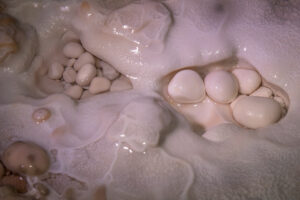
Cave Pearls at Cave of the Mounds
Unlike elusive jinn, cave pearls were readily found in the 1940s in a cave wall cavity in Blue Mounds, Wisconsin. The cave was a geological secret with no natural entrance until a dynamite explosion. On the morning of August 4, 1939, in the quarry on Charles Brigham Sr.’s farm, an explosion opened two gaping holes never before seen. The Cave of the Mounds was promptly opened to the public by the following May.
“Everyone is crazy to get into [the cave]. Stalactites and stalagmites of limestone -lovely – Charles is so excited!” Rosanna Gray Brigham, wife of Charles Brigham, Sr., exclaimed that day.
“When I arrived at the scene of the blast,” her husband noted, “the workers had blasted open the ceiling of the cave.” The original plan was to wait three days before exploring the unknown darkness. They waited three hours.
“That first summer,” writes Stalac-Tate in The Pearl of the Cave, on CaveoftheMounds. com, “Larry Burns, a geology student from Beloit College, worked as a guide. While there, he examined a section of wall with a flashlight. He found a small cavity, called a vug, in a little water. It was about a dozen cave pearls.”
When researchers at the University of Wisconsin-Madison were given one of the cave pearls to cut in half, they found 14 layers surrounding a grain of sand.
How Cave Pearls Formed at the Cave of the Mounds
Alonzo W. Pond, the foremost authority on Wisconsin cave pearls, noted in the August 1945 issue of The Journal of Sedimentary Petrology that the cave’s geologic story began with limestone formed over 450 million years ago during the Ordovician Period. At that time, Wisconsin was a shallow equatorial sea teaming with shellfish rich in calcium carbonate (the main ingredient to limestone) that would, over millions of years, become the Galena Dolomite where Cave of the Mounds formed.
“Cave of the Mounds is a solution cave, which means rock dissolved to create cavities. As surface water seeps through soil and rock, it dissolves calcite. The pressure of the rock around the water keeps calcite in the droplet until it enters the air-filled cave. Once the mineral-laden water drop enters the cave, the calcite precipitates in the form of speleothems,” Pond wrote.
On average, the precipitation/growth rate inside the Cave of the Mounds is 100 years for one cubic centimeter.
“Each and every drop of water entering the cave leaves behind calcite crystals on any surface they touch. Those with keen eyes can spot small but ever-present formations known as oolites – cave pearls – that hide in pockets and pools of water within other formations, and form as small sediments encased in calcite,” Pond concluded before adding with a flourish of mystery, “To date, efforts to find more cave or connections to other caves have been unsuccessful; however, due to the nature of our landscape it is almost a certainty that more caves exist nearby. While we dream of untold treasures and caverns, we cherish the beauty of the cave already revealed to us.”
Why Cave Pearls Are Protected
“We are not the only caves to find little oolites. Carlsbad Caverns, Cathedral Cavern, and others have found cave pearls. However, their size and fragility make them hard to share. We want to protect them to their fullest extent,” Stalac-Tate continued.
“The cave will make more. And what we have is all we have. It is part of the cave. It is the pearl of the cave.”
Maybe those protective jinn have had it right all along.
Cave Pearls at Carlsbad Caverns
The Rookery on the Lower Cave tour is popular for its cave pearls. It is illegal to remove pearls from these Carlsbad, New Mexico, caves now. But the Rookery once had so many that they were given away as souvenirs! Carlsbad Caverns National Park was established in 1930 and contains over 300 limestone caves in a fossil reef laid down by an inland sea 265 million years ago. Timed entry tickets are required to visit (reservations are recommended) and can be purchased at nps.gov/cave/planyourvisit or by calling (877) 444-6777.
FAQs About Cave Pearls
What are cave pearls?
Cave pearls are small, rounded mineral formations created when calcite builds in layers around a tiny particle inside a cave pool.
How do cave pearls form?
They form when dripping mineral-rich water loses carbon dioxide and deposits calcite around a nucleus such as sand, bone fragments or cave debris.
Where are cave pearls found?
Cave pearls are found in limestone caves worldwide. These include the Cave of the Mounds in Wisconsin and Carlsbad Caverns National Park in New Mexico.
Are cave pearls valuable?
Cave pearls are prized more for their scientific and geological significance than monetary value because they are fragile and protected in many caves.
Can visitors collect cave pearls?
No. Removing cave pearls from protected caves and national parks is illegal in many locations because the formations take hundreds or thousands of years to develop.
Final Thoughts
Cave pearls are among the underground world’s rarest geological treasures. They formed slowly over centuries as mineral-rich water deposits, layer after layer of calcite around tiny nuclei hidden within limestone caves. From the mysterious depths of Yemen’s Well of Hell to the protected formations of Wisconsin’s Cave of the Mounds and Carlsbad Caverns, these unusual speleothems continue to inspire both scientific curiosity and folklore.
Although small and fragile, cave pearls reveal the remarkable patience of geological processes and the delicate balance required for cave ecosystems to thrive. Their rarity is also why many caves now strictly protect them. This ensures future generations can continue discovering the beauty hidden beneath the Earth’s surface.
This story previously appeared in Rock & Gem magazine. Click here to subscribe. Story by L.A Berry.