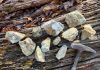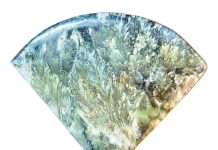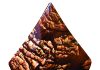

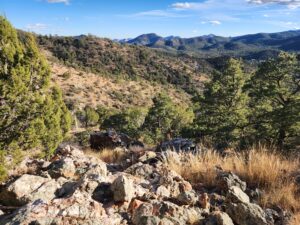
Starburst quartz crystals can be found on a steep hillside just east of Water Street in the mountains north of Kingston, New Mexico. These distinctive crystals formed in a Tertiary quartz monzonite porphyry that intruded Pennsylvanian-Permian sedimentary rocks. Quartz developed in veins and vugs within silicified sections of the porphyry, producing radiating crystal clusters with excellent terminations. Most crystals are small. They are typically less than a half-inch long. They are abundant and commonly occur in dense aggregates containing hundreds of crystals. Their color ranges from milky white to nearly transparent.
Although quartz is one of the world’s most common minerals, well-formed crystals are far less common and remain highly sought after by collectors. Appreciating the beauty of quartz crystals requires no special expertise. Quartz occurs in nearly every geologic environment. However, accessible collecting sites with quality crystals are increasingly difficult to find. Many localities are on private property, within active mines, inside protected areas, or in remote locations. The Kingston quartz crystal locality is unusual because it offers abundant, attractive crystals and is relatively easy to access.
Key Takeaways
- Starburst quartz crystals occur on a hillside north of Kingston, New Mexico.
- The crystals formed in silicified rocks associated with a Tertiary quartz monzonite porphyry intrusion.
- Many specimens display attractive radiating crystal clusters with a distinctive “starburst” pattern.
- Most crystals are less than a half-inch long, but they commonly occur in dense aggregates containing hundreds of crystals.
- The locality is relatively accessible compared to many quartz crystal collecting sites, though the hike is steep and brushy.
- The best specimens are typically found near the white silicified outcrops higher on the hillside.
- Long pants, gloves and sturdy footwear are recommended due to dense thorny vegetation.
Kingston, New Mexico Starburst Quartz Locality
Kingston is a former mining camp that started when silver was discovered in the area. As the center of a rich silver-producing district, the camp grew rapidly. The town took its name from the Iron King Mine, a silver mine north of the camp. At its peak, Kingston had 7,000 people, 22 saloons, three hotels, three newspapers and one church. Miners rapidly depleted the ores. And, the real end of the mining boom came when the price of silver collapsed during the Panic of 1893. Kingston was soon a shadow of its former self. As of 2025, Kingston has seen a resurgence with tourism, but the mines and saloons are long gone.
The Gila National Forest surrounds much of Kingston. Many of the former mine sites are patented claims. These lands are private and cannot be accessed without permission. If you go off the main roads, you must watch for signs indicating private land, so you do not inadvertently trespass.
Kingston is within the Kingston, New Mexico 7.5-minute topographic quadrangle published by the United States Geological Survey. This can easily be found online through Arcgis.com or pickatrail.com. I recommend looking at the older topographic maps, as these often show the former mines. For the Kingston Quadrangle, the 1985 version has the mines. The later versions have removed the mines and many other cultural features.
Geology of the Starburst Quartz Deposit
Kingston is on the edge of the Emory Cauldron, which is a collapsed volcanic caldera. The geology of the area is complex. It contains faulted Paleozoic sediments that have been intruded by Tertiary-age intrusive rocks and covered by volcanic rocks. The mines of the Kingston District are primarily northwest of Kingston. There is also a group known as the Grey Eagle Mine that is southwest of Kingston.
Based on a geologic map in United States Geological Survey Bulletin 1876, “Mineral belts in western Sierra County, New Mexico, suggested by mining districts, geology, and geochemical anomalies,” published in 1989, the area with the starburst quartz crystals is underlain by a Tertiary quartz monzonite porphyry. The surrounding rocks are Paleozoic sediments, which have some fossils but no crystals. Other geologic maps described the area as underlain by Tertiary andesite. The geology around Kingston is complex. Despite the generally excellent exposures of rock, detailed geologic maps of the area can vary considerably.
The quartz crystal locality is described in the sixth revised edition of Gem Trails of New Mexico, by James R. Mitchell, published in 1987 by Gem Guides Book Company. This book referenced stopping at a gate on the dirt road north of Kingston, and said “the crystals are found on the hill to the right in seams as well as loose in the soil.” The book suggested using a rake to look for crystals in the soil but said the most productive method is to split boulders found throughout the hillside and look for crystals inside the rock.
Finding Starburst Quartz Crystals
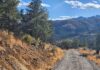
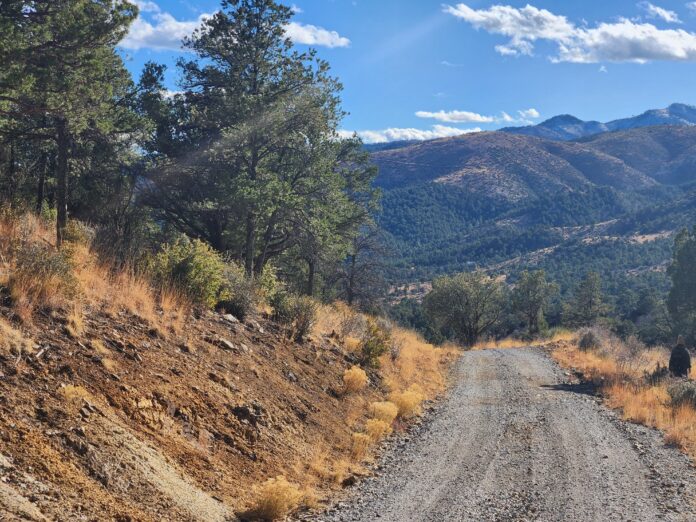
Water Street does not have many landmarks, and the most useful landmark is where the road turns sharply left (to the west). This is the gate mentioned in Gem Trails of New Mexico. This gate is normally unlocked as it continues into Forest Service land. This area has adequate parking, and during previous trips, we would always park here to start looking for crystals.
During our most recent visit in February 2025, we went through this gate and continued northwest up a road that paralleled a drainage. We looked for some of the mines that were marked on the Kingston topographic map in this drainage, but did not find any of them. This road eventually ended at a locked gate, and we had to turn around, which was extremely difficult on this narrow road.
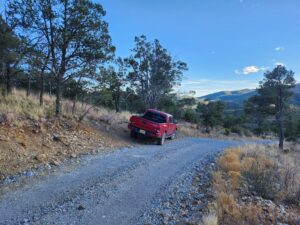
I have visited the area many times and always returned with good crystals. The road from Kingston, which starts as Italian Street and turns into Water Street, is not paved. The road has some rough areas, but is drivable with a two-wheel drive vehicle with high clearance. The southern part of the road crosses some drainages and is a little rough, and the northern part of the road is a huge waste of time that could have been better spent looking for quartz crystals at the main locality.
Climbing the Hillside: Choosing a Route
During previous trips, we walked up the steep hillside east of the hill, but this was difficult because of the lack of trails and thick forest growth. We saw a few quartz crystals near the road, but much of the rock was shale and limestone. I knew we had to find the igneous rocks to get to the best quartz crystals.
We started to walk south on the road and looked for a good area to start walking up the side of the hill, but the hillside was too steep. When we finally went back to the car, we decided to drive to a place where we could park and then walk up the hill. We did not want to hike back uphill to the car.
We found a small space on the east side of the road where I could park the truck safely off the road.
Fighting Through the Thorns
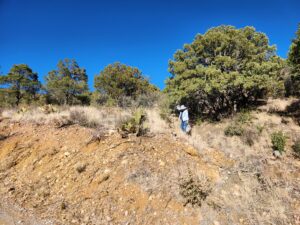
From here, we were able to start the climb up the road. I noticed that the bedrock was mainly gray sediments, and there were no signs of quartz crystals yet. We started to hike up the slope, but it was very difficult. The area was covered with thick brush that was full of thorns, and there were very few distinct trails through the thorns.
I could soon see some white outcrops up the hill, but when I reached them, they were mainly gray limestone with some white quartz, but the quartz sections did not have any crystals. I continued walking up the hill through the thorns, and my arms and hands were getting badly scratched. Fortunately, I was wearing long pants. If I was in shorts, like during most of my desert collecting trips, my legs would have been ripped apart by the thorns.
Where the Best Crystals Occur
I soon reached some white outcrops that were further up the hill. These contained the crystals that we were looking for. I did not see any of the quartz monzonite porphyry, but rather large outcrops of milky white quartz. The rocks were highly silicified, and this obscured the original character of the host rock. Some of the outcrops had large vugs that were lined with quartz crystals, but many of these crystals were small and embedded deep within the outcrops. No amount of hammering was going to break out these crystals.
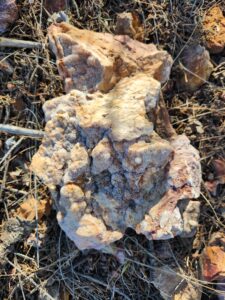
I found several pieces of starburst quartz with white to clear crystal terminations on the ground near these outcrops. They were hand-sized to football-sized. Not all the crystals had a starburst pattern. Many were small drusy crystals, and some pieces did not have any crystals at all. It took some time to look and find the best crystals. However, most pieces with crystal aggregates had crystals with a starburst pattern.
Unfortunately, at this point, my wife was getting impatient, and I knew we had to start heading downhill soon. We were able to find several nice pieces before starting down. The best crystals are found up near the top of the hill in the white outcrops, and uphill of the limestone outcrops. It takes some effort to find the best crystals. During previous trips, I have found some large pieces that were almost entirely starburst quartz crystals, and I know there are many more similar pieces to be found in this locality.
Collecting Tips and Safety
- Parking along Water Street north of Kingston: 32°55’36.0”N 107°42’36.4”W
- Approximate area of crystal outcrops on ridge: 32°55’42.5”N 107°42’33.3”W
We had poor cell coverage here, and consequently, the coordinates for the parking and the crystal outcrops are my best estimates based on using Google Earth and recollection of where we were on the ground. This site is a good day trip when in the area, but you must be sure to bring long pants and gloves, as the thorns are terrible, and you can expect to get scratched up when hiking to this site. The site is accessible year-round, but I recommend staying away if it has snow or ice, and you should also be careful during fire season, as there is no escape if you are on this road.
Starburst Quartz GPS Coordinates
The following are GPS coordinates for these localities:
- Parking at Gate: 32°55’49.4”N 107°42’35.6”W
Frequently Asked Questions
What is starburst quartz?
Starburst quartz is a collector’s term for radiating clusters of quartz crystals that grow outward from a central point, creating a star-like appearance. The crystals at Kingston commonly occur in dense aggregates with excellent terminations.
Where can you find starburst quartz in New Mexico?
One of the best-known localities is near Kingston, New Mexico, where starburst quartz crystals occur in silicified rocks on a steep hillside north of town.
Are the quartz crystals at Kingston large?
Most crystals are relatively small, generally less than a half-inch long. However, they often occur in large clusters containing hundreds of crystals, making for attractive display specimens.
Is the Kingston quartz locality easy to access?
The locality is more accessible than many crystal-collecting sites, but reaching the best material requires a steep hike through dense brush and thorny vegetation.
What should collectors bring to this locality?
Collectors should wear long pants, sturdy footwear and gloves. Water, sun protection and a GPS or map are also recommended because cell coverage in the area can be unreliable.
Final Thoughts
For collectors willing to brave a steep climb and plenty of thorns, the Kingston locality offers the chance to find attractive starburst quartz crystals in a scenic mountain setting. While the crystals are generally small, their radiating growth patterns and abundance make them rewarding finds. With proper preparation and respect for land access restrictions, this New Mexico locality remains an excellent destination for quartz enthusiasts and rockhounds alike.
This story about Kingston starburst quartz crystals appeared in Rock & Gem magazine. Click here to subscribe. Story and photos by Robert Beard.