
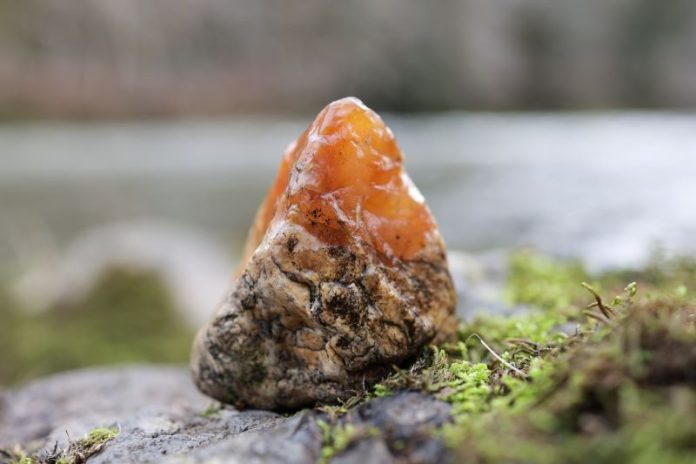
If you’ve ever wanted to expand your rock collecting range beyond what you can reach on foot, rockhounding by kayak opens up entirely new access to gravel bars, shorelines, and remote deposits. Having the ability to explore just a little further in any direction changes things significantly. It opens doors to the unknown and expands horizons. With the increased accessibility lies a whole new world and level of excitement.
When researching a rock collecting locality, first try to find somewhere known for having minerals you hope to find. Having a kayak on board can often make all the difference in having a high-yielding excursion or not. If the area you’re searching in is not known for anything in particular, the outing becomes more reconnaissance and exploratory. Scouting for traces of specific minerals along the water’s edge can be exhilarating.
Coastal rock collecting guides are typically well-versed in what waters might be worth exploring. If you are unsure where to begin, a guide or a good guidebook is a great place to start. Local outfitter shops and gear experts are also valuable resources.
Rock collecting via kayak has many benefits. It can help you search an unknown area much quicker or more efficiently than on foot, given the right circumstances. Remote areas can be accessed more easily. It can also help you carry gear and haul things in and out. And lastly, it’s really fun! If you know, you know.
SAFETY FIRST! If you’ve never been kayaking before, remember to be safe and do not exceed your water skills. No matter your skill level, always wear a life jacket. Best practices for life jackets are to choose a jacket that is U.S. Coast Guard (USCG) approved and rated for your weight, chest size, and specific water activity.
Key Takeaways
- Rock collecting by kayak allows access to gravel bars and shorelines that are difficult or impossible to reach on foot.
- High-yield finds often occur after storms or flood events that reset river and beach surfaces.
- Seasonal water levels change access points, exposing new gravel bars and hiding others.
- Success depends on researching local geology and knowing what minerals are likely in the area.
- Lightweight, waterproof gear and safe paddling practices are essential for effective kayak-based rockhounding.
- Moving upstream and downstream strategically can help trace mineral sources along a waterway.
Collecting in High Traffic Areas
First and foremost, respect private land and stick to known property boundaries. When you head out to a river for example, to look for your materials of choice, you naturally gravitate toward any exposed rocks to look around in. Many public areas have access within certain boundaries and that’s it. The gravel in those areas is often limited and can sometimes be cleaned out by other rockhounds. If you’re not having luck, you could likely be searching in frequently hunted spots.
Rock collecting in more premier areas has seasonal traffic. If you hope to potentially find bigger and better materials, you may want to consider trying your luck in the off-season or after substantial weather events. Flood aftermath makes for some of the best kayak rockhounding conditions. Any gravel bar that was in or around a river that just flooded got its slate wiped clean. Debris that was on the surface is now gone. Any area that was previously picked through now has new material exposed. Often, interesting things work their way downstream. The same logic applies to beach combing the morning after the storm; this is when some of the best finds can and have been found.
Seasonal Water Levels
Depending on the time of year, the size of those gravel bars also varies based on seasonal water levels. Sometimes you can even see other inaccessible spots on the other side of the river, or up/down the river as mid-channel bars or islands. Access to those more remote depositions becomes an immediate next thought. Sometimes you can’t see anything at all and it is worth checking different maps for help and tips in understanding a river’s morphology. Point bars, which are usually crescent-shaped and located on the convex inner curve of a river bend, are naturally shallower, and wading in the water can be fruitful.
 Choosing a Kayak
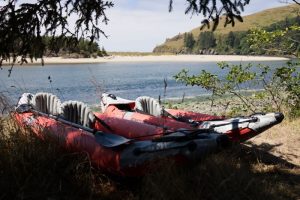
Inflatable kayaks can be a good option for the average rockhound. They can be both affordable and durable while maintaining good portability and general ease of use. A deflated kayak along with all related equipment (paddle, PFD, pump, skeg) can easily fit in a roof cargo box, or back seat/trunk and is effortlessly carried.
Tandem kayaks work well if you want to kayak with someone else because they can carry an extra person, but if used solo, there’s a bit more room and they can carry more gear/weight. Not to mention, longer kayaks usually track a little better and provide a better ride. Their cost is usually not much more than a standard-sized boat. Any kayak can be used, whether it’s a hardshell or an inflatable; there are pros and cons to each and those are for you to decide what’s best for your setup and situation.
Researching Local Materials
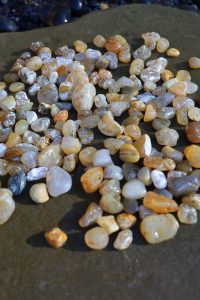
Many rockhounds know what they’re looking for beforehand, but some don’t. It’s always wise to do a little homework and have good examples or visuals in your head before you go. But sometimes, if you’re mainly seeking a certain type of material, you may overlook other materials because you’re hyper-focused on that one specific thing or two. A good rule to follow is to trust your instincts; if something catches your eye, even for a second, stop and check it out. It could make the difference between a lackluster find and the find of the day.
Transparency Clues
Checking the transparency of a stone is one of the easiest field tests you might be able to use to help narrow down whether you’ve found something interesting. If you can hold up what you’ve found to the sun or a flashlight and see how much light can transmit through it, you can determine if it’s transparent, translucent or opaque. Knowing the difference between those few words is a great start to understanding some of the semi-precious gems most rockhounds are looking for when they go out.
Quartz (rock crystal) is a good example of something transparent, chalcedony (agate) is a good example of something translucent, and chalcedony (jasper) is a good example of something opaque that people may find while kayaking. While those are basic examples, know that there can be many others out there. You can also encounter things that are partly transparent or translucent and opaque at the same time. Petrified wood is a good example of something typically opaque but can have translucent sections also if that piece has been agatized or opalized.
Knowing that different colored gemstones are out there can also help if you have those colors in your head. On the Oregon Coast, most of the chalcedony or agates are clear, however, they can be white, grey, black, or any color of the rainbow with purple/ violet being the rarest. Some can even be a blend of colors like clear agate mixed with blood-orange carnelian. If you haven’t already, it’s good to train your eyes to look for anything gemmy and have a loose idea of what’s possible to find in the area you’re rock collecting.
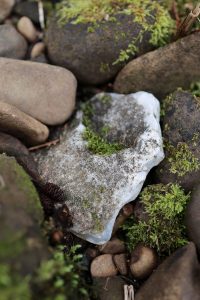
Finding Rock Collecting Locations
When there is one, there is more. Material has likely traveled downstream to that spot, which means more is likely upstream from where you are, and that path should be explored in sections at a time until the source of the deposit is found. If you travel upstream and eventually reach a point where the desirable materials have disappeared, you’ve probably gone beyond the source and should potentially backtrack. If you get to an area that is very rich in the minerals you’ve been searching for, well done. Enjoy the fruits of your work!
Additionally, if that type of material has traveled downstream to that spot, it’s more than likely that similar materials can be found further downstream as well. With a kayak, you can chase those minerals and gravel bars as far as you desire. If you are not able to find traces, you may like to try another spot further upstream or downstream from where you currently are.
Wherever you find traces of materials you’re looking for, make note of it. You may even like to map it out.
Gear for Rock Collecting in a Wet Environment
A good practice in any wet environment is to have reliable waterproof gear. There are also some great tools and essential pieces of gear that can benefit anyone rockhounding via kayak. Waterproof Rite in the Rain products are great for kayaking and taking notes.
When river kayaking, there are shallow sections where you can get out of the kayak and rockhound next to it, tossing things in as you find them. This is also the perfect time to try an underwater viewfinder (UVF). As a concept, you look through a rigid transparent container on the surface of the water, and it offers a similar viewing experience to snorkeling goggles. It allows users standing in waist-deep or shallower water to disrupt the surface and peer down to see what is below more clearly without physically going underwater. You can make your own or find these types of viewers in children’s educational products.
Another good tool to have on board is a sand scoop. These can offer a longer reach underwater without having to get as wet or without having to go completely under to grab something. Estwing Rock Picks can be used to break down larger material and help dig or pry finds that are embedded in the rocks. Waterproof flashlights are always good to have on hand and allow you to start your hunt before the sun comes up, and you never know when you’ll be out later than expected. Further, uvBeast flashlights are great for checking for fluorescence.
Recommended Equipment List
Below is a list of the equipment I use and can recommend.
Kayak: Intex Excursion Pro Inflatable (K1-Solo, K2-Tandem)
Paddle: Backwater Assassin Carbon Fiber Hybrid (250- 260 cm)
Life Jacket: U.S. Coast Guard (USCG) approved and rated for your weight, chest size, and specific water activity.
Writing: Rite In The Rain -Monsoon Field Desk | Universal Field Book | Pocket Pen
Viewfinder: Bino XL SOHO Bin
Sand Scoop: VOS Ora Sand Sifter
Rock Pick: Estwing EO-14P
Flashlight: Streamlight PolyTac X
UV Light: UVBeast V3 365nm Filtered
Footwear: The North Face Skagit Water Shoe
FAQs About Rock Collecting by Kayak
Is kayak rock collecting legal on rivers and beaches?
In most areas, rock collecting is allowed in public waterways, but rules vary by state, land ownership, and protected zones. Always confirm local regulations and avoid collecting on private land or in restricted areas.
What types of rocks can you find while rockhounding by kayak?
Common finds include agates, jasper, quartz, petrified wood, and other water-worn or semi-precious minerals that concentrate in gravel bars and along shorelines.
When is the best time to go rock collecting on water?
The best times are typically after storms, floods, or seasonal water shifts, when new material is exposed and gravel bars are refreshed.
Do I need a special kayak for rock collecting?
No, but inflatable or tandem kayaks are often preferred for their storage capacity and portability. Stability, weight capacity, and gear storage are more important than type.
What safety gear should I bring for kayak rockhounding?
A properly fitted PFD, waterproof storage, navigation tools, and weather-appropriate gear are essential. Always check water conditions before heading out.
How do I know if I’ve found a good rock-collecting area?
Areas with active gravel bars, exposed sediment layers, or visible concentrations of similar materials often indicate productive rockhounding zones.
Final Thoughts on Rock Collecting by Kayak
Rock collecting by kayak combines exploration, geology, and water-based travel into a single approach that can dramatically expand where and how you search for materials. By accessing gravel bars, shorelines, and remote deposits, you can reach areas that are often overlooked or impossible to access on foot.
Success comes down to preparation: understanding seasonal water changes, knowing local geology, and using the right gear for safety and efficiency. Just as important is adaptability—some of the best finds come from following water routes, reading the landscape, and responding to changing conditions in real time.
Whether you’re scouting new locations or revisiting familiar waterways after a storm, kayak-based rockhounding offers a practical way to extend your range and improve your chances of finding quality material.
This story about rock collecting via kayak previously appeared in Rock & Gem magazine. Click here to subscribe. Story and photos by Eric Davis.