
Meteoritics is the study of meteors, meteorites and meteoroids. It was born rather dramatically on the afternoon of April 26, 1803, at L’Aigle in Normandy, France. As fireballs flashed across the sky leaving trails of smoke, residents gazed in awe as thousands of rocks plummeted to Earth.
Besieged by demands to explain this surreal event, the French Academy of Sciences sent 29-year-old astronomer and physicist Jean-Baptiste Biot to investigate. Biot, the namesake of the biotite mineral group, studied numerous meteorites. He interviewed hundreds of individuals who had witnessed the fall. After confirming that no volcanic activity had occurred anywhere near France on the day of the fall, Biot formally reported that the meteorites had an extraterrestrial origin. This was a daring conclusion that flew in the face of conventional logic.
Key Takeaways
- Meteoritics is the scientific study of meteors, meteorites and meteoroids and draws on geology, chemistry, astronomy and physics.
- Meteorites are fragments of asteroids, comets or planetary bodies that survive atmospheric entry and reach Earth’s surface.
- Meteorites are classified into three broad groups: stony, iron and stony-iron, with additional classifications based on chemistry, structure and origin.
- The three major meteorite groups differ significantly in composition, formation and appearance.
- The 1947 Sikhote-Alin meteorite fall remains one of the most important and extensively collected meteorite falls in history.
- Meteorites are scientifically and commercially valuable, with rarity, type, condition, size, aesthetics and provenance all influencing specimen value.
Meteoritics: Stones From the Sky
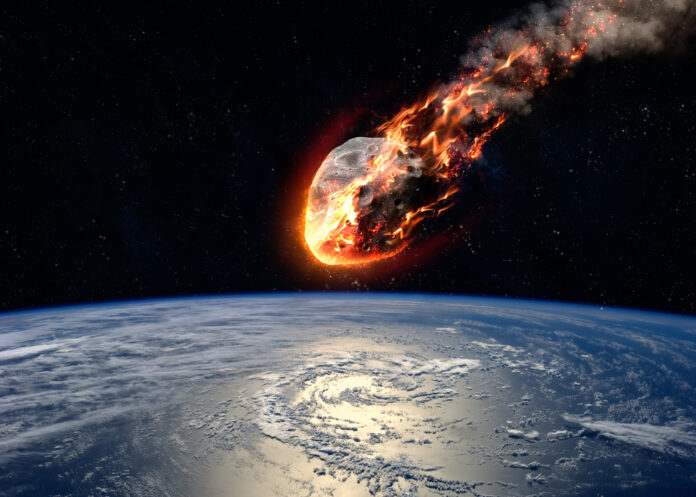
Today, meteoriticists define meteorites as fragments of rock or iron from a meteoroid, asteroid or comet that pass through a planet’s atmosphere to impact the surface. Meteoroids refer to meteoritic masses while still in space. Meteors are the streaks of light produced when meteoroids burn up while passing through the atmosphere.
Despite having no concept of their extraterrestrial origin, the ancients were quite familiar with meteorites. Biblical scholars suggest that Joshua 10:11, which tells of “stones from heaven” smiting the Israelites’ enemies some 3,000 years ago, may have referenced a meteorite fall. Since 605 C.E., Muslims have kept a sacred meteorite in the Kaaba at Mecca. Meteorites have been found in the ruins of Aztec temples and among the sacred relics of several North American tribes.
Several pre-Iron Age cultures are known to have hammered iron meteorites into tools and weapons. The early Egyptians fashioned beads and bracelets from the space rocks. Scientists have determined the blade of a ceremonial dagger from the tomb of the pharaoh Tutankhamun from 1330 B.C. was fashioned from an iron meteorite.
Early Ideas About Meteorites
Jean Baptiste Biot’s report on the L’Aigle meteorite fall, published in 1804, was enormously controversial. For many, the idea of stone and metal falling from the sky was simply unbelievable. At that time, most scientists attributed meteors and meteorites to earthly origin. They assumed them to be solidified masses of magma emitted by distant volcanoes. And some still adhered to such medieval concepts as divine origin, witchcraft or the work of the devil.
When the first meteorite with a documented fall slammed into Earth in France’s Alsace region in 1492, townsfolk chained the two-foot-diameter piece of stone and iron to a tree to prevent it from “escaping.”
A century later, natives of Argentina’s Chaco region showed Spanish soldiers a metal boulder they had observed falling from the sky. But the Spanish chose to believe that the boulder was an outcropping, high-grade iron deposit that they named Mina de Fierro (Iron Mine).
German physicist Ernst Chladni was the first to propose an extraterrestrial origin for meteorites. Because he had never personally witnessed a meteoric fall or interviewed those who had, his theory, published in 1794, was ridiculed.
The following year, a 56-pound meteorite narrowly missed striking a farmer in Yorkshire, England. The astounded farmer did not doubt that the meteor he had just seen was connected with the object lying at his feet. But scientists rejected the observations of a poorly educated farmer.
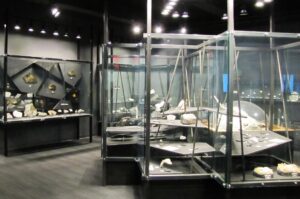
Meteoroids, Meteors, and Meteorites
Meteorites are extremely rare because only a tiny percentage of all meteoroids survive atmospheric entry. Most of these fall unnoticed into oceans.
The first meteorite classification systems, devised in the 1860s and based on the study of limited numbers of specimens, had three basic groups: stony, iron and stony-iron.
Since then, advances in the fields of chemistry and astrophysics, along with the study of many thousands of specimens through meteoritics, have made meteorite classification more complex. The various modern classification systems are based on a combination of chemistry, structure and assumed origin. Generally, the three basic groups recognized in the 1860s, stony, iron, and stony-iron, are still valid today.
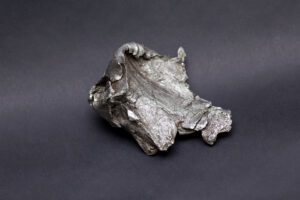
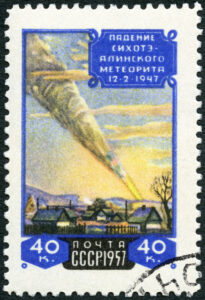
The Sikhote-Alin MeteoritesAnyone interested in meteorites and meteoritics is familiar with the name Sikhote-Alin, the Russian site that hosted the largest meteorite fall in recorded history. Today, 79 years after this legendary fall, Sikhote-Alin specimens still dominate the international meteorite markets. On the morning of February 12, 1947, a huge meteor flashed through the sky over the densely forested Sikhote-Alin Mountains in the far southeastern Soviet Union. Brighter than the sun, it descended at an angle of about 41 degrees and left behind a 20-mile-long smoke trail that lingered for hours. The flash of light, along with the accompanying sound and shock waves, was recorded 190 miles away. Scientists later determined that an iron meteoroid weighing some 200 tons had entered the Earth’s atmosphere at an estimated speed of 31,300 mph. It quickly superheated and, at an altitude of 3.5 miles, broke apart in a cataclysmic explosion. Fragments fell over an area of 40 square miles, creating 122 craters, the largest 85 feet across and 20 feet deep. An estimated 70 tons of the original 200-ton mass actually reached the Earth’s surface. Investigators from the Soviet Academy of Sciences eventually collected 25 tons of fragments of all sizes. The largest weighed 3,850 pounds, the smallest less than a gram. The meteorite consisted of 93% iron, 5.9% nickel and lesser amounts of cobalt, phosphorus and sulfur. Sikhote-Alin SpecimensSikhote-Alin specimens are of two types: regmaglypt specimens shaped by atmospheric ablation that broke off the main mass early in the descent, and sharp-edged fragments that formed from violent impact with the ground. The Soviet government restricted access to the impact site, but clandestine meteorite hunters, including many skilled woodsmen familiar with the mountainous terrain, won out in the end. These so-called “meteorite pirates” recovered many thousands of specimens that eventually ended up on the international collectors’ markets. Scientists estimate that perhaps 40 to 50 tons of meteorites still remain in the ground at Sikhote-Alin. This is not lost to the meteorite pirates who continue their work today. Perhaps the best description of this fall came from local artist Pyotr Medvedev. While preparing to paint a landscape scene, the fireball appeared in the direction he was looking and he immediately painted what he saw. The Soviet Union later reproduced Medvedev’s painting on a stamp commemorating the 10th anniversary of the Sikhote-Alin meteorite fall. |
Stony Meteorites
About 94% of all meteorites are of the stony type that originate in the outer crust of planets or asteroids. Most stony meteorites are chondrites, which contain chondrules. These are small, colorful, grain-like inclusions of cosmic material that originated in the solar nebula. Predating the formation of our solar system, they are the oldest known matter existing on Earth.
A small percentage of stony meteorites are achondrites. These are volcanic rocks from space that formed from igneous activity within planets or moons, where melting and recrystallization eradicated all traces of the original chondrules.
Virtually all stony meteorites contain small amounts of iron that produce traces of magnetism. Since they contain the least amount of iron, achondrites are the most difficult to detect. Freshly fallen stony meteorites often exhibit a glossy, black fusion crust. This is created by partial melting during the heat of atmospheric entry. But stony meteorites that weather on the surface for extended periods can be easily mistaken for terrestrial rocks.
Iron Meteorites
Five percent of all meteorites are classified as iron and consist largely of the iron-nickel alloys kamacite and taenite. Kamacite is mostly iron. Taenite contains higher proportions of nickel. Iron meteorites, which are highly magnetic, originated as the cores of long-vanished planets or large asteroids within the asteroid belt between Mars and Jupiter.
Far denser than most terrestrial rocks, iron meteorites have a distinctive heft and appearance. They are readily identifiable. As they partially melt during atmospheric entry, many acquire oval-shaped, surface “thumbprint” depressions called regmaglypts that are not seen on terrestrial rocks.
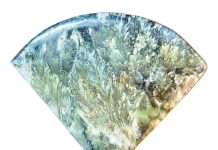
Kamacite and taenite alloys also exhibit a complex, interlocking crystalline arrangement known as the Widmanstätten pattern. This was named for Austrian mineralogist Count Alois von Beckh Widmanstätten, who first described it in the 19th century. This visually striking, lattice-like pattern, caused by exsolution (separation) of the iron-nickel alloys, is dramatically displayed when iron meteorites are slabbed, polished and etched with acid.
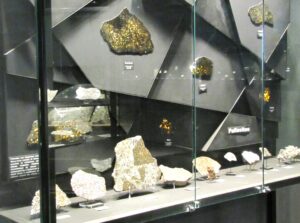
Stony-Iron Meteorites
Stony-irons, which amount to only 1% of all meteorites, formed at the core-mantle boundary of their parent bodies. They are comprised of roughly equal amounts of iron-nickel alloys and silicate minerals. They fall into two groups: pallasites and mesosiderites.
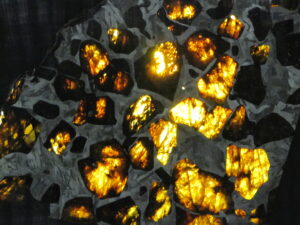
Pallasites, the most visually attractive of all meteorites, consist of a nickel-iron matrix included with yellow-green olivine (peridot) crystals. Pallasites are named for German zoologist and explorer Peter Pallas, who first studied them in the 1770s. When pallasites are slabbed and backlighted, their olivine crystals glow with an otherworldly beauty.
In the even rarer mesosiderites, silicates and metal occur in fine-grained, high-contrast, silvery-black intergrowths. In the mid-1800s, an unusual concentration of mesosiderite meteorites found in Chile’s Atacama Desert was mistaken for silver ore and triggered a short-lived mining rush.
Meteorite Falls and Finds
Scientists define meteorite “falls” as specimens collected soon after a fall is witnessed. Meteorite “finds” are specimens found later from unwitnessed falls. Of more than 60,000 documented meteorite finds, only 1,500 came from witnessed falls. These almost all yielded specimens.
Meteoriticists still debate the question of how many meteorites impact the Earth’s surface. NASA scientists estimate that 50 tons of meteoroids of all sizes enter the Earth’s atmosphere each day, but only a tiny fraction of these survive entry to become meteorites. The consensus of the wildly varying estimates is that about 17 meteorites impact the Earth’s surface each day, or more than 6,000 per year. Most fall unwitnessed at night or over water, ice caps or wilderness areas.
Popova Olga/Adobe Stock
Collecting Meteorites
As with mineral specimens, the value of meteorite specimens is determined by a complex relationship of rarity, type, condition, size, aesthetics and provenance. Not surprisingly, the abundant stony chondrites have the least value. Meteorites are usually priced by the gram, with stony chondrite specimens selling for as little as 50 cents per gram.
Prices for iron and stony-iron meteorites are much higher. Irons typically go for $1-10 per gram, while the much less common stony-iron pallasites with good crystal development and yellow olivine colors can fetch $20-100 per gram. The price of the rarest meteorites—those scientifically confirmed to be of lunar or Martian origin—can exceed $1,000 per gram.
The condition of a meteorite refers to its degree of terrestrial wear and weathering. Iron meteorites with intact, glossy black fusion crusts or well-defined regmaglypts are considerably more valuable than those rounded by alluvial wear.
Size, aesthetics and provenance are obvious factors in the value of meteorite specimens. Larger sizes are much less common and more valuable. Slabbed, backlighted pallasites and acid-treated irons displaying Widmanstätten patterns command very high prices. And specimens from documented and scientifically investigated falls have added interest and value.
Frequently Asked Questions About Meteoritics
What is meteoritics?
Meteoritics is the scientific study of meteors, meteorites and meteoroids, combining knowledge from geology, chemistry, astronomy and physics.
What is the difference between a meteoroid, meteor and meteorite?
A meteoroid is a rocky or metallic body traveling through space. A meteor is the streak of light produced when a meteoroid enters an atmosphere. A meteorite is the portion that survives atmospheric entry and reaches the surface.
What are the three main types of meteorites?
Meteorites are broadly classified as stony, iron or stony-iron. Modern classification systems further divide these groups according to their chemistry, structure and origins.
How much is a meteorite worth?
Meteorite values vary widely depending on type, rarity, condition, size, aesthetics and provenance. Common stony meteorites can sell for relatively little per gram, while rare lunar and Martian meteorites can command more than $1,000 per gram.
How many meteorites fall to Earth each day?
Estimates vary, but the article notes a consensus of roughly 17 meteorites reaching Earth’s surface each day. Most fall unnoticed over oceans, ice, wilderness or other areas where they are unlikely to be recovered.
In many ways, the science of meteoritics, pioneered by Jean-Baptiste Biot in 1803, is just beginning. Many questions remain to be answered, but meteoritics, with its legacy of history, mystery and science, will undoubtedly continue to hold our interest.
Want to deepen your Earth Science and meteoritics knowledge? Subscribe to Rock & Gem magazine for expert insights, collecting tips and discoveries delivered to your inbox and mailbox. Story about meteoritics by Steve Voynick.