
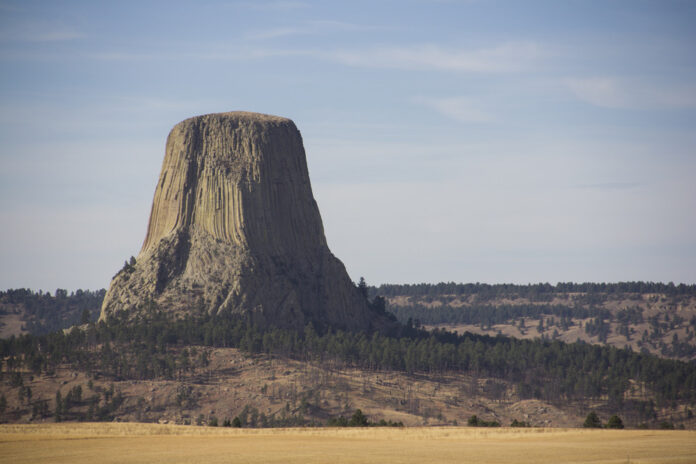
Devils Tower National Monument in northeastern Wyoming became world-famous after its dramatic appearance in Steven Spielberg’s Close Encounters of the Third Kind. Long before Hollywood brought UFOs to its summit, however, this striking monolith was already a geological wonder and a sacred landscape shaped by deep time and cultural meaning.
Rising abruptly from the plains, Devils Tower is a massive igneous formation created by ancient volcanic activity and later exposed through millions of years of erosion. Today, it is known for its unusual columnar rock structure, for its enduring significance in Native American traditions and modern outdoor recreation.
(National Park Service)
Key Takeaways
- Devils Tower National Monument is an ancient igneous formation exposed by erosion over millions of years.
- It is composed primarily of phonolite porphyry and is famous for its columnar jointing.
- The monument holds deep cultural and spiritual significance for several Native American tribes.
- It gained worldwide attention after appearing in Close Encounters of the Third Kind.
- Today, it is both a protected sacred site and a popular destination for climbers and visitors.
Geology of Devils Tower
Devils Tower is an exposed laccolithic intrusion. It is composed primarily of phonolite porphyry. It formed when magma cooled underground and was later revealed through erosion.
Geologists describe Devils Tower as an isolated, exposed remnant of a laccolithic intrusion. It is a body of igneous rock that is, oddly enough, surrounded by sedimentary formations of sandstone, siltstone and shale.
Some 40 million years ago, at what is now Devils Tower, a surge of magma penetrated the overlying sedimentary rock to solidify as a laccolith—a mushroom-shaped mass of igneous rock that spread between the layers of sedimentary rock but did not reach the surface.
When it was emplaced, the top of this laccolith was about a mile below the surface. Much later, a period of accelerated erosion greatly reduced the surface to expose the laccolith. Because of its harder, more durable igneous rock, the laccolith resisted erosion. It emerged as a prominent monolith that loomed majestically above the surrounding landscape.
(National Park Service)
Devils Tower’s Columnar Jointing
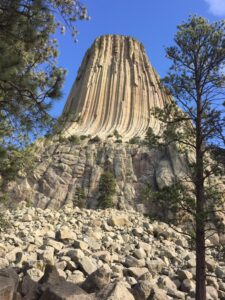
Devils Tower is the world’s most striking example of columnar jointing, a geological feature formed as igneous rock cools and contracts. As molten magma beneath the surface gradually solidified into phonolite porphyry, it began to shrink. This contraction created internal stress that caused the rock to fracture in a highly organized pattern.
The fractures formed long, vertical columns that typically have six-sided (hexagonal) shapes, although five- and seven-sided columns can also occur. Over time, erosion exposed these tightly packed columns. They now rise hundreds of feet above the surrounding landscape and give Devils Tower its unmistakable, ribbed appearance.
This natural process of cooling and cracking is what produces the tower’s dramatic vertical faces. This makes it geologically significant and visually iconic.
(National Park Service)
Native American Legends of Bear’s Lodge
Many Native American cultures that were drawn to Devils Tower were intrigued by its prominent, vertical columnar jointing. Indigenous names for the monolith often refer to bears and include “Bear’s Lair,” “Bear’s Lodge,” and “Bear’s Tipi” because of the resemblance of the columns to the claw marks that bears make on trees.
Crow, Arapaho, Cheyenne, Kiowa and Lakota cultures all share somewhat similar tales to explain the origin of Devils Tower. In the Kiowa and Lakota versions, giant bears began chasing a group of girls who scrambled to the top of a low rock where they fell to their knees and beseeched the Great Spirit to save them. Hearing their prayers, the Great Spirit lifted the rock from the ground toward the heavens. The giant bears tried unsuccessfully to reach the girls by climbing the sheer monolith, leaving their deep claw marks in the rock that appear today as columnar jointing.
History of Devils Tower Naming and Designation
Long before European contact, this was a sacred site where Native Americans conducted vision quests and summer ceremonies. When a 1873 Office of Indian Affairs scientific survey passed through northeast Wyoming, a translator misinterpreted a Native American name for the monolith as “Bad God’s Tower,” which received a Christocentric reinvention as “Devil’s Tower.” (A formal governmental naming convention later dropped apostrophes from all place names.)
In 1892, Devils Tower became part of a national forest preserve. The following year, two local ranchers were the first to climb its nearly sheer walls, driving wooden pegs into cracks in the rock face to serve as steps and handholds.
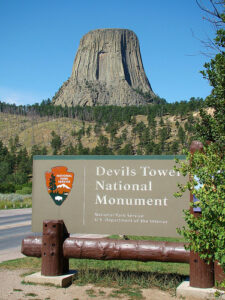
In 1906, President Theodore Roosevelt designated Devils Tower and two square miles of surrounding land as the nation’s first national monument.
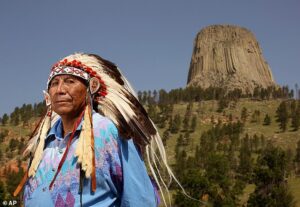
(National Park Service)
Devils Tower Today: Tourism and Climbing
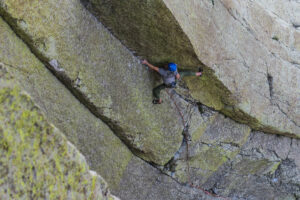
When Close Encounters was initially released, Devils Tower had been attracting fewer than 20,000 visitors each year. Today, the national monument welcomes more than half a million visitors annually, most during the summer months. In 2023 alone, some 5,000 rock climbers attempted to reach the summit of the monolith.
Managing Devils Tower for both modern and traditional uses is a challenge for the National Park Service. The monument remains a sacred site for Native Americans who return each year for traditional ceremonies. Visitors are asked not to touch, disturb or photograph the Native American prayer cloths and prayer bundles. These are often seen hanging from the monument’s trees.
Many Native American groups consider rock climbing disrespectful to their sacred monolith. In a use compromise, the National Park Service encourages a voluntary climbing ban in June. This is when many Indigenous groups conduct their ceremonies.
The monument’s name is also controversial. In 2004, Native Americans unsuccessfully petitioned Congress to change the name of Devils Tower National Monument to Bear Lodge National Historical Landmark. A decade later, a similar proposal to the United States Board of Geographic Names, an office of the United States Geological Survey, also failed.
And while visitors have not yet encountered extraterrestrials, they have seen a sacred Native American site and the “claw marks” left by those giant bears of legend in the sheer rock faces of an astounding geological feature.
Frequently Asked Questions
What is Devils Tower made of?
Devils Tower is primarily composed of phonolite porphyry, an igneous rock formed from cooling magma beneath the Earth’s surface.
How was Devils Tower formed?
It formed as a laccolithic intrusion when magma pushed into surrounding rock layers and cooled underground. Over time, erosion removed the softer surrounding rock, exposing the tower.
Why is Devils Tower important to Native Americans?
Many Native American tribes consider Devils Tower a sacred site associated with creation stories, prayer, and spiritual ceremonies. It is known in several traditions as Bear Lodge.
Can you climb Devils Tower?
Yes, climbing is allowed year-round, but voluntary restrictions are encouraged in June out of respect for Native American ceremonial practices.
Why is it called Devils Tower?
The name likely originated from a mistranslation of a Native American name that was interpreted as “Bad God’s Tower,” later shortened to Devils Tower.
Conclusion
Devils Tower stands at the intersection of geology, culture, and imagination. Formed deep underground as a laccolith and later revealed through millions of years of erosion, this striking monolith remains one of North America’s most recognizable geological landmarks.
Beyond its scientific significance, Devils Tower holds enduring meaning for Native American tribes who continue to honor it as a sacred site. Its dramatic appearance also cemented its place in modern popular culture, bringing global attention after its role in Close Encounters of the Third Kind.
Today, this National Monument is both a protected natural wonder and a shared cultural landscape—where ancient geological forces and human stories continue to meet beneath its towering columns.
This story previously appeared in Rock & Gem magazine. Click here to subscribe. Story by Steve Voynick.