
The Hinckley Reservation reveals a fascinating slice of Ohio’s geological history through towering sandstone ledges, forested trails and rock formations shaped by ancient seas, rivers and glaciers. A recent trip back to northeastern Ohio to reconnect with family reminded me just how diverse the state’s landscape truly is, and how easy it is to overlook extraordinary natural places hidden close to home.
Since my brother, sister-in-law, and their four kids were also back from Hungary for a visit, we decided to venture out onto local trails. Because we were not familiar with the extensive system in the area, we headed to the Hinckley Reservation. My first thought was, “How did I miss this all of my life?”
Key Takeaways
- Hinckley Reservation is known for its towering sandstone ledges and scenic hiking trails in northeastern Ohio.
- The reservation’s rock formations were shaped by ancient seas, rivers, erosion and glaciation over hundreds of millions of years.
- Sharon Conglomerate sandstone forms many of the dramatic cliffs and ledges found throughout the area.
- Hinckley Reservation is famous for its annual “Buzzard Day” celebration tied to migrating turkey vultures.
- Historic stone carvings created by Noble Stuart can still be found within the reservation’s ledges.
- Honeycomb weathering patterns in the sandstone may be linked to biological and environmental processes.
Discovering the Hinckley Reservation
We climbed the long steps to begin the journey. It was April, so a few spring flowers bloomed among the leaf litter of last season’s grand canopy of trees. The narrow path through the ledges grabbed my attention.
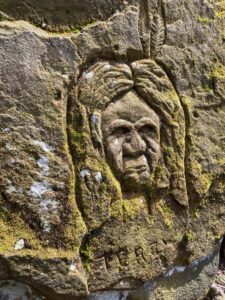
As we walked along, it was disappointing to see more recent graffiti sprayed along some of the walls. Then we noticed the older version. Names and dates from the mid-1800s were carved, obviously with a chisel, into the soft stone. And, as we continued hiking, we found several more intricate works. These included an indigenous man wearing a feather and what looked like a representation of the north wind. This was not vandalism. This was art.
Growing up in Sharon Center, much of my free time was spent in the woods and swamps behind our home. Outside of a few camping misadventures with my best friend in high school at Mohican State Park, I had never explored the area before I left for Montana. I had no idea such a beautiful and fascinating area existed within 20 minutes of where I was raised. I walked away with a long list of questions and wanted to learn more.
History of the Hinckley Reservation
The township of Hinckley has a long history within the settlement of the region. Notably, Judge Samuel Hinckley purchased the township from the Connecticut Land Company for 23 cents per acre in 1795. Part of the Western Reserve remained unsettled until 1819, when he parceled 100, 160-acre plots to sell to pioneers and created the official township.
Hinckley Reservation and Buzzard Day
I guess that most people, especially bird enthusiasts, know Hinckley because of its “Buzzard Days.” Dating back to 1957, it celebrates the return of the turkey vultures every March 15. The myth surrounding their return revolves around “The Great Hinckley Hunt” on Christmas Eve, 1818, when nearly 500 men cleared the Hinckley area of 17 wolves, 21 bears, 300 deer and a multitude of other wildlife to make way for “civilization.” The story claims the turkey vultures arrived in the spring to clean up the thawing carrion.
In reality, turkey vultures prefer to nest in the ledges, caves and rocky outcroppings that are prevalent in this area. They utilize the thermals created by the contrast of the ridges and valleys to soar, looking to spot their next meal.
“They are big birds. If they’re going to be efficient, they like to soar. To get them in the air, it involves a lot of flapping or the ability to float,” explains Wolfgang Pelz, board member of Greater Akron Audubon. He says the wind from Lake Erie hits Whipps Ledges at the Hinckley Reserve and offers excellent loft for the turkey vultures. “Once they’re up there, they can see their buddies.”
Wolfgang notes that the official migration has changed over the years. “They do migrate somewhat based upon our snow conditions, but there are sightings throughout the year.” Even so, Hinckley is long renowned for this popular spring celebration.
The Stone Carvings of Noble Stuart
During the early days of Hinckley’s settlement, Hiram Mace Worden, who was a stone carver and one of the eventual founders of the Medina Monumental Company, came to the area from New York in the early 1840s. After marrying Melissa Bissell, the couple welcomed four children and settled into their 13-acre farm and home at what is now the Hinckley Reserve.
The home was eventually passed down to their youngest daughter, Nettie, who married Noble Stuart, a bricklayer with artistic tendencies, in 1945. Nettie passed away the following year, and Noble channeled his grief into carving ten images, including Ty Cobb, a cross and a bible — even a large sphinx — into the sandstone. Sadly, the original Worden homestead house was demolished by Cleveland Metroparks in 2017, despite being the home base for the Hinckley Historical Society for decades.
The Ancient Seas of Ohio
Long before any of us could spend a beautiful spring day watching turkey vultures in Hinckley, this region underwent massive geological changes when the region we now call Ohio sat closer to the equator. The story is told in sedimentary layers that draw us to the ledges today.
“Ohio would have been a tropical environment,” explains Andy Nash, Mapping Group Supervisor for the Ohio Geological Survey with the Ohio Department of Natural Resources, who regularly visited the Hinckley Reserve during his childhood in Strongsville, Ohio. “Ohio was located right at the equator at this time, but movement from plate tectonics was moving us northward to our current position in the mid-latitudes, around 39 to 42 degrees.”
“Water is going to play a huge role,” says Andy. “There are lots of changes in Ohio, primarily driven by changes in the sea levels. During the Devonian Period (spanning approximately 419 to 356 million years ago), there was a really deep sea that covered most of the state.”
Because of the immense water depth at this time, the sea did not exert much energy. There was no flow in these areas, even though sand was deposited along the beaches in the shallower regions. As a result, carbon-rich materials, along with silt and clay, settled to the bottom forming the Ohio Shale. Yet, as the sea became shallower, tributaries moved materials from the surrounding landscapes.
How the Appalachian Mountains Shaped Ohio
“The bigger story of the whole plate tectonics is Pangaea is forming,” he says. During this time period, the Appalachian Mountains are at their highest point, created from tectonic plate collisions. The young mountains looked more similar to the dramatic Himalayas and were most likely the largest mountains on earth.
Erosion shaped them over hundreds of millions of years. It provided the materials that created the eye-catching formations within the Hinckley Reserve, and many other areas within Ohio. On top of the Ohio Shale, the Bedford Shale formed from this erosion process. The Berea Sandstone and Cuyahoga Formation were the next geological layers created, finally reaching what we call the Sharon Conglomerate.
Sharon Conglomerate and Hinckley’s Ledges
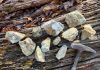
“At this time, about 315 million years ago, is when the Sharon Conglomerate was deposited,” says Andy. “There are features we see in that rock that indicate that they came from the Appalachian mountains. They are made up mostly of coarse sand, then there will be layers of pebbles. These distinctive quartzite pebbles were smoothed and rounded as they tumbled through rivers from the core of the Appalachian Mountains in upstate New York.”
“There were rivers carrying things from the mountains to the sea. The Sharon Sandstone is the direct result of those rivers, as the sand and pebbles filled in the river valley over time,” he says. The result of this process, which lasted until roughly one hundred million years are various layers of sand and silt with other strata made up of mud and quartz pebbles.
“You go to different parts of Ohio today, and you’ll see different types of rocks,” says Andy. “It’s been a fairly steady changing environment throughout the Paleozoic era.”
Glaciers and the Shaping of Northeastern Ohio
Glaciers also played a significant part in shaping the Northeastern Ohio landscape.
“As far as glaciation goes, the last event ended about 14,000 years ago,” Andy notes. “Those have an effect on the sea level, too. When there’s more ice on the land, sea level drops.”
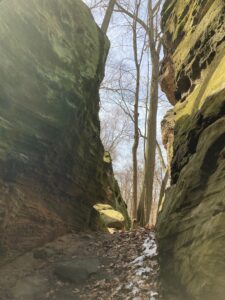
The continued presence of erosion through the resulting streams and rivers continues to create the forms we see today. The layering of sediments is evident as some of the stone faces reach nearly 50 feet tall.
“We call it a cliff-forming unit,” explains Andy. “Sandstone formed that nice, natural cliff.”
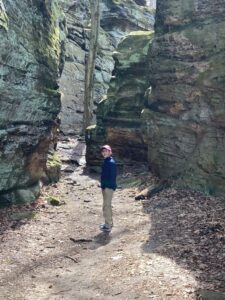
The trail passed through these massive stone walls that seemingly parted just for this purpose, but Andy explains that they fractured at a joint, which are regularly spaced at 90 degrees to each other. Through gravity and time, the rocks separate ever-so-slowly, separating the rocks as they creep down the terrain.
Honeycomb Weathering in Hinckley Reservation
Following the trail through these areas was particularly remarkable. The kids could not resist practicing their bouldering skills on a few of the more accessible rock faces. Looking back, these rocks shared their story without us understanding the timeline, including a unique feature called honeycombing. At first glance, it did not look like a rock.
“There is debate among geologists exactly how this weathering pattern develops on sandstones. It is common on coastal sandstone cliffs so initially, it was thought to be related to salt weathering. Of course, that doesn’t really explain honeycomb weathering here in Ohio, so we think it might be related more to biological (lichen) case hardening. Essentially, the lichen is getting water from cracks in the rock and precipitating a type of biologic cement to harden areas of the rock (the raised ridges) and the relatively softer rock between these ridges gets weathered away to leave behind the pits,” says Andy.
Quarrying and Early Industry in Hinckley
Beyond the Hinckley Reservation’s dramatic geological features, Andy notes that the stone from the Sharon Conglomerate was an important building stone. “They quarried it to build foundations. It was one of the early ones they tried to use,” he says. He also points out, “They would use it for early glass manufacturing. The Sharon Conglomerate is a great source of silica because it is made almost entirely of quartz.”
Frequently Asked Questions
What is Hinckley Reservation known for?
Hinckley Reservation is known for its sandstone ledges, scenic hiking trails, turkey vultures and unique geological formations in northeastern Ohio.
How were the ledges at Hinckley Reservation formed?
The ledges were formed through millions of years of sediment deposition, erosion and glacial activity. Much of the rock is Sharon Conglomerate sandstone created from ancient river systems.
What is Sharon Conglomerate?
Sharon Conglomerate is a quartz-rich sandstone containing rounded pebbles that were carried by ancient rivers from the Appalachian Mountains more than 300 million years ago.
Why are turkey vultures associated with Hinckley Reservation?
Turkey vultures are drawn to the ledges and thermal air currents around Hinckley Reservation, which help the large birds soar efficiently.
What causes the honeycomb patterns in the rocks?
Geologists believe the honeycomb weathering may result from differences in rock hardness combined with moisture, weathering and possibly biological activity from lichen.
Can you hike through the ledges at Hinckley Reservation?
Yes. Several trails wind through the ledges, allowing visitors to walk between towering sandstone walls and explore the reservation’s unique geological features.
Exploring Hinckley Reservation Today
Sometimes, the most incredible finds are under our noses without us ever realizing it. Although it took me decades to experience the landscape of the Hinckley Reserve, I look forward to exploring more of its trails and ledges. I encourage others to do the same.
This story about the Hinckley Reservation previously appeared in Rock & Gem magazine. Click here to subscribe. Story and photos by Amy Grisak.