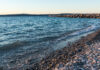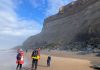

Beach fossils are one of the most rewarding discoveries along the Oregon Coast. In this area, waves constantly expose layers of ancient seafloor. Much of this coastline and parts of the nearby Coast Range were once submerged under a prehistoric ocean. This left behind rich fossil-bearing formations that continue to yield marine remains today. As a result, fossil material can be found on beaches and inland, where erosion has revealed older sedimentary layers.
On the Oregon Coast, beach fossils are most commonly associated with three key formations: Astoria, Nye Mudstone, and Coaledo. The Astoria Formation is found across the northern and central stretches. It is roughly 15–20 million years old. It is made up of blue-gray sandstone mixed with volcanic ash. The Nye Mudstone is slightly older in some areas. It is a fine-grained sedimentary rock known for preserving detailed marine fossils along the central coast. Farther south, the Coaledo Formation dates back roughly 25–30 million years and contains darker sandstones and ash layers that often yield a wide range of marine life remains.
Together, these formations help explain why the Oregon Coast is such a productive region for fossil hunting. From intact shells and impressions to fossilized wood and marine vertebrates, each stretch of beach can reveal a different piece of the region’s ancient underwater history.
Key Takeaways
- Beach fossils are common along the Oregon Coast because much of the region was once an ancient seafloor.
- The most productive fossil-bearing formations include the Astoria Formation, Nye Mudstone, and Coaledo Formation.
- Fossils can be found both on beaches and inland, where erosion exposes older sedimentary rock layers.
- Central and southern Oregon Coast beaches are especially known for yielding well-preserved marine fossils in mudstone and sandstone.
- Beach fossils may include shells, impressions, marine vertebrate remains, and occasionally fossilized wood or trace fossils.
- Low tides, storm activity, and areas near stream or cliff erosion are often the best times and places to search.
Know Before You Go: Identifying Beach Fossils
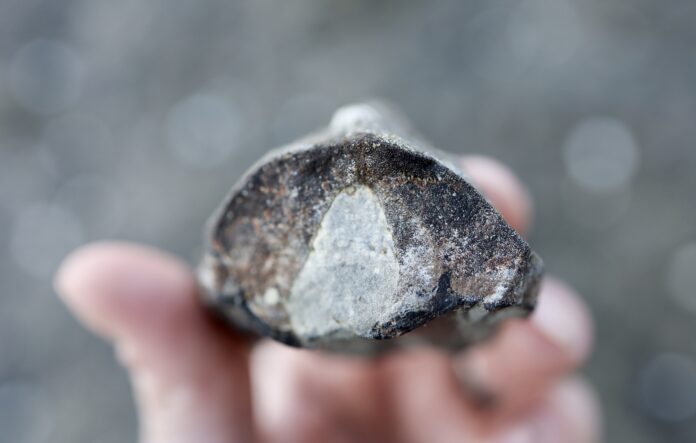
One of the first things to do is to have an idea or a visual in your head of what is out there and possible to find. Sometimes what you think you’re on the hunt for looks a bit different in reality because of the age or the conditions in which it can be found today. Other times, fossils can take you by surprise and you might not think something is a fossil at all when it really is. Be open-minded, question things, and have fun, too.
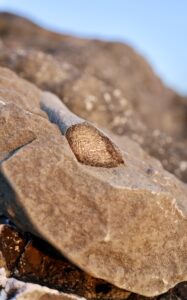
Keep in mind that fossils can be found in their original plant or animal forms, as broken-down pieces of those same forms, or impressions, molds and casts of their original forms. Informing yourself with a good local book or online search can help identify worthwhile places to visit that are not on many people’s radars to visit. With fossil hunting, you may never know what’s out there if you don’t look around for yourself.
Museums and Local Stops Along the Oregon Coast
On the north coast, the Tillamook Pioneer Museum is an overlooked place to catch glimpses of some amazing discoveries. The rock room upstairs features a fantastic assortment of rocks, gems and fossil finds collected from within the county. The Hatfield Marine Science Center and the neighboring Oregon Coast Aquarium, along the central coast, both offer fun and interactive fossil displays from time to time. Further down on the south coast, the Charleston Marine Life Center is full of all types of fascinating creatures and unique museum specimens.
Southern Oregon Coast Beach Fossils and Fossil Sites
One of the most fossil-rich areas on the southern Oregon Coast is between Cape Arago and Coos Bay. Lots of what’s in Coos County is part of the Coaledo formation. The Coos Conglomerate is a separate nearby occurrence that is part of the Empire formation.
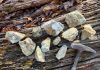
There is an abundance of fossil shells surrounding the cape. The best specimens are likely to be found during a low tide, where sedimentary rocks are freshly exposed at the bases of cliffs, inside sea caves, and in the bay where waves are constantly uncovering new material. While there are several different sites in the vicinity, one noteworthy locality is aptly called Fossil Point.
This area is best known for its whale skull fossils. Over a century ago, another skull was discovered nearby, this one of an immense carnivorous walrus (Pontolis magnus) that rivaled the southern elephant seal as the largest pinniped of all time. Fossil Point is also known for producing a variety of other marine vertebrates & invertebrates, including fossilized and calcitized sand dollars, sea urchins, starfish and crabs trapped in concretions.
Some interesting plant fossils have also been found as impressions on rocks. Sunset Bay also has records of fossil shark teeth, crab claws and an assortment of mollusks. These can typically be found in the steep sandstone walls both north and south of the bay during lower tides.
Central Oregon Coast Beach Fossils
The central Oregon Coast is arguably the most accessible fossiliferous region. There are many amazing beaches along this stretch and the fossils here are often found intact within the sometimes clay-like Nye Mudstone formation.
This is where we have found some of our best-preserved fossil specimens to date. The largest fossil in my collection has been identified loosely as a fossilized mammal rib either from a prehistoric whale or a sea cow. The fossil itself was found just sitting atop random beach cobble after a large swell and the high tide receded.
In Lane County, between Tokatee Klootchman and Stonefield Beach, some amazing pieces of petrified driftwood have been found. Some of these varieties are highly detailed with excellent cell preservation, including a recognizable carbonized myrtlewood, which often looks charred as if it’s been exposed to fire.
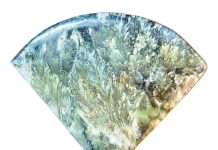
Some mineralized woods have quartz veins running through them, adding to the look, and some are completely agatized or even opalized. In Lincoln County, the area from Lost Creek to the South Beach Jetty is a personal favorite. It’s loaded with an abundance of bivalve fossils, gastropods and petrified teredo wood.
Fossil Hunting the Central Coast
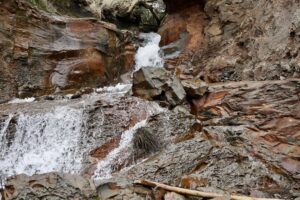
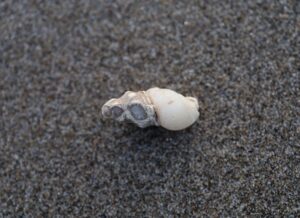
On a Central Coast adventure, my daughter was playing in a waterfall runoff on top of some Nye Mudstone. An underwater hole in the ground was full of debris that she began scooping and watching it flow over the bedrock and down the little stream toward the ocean. All of a sudden, something small tumbled away with the water current. She chased it and pulled out a tiny little bivalve clam fossil.
We discovered a second fossil in the hole. At first glance, both seemed identical, but there was something different about number two. This clam fossil had a small, perfectly round hole, about the size of a BB. The hole was bored by a predatory gastropod. Sea snails would creep up on clams, grab them, and begin drilling into and eventually through their shells. They would inject an acid into the shell and consume the contents, leaving the closed shell empty and moving on to look for more.
In my experience, beaches with stream runoffs and creek washes are some of the best places to search for fossils, especially those with significant or recent erosion from water. Some fossils work themselves completely free from anything that they were trapped in and have a short window before they start deteriorating from exposure.
Underneath the Yaquina Bay bridge, during negative tides, all types of fossil bones and shells have been found. Some really interesting things have been found in the Newport area, including the shell of a gigantic tortoise, and more recently, the well-preserved teeth of the hippo-like Desmostylus.
Central Oregon Coast Bedrock and Fossil-Rich Zones
The bedrock in between Moolack and Beverly Beach is legendary. It’s not always exposed, but when it is, that’s the time to be there. The bedrock is a labyrinth of grooves and chasms carved into the ground, and all types of fossils have been reported to be found here, including several rare fossilized Megalodon teeth.
Further north, between Fogarty Creek and Fishing Rock, is an amazing spot for everything rockhounding. There’s an assortment of unique fossils, including one of the largest gastropods on the coast (Musashia indurata) and concretions. High-quality Oregon Coast agates are often found here as well.
Northern Oregon Coast Beach Fossils and Rockhounding Sites
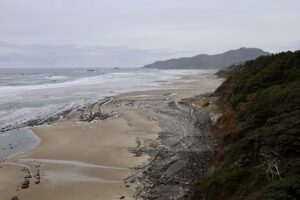
On the north Oregon Coast, some of the largest outcrops of Astoria formation fossils can be found in Tillamook County. Various road cuts along the Three Capes Scenic Loop are excellent places to find all types of things. Cape Kiwanda has been known for some incredible bones turned into stone over the years. There are some enormous, partially enclosed concretions, and you can only imagine what’s inside them. You cannot dig into sea cliffs or any bedrock to remove these. However, if Mother Nature has freed them from their matrix, then theoretically, they can be collected or split open.
Some amazing fossil death plates have also been discovered in the Oceanside and Bayocean areas. Typically, the fossils in this region are found around the headlands. Others come from offshore sea stacks or underwater sources. After a good storm, all types of things can wash ashore that have been sitting on the ocean floor for years. As a rule of thumb, any rocky area where freshwater meets the sand and where saltwater meets the cliffs is worth exploring. Just be mindful of the ocean, use good judgment when you should and be aware of erosion possibilities.
Northern Oregon Coast Fossil Collection Guidelines and Safety
The Oregon Coast beaches have daily and annual limitations for the removal of anything, including fossils. If something you find is unusually large or fragile, you may wish to call in professionals to best recover and preserve the specimen. If something is worth taking home, try your best to protect it or donate it to a museum that can care for it. That way, these places can continue to teach and inspire the next generation of adventurers with more of the lost and found treasures from the Oregon Coast.
FAQ: Beach Fossils on the Oregon Coast
What are beach fossils on the Oregon Coast?
Beach fossils are preserved remains or traces of ancient marine life found in coastal rocks and sediments. On the Oregon Coast, they often include shells, marine vertebrates, impressions, and fossilized wood from ancient seafloors.
Where are the best places to find beach fossils?
Some of the most productive areas include exposures of the Astoria Formation in Tillamook County, Nye Mudstone along the central coast, and Coaledo Formation sites in the south. Beaches near headlands, stream outlets, and freshly eroded cliffs are especially good.
When is the best time to look for beach fossils?
Low tides—especially negative tides—combined with recent storms or heavy surf are ideal. These conditions expose fresh sediment and can uncover newly released fossils.
What kinds of fossils can be found on the Oregon Coast?
Common finds include fossil shells (bivalves and gastropods), marine mammal bones, concretions with fossil inclusions, trace fossils, and occasionally petrified or agatized wood.
Is it legal to collect fossils on Oregon beaches?
Collection rules vary depending on location and material. In general, small, loose specimens may be collected, but digging into cliffs, removing large fossils, or disturbing protected areas is not allowed. When in doubt, check local regulations or contact land managers.
Are beach fossils rare on the Oregon Coast?
Not necessarily. Fossils are relatively common in certain formations, but well-preserved or unusual specimens are less frequent and often depend on erosion events and storm activity.
Conclusion
The Oregon Coast offers one of the most accessible and dynamic fossil-hunting environments in the Pacific Northwest. With its mix of marine sedimentary formations, shifting tides, and constant coastal erosion, beach fossils can be found in many locations if you know where—and when—to look.
From the Astoria Formation in the north to the Coaledo Formation in the south, each stretch of coastline reveals a different chapter of ancient marine life. Whether you’re searching stream cuts, scanning storm-washed beaches, or exploring exposed bedrock at low tide, the Oregon Coast continues to reward careful observation and patience.
Most importantly, fossil hunting here is as much about stewardship as discovery. Preserving notable finds and respecting collection guidelines helps ensure these ancient remains remain available for future study and exploration.
This story about Oregon coastal beach fossils previously appeared in Rock & Gem magazine. Click here to subscribe. Story by Eric Davis.