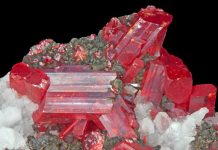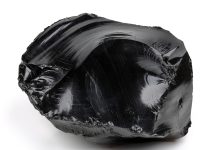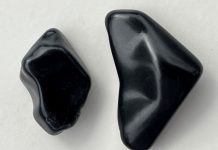

Blue gems range from royal and cobalt blue to midnight blue and deep violet-blue, offering some of the most dramatic colors found in the mineral world. Some resemble a night sky or outer space, especially when their dark bodies contain glittering pyrite, chatoyancy or flashes of spectral color. These rich hues make blue gems popular with collectors, lapidaries and jewelry artists.
Sapphire, azurite, hawk’s eye, pietersite, apatite, benitoite, lapis lazuli and sodalite all contribute distinctive shades and appearances to this dark-blue palette. While relatively few minerals and gemstones exhibit the intense colors of a moonless night sky, the examples that do are especially captivating.
Key Takeaways
- Blue gems range from bright cobalt and royal blue to midnight blue and deep violet-blue.
- Sapphire, including star sapphire, is one of the best-known blue gemstones and occurs in a wide range of colors.
- Minerals such as azurite and sodalite provide intense blue colors, while hawk’s eye and pietersite create blue hues through distinctive mineral textures and structures.
- Blue apatite and benitoite can form gem-quality crystals prized by collectors and lapidaries.
- Lapis lazuli is an opaque metamorphic rock whose blue color comes primarily from lazurite, often accompanied by calcite and pyrite.
- Black opal can contribute dark blue, violet and purple tones to the night-sky color palette through its body color and play-of-color.
Blue Sapphires & Star Sapphires
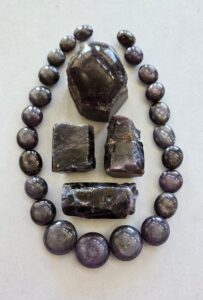
Sapphires, the gem variety of corundum, occur in every color of the rainbow. Transparent gemstones are commonly faceted, carved, or cut as faceted beads, while opaque gemstones are mostly cut as cabochons, carved, or cut as beads in many shapes and styles. Some of the most valuable sapphires fall within the midnight blue or plum color.
Perfectly-shaped hexagonal blue-violet-colored crystals with growth lines and triangles have been discovered within the past 30 years in the northern province of Antsiranana in Madagascar.
When rutile crystals are perfectly oriented within rubies and sapphires, they create an effect known as silk. These fine needle crystals are the cause of the optical phenomenon of asterism, and when cut as cabochons, they exhibit six-ray stars or the rarer twelve-ray stars. Highly translucent blue star sapphires are among the most famous star gemstones, mined in Australia, Myanmar, Sri Lanka, and Thailand. Opaque, plum-colored star sapphires typically come from India.
Prospecting for Sapphires
If you want to go prospecting for sapphires in this country, head to either western Montana, near Philipsburg and Helena, or to western North Carolina, in Cowee Valley near Franklin. Several mines are open to the public.
Among them is the Sheffield Mine, once owned by Tiffany’s. Open to the public for the past 60 years, the mine produces sapphires and rubies, even star rubies. The Sheffield mine is known as “Home of the honkers” — crystals that weigh between 30 and 100-plus carats. The mine has two covered flume lines where patrons sift, scrub and clean the rocks to find the ruby and sapphire crystals. Admission is $10 per person. Native or enriched buckets range from $5 to $200. Visit www.sheffieldmine.com or call (828)369-8383.
Azurite
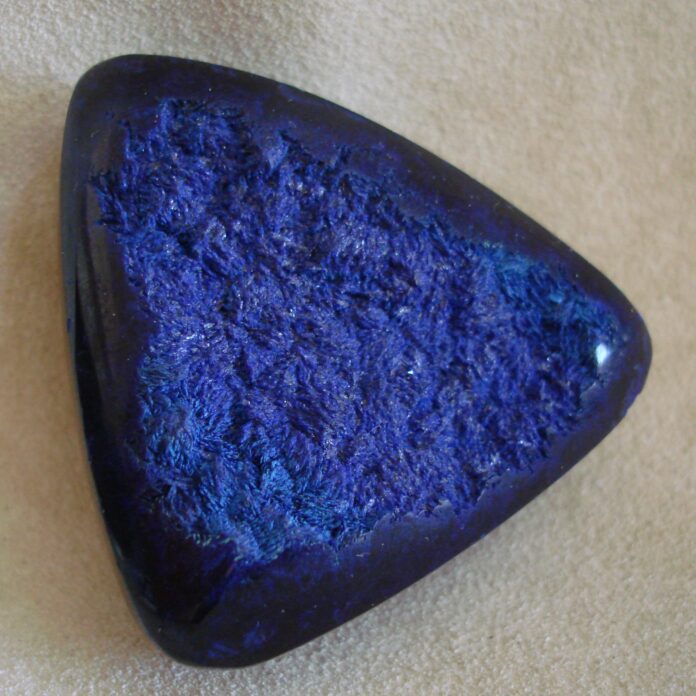
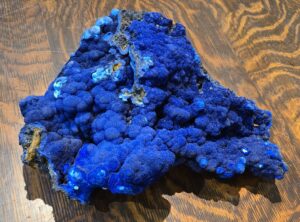
Azurite [Cu3 (CO3 )2 (OH)2 ] is a deep blue-colored copper mineral. It forms as dark, midnight-blue prismatic crystals. More commonly, azurite is found in a massive, nodular, drusy, or stalactitic form. Azurite is very soft, only 3.5-4 on the Mohs scale of hardness. Stunning azurite crystals come from copper mines worldwide, including Morocco, Namibia, Hungary, Greece, the mined-out Milpillas Mine in Sonora, Mexico, and the Bisbee and Morenci mines in Arizona.
Lapidaries use azurite in various forms. When the material is solid, it can be cut and polished to a high finish. Azurite often exhibits a drusy textured surface, a unique rosette structure, and a scintillating pattern of tiny prismatic crystals that move around in different directions within the surface. It can be cut just like other drusy material by leaving the drusy untouched and polishing the surrounding surfaces.
Hawk’s Eye
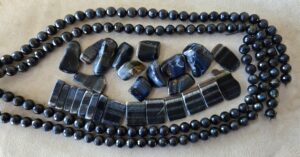
Hawk’s eye is the blue variety of tiger’s eye, known as falcon’s eye. Both species are cryptocrystalline replacement varieties of quartz, or pseudomorphs, as the silica-rich quartz has replaced the original crocidolite mineralization. When both golden and blue colors are present, it’s known as variegated tiger’s eye. Hawk’s eye stones have been considered and worn as amulets and talismans throughout the centuries.
Geological conditions with the presence of all the components to form hawk’s eye are much rarer than those forming tiger’s eye, thus making the blue variety a limited find. Primary sources for hawk’s eye include South Africa, Australia, Brazil, India, Namibia, Arizona and California.
Hawk’s eye shows a characteristic deep cobalt blue to gray color, with a touch of golden streaks. The optical effect of chatoyancy and the shimmer is caused by small blue crocidolite asbestos fibers in a parallel arrangement. Hawk’s eye is an opaque mineral with a hardness of 6.5 to 7 Mohs. When cut correctly into cabochons or beads, a bright light glides across the surface.
Pietersite
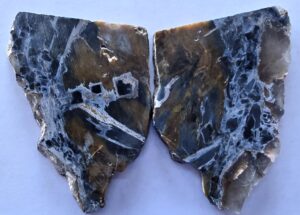
Pietersite is a breccia aggregate material, comprised of blue crocidolite, amphibole minerals, and sodium, iron and aluminum silicates. Both tiger’s eye and hawk’s eye can be present in pietersite. Color ranges from deep blue to golden, depending on the minerals present, often creating swirly patterns.
Pietersite was discovered in 1962 by a prominent collector named Sid Pieters in Outjo, in north-central Namibia. High-quality pietersite is rare and expensive. A less expensive golden variety comes from China.
Blue Apatite
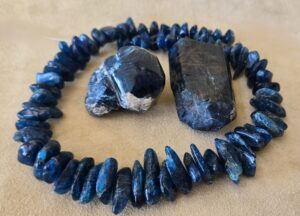
Apatite is the index mineral for hardness 5 on the Mohs scale. It is a member of the apatite group of minerals, with chemical formula Ca5 (PO4 )3 (F,Cl,OH). Apatite occurs in green, yellow, purple, pink and blue colors, which range from neon-blue to deep dark blue gems.
Deposits are found around the world, but deep blue gemmy apatite hexagonal crystals are mostly found in Brazil. Apatite is usually transparent to translucent, with some opaque varieties. Care must be given when it’s cut, especially when faceted, as apatite may be brittle, or have good cleavage in one direction that may split the crystal.
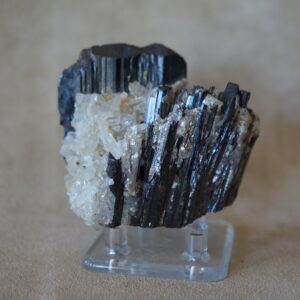
Hübnerite: A Dark Mineral
The now-closed Pasta Bueno Mine in the Pallasca Province, Ancash Department of Peru, produced magnificent hübnerite (MnWO4 Fe+2 WO4) specimens in the mid and late 1980s. The color of the hübnerite crystals ranges from dark brown to brownish black, often with a deep cherry-red color around the edges when backlit. Hübnerite often forms together with quartz crystals. Hardness is 4-5 Mohs, and luster is metallic and resinous. Monoclinic hübnerite crystals are prismatic with good terminations, often with parallel growth, columnar, and vertically striated, reminiscent of outer-space landscapes.
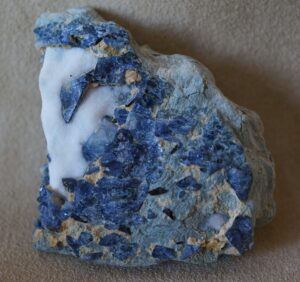
Benitoite
A rare barium titanium silicate mineral, benitoite has a chemical composition BaTi (Si3O9). It is typically blue and, when cut, may resemble a blue sapphire. Its hardness is 6-6.5 Mohs. Benitoite crystals often form together with black neptunite crystals on a white natrolite background.
Although benitoite has been discovered in a few locations worldwide, the best gem-quality benitoite comes from San Benito County, California. Gemmy benitoite crystals are usually faceted into round brilliant stones, carefully taking advantage of their high refractive index and dispersion, which is higher than that of a diamond.
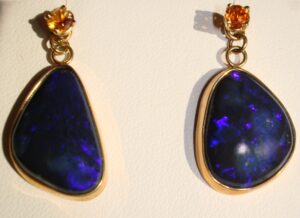
Black Opal
Opal is a hydrated form of silicon dioxide with a variable amount of water ranging from 3-20%, and a molecular structure of a multitude of silica spheres arranged in perfectly aligned rows. The spectral colors displayed in precious opals are the result of light reflecting and refracting from the small spheres, and depending on their size, they display different spectral colors.
Black crystal opals, also known as jellies, come from Lightning Ridge, Australia. Their play of color floats and glides over the translucent body color. The most famous ones exhibit a full color spectrum, while others show a purple flash.
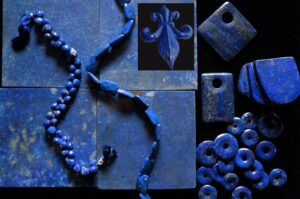
Lapis Lazuli
An opaque metamorphic rock, lapis lazuli is composed of various minerals, with lazurite being the main blue mineral component. Lazurite is a tectosilicate mineral. Lazurite is usually accompanied by white calcite veins, pyrite crystals, and smaller amounts of diopside, mica, hauyinte and hornblende. Lapis has a hardness of 5-5.5 Mohs.
The best quality lapis displays a perfect balance between the bright royal blue body color, sprinkled with a small amount of pyrite crystals and some fine lines of calcite, both of which add a more authentic and natural look to lapis. Too much metallic pyrite makes the stones dull and unattractive. High-grade natural lapis without any calcite or pyrite inclusions present is rare, and the absence of any inclusions raises suspicions for the material’s natural origin.
Finding Fine Quality Lapis Lazuli
Fine quality lapis is found in three major deposits in the world. The Russian lapis, often used in Faberge carvings and the famous eggs, comes from the Tultui Lazurite deposit in the Lake Baikal area, south of Irkutsk, in Siberia. Lapis from Chile is mined in the Andean mountainous Coquimbo Region, near the city of Ovalle, north of Santiago. In general, this lapis shows a lighter blue color with more calcite inclusions.
Lapis from Afghanistan, the finest quality of lapis in the world, comes from the ancient historic mines of Sar-e-Sang that have been in operation for over 6,500 years in the Badakhshan province, located in the West Hindu Kush Mountains. Ancient Greek, Persian and Indian civilizations traded for Afghan lapis, transporting it over 2,000 miles to Egypt, Mesopotamia and the Roman Empire, where it was highly valued and used for carving scarabs, seals and beads.
Lapis Lazuli is a beloved gemstone among lapidaries and jewelry artists. It is cut as cabochons, beads, carvings, eggs and spheres, small sculptures and decorative items, and used in inlays and mosaics.
Sodalite
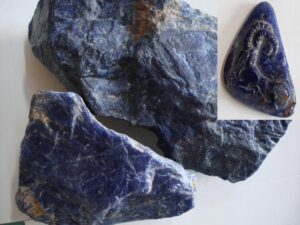
Sodalite is a tectosilicate mineral. The name sodalite reflects its sodium chemical composition. Transparent to translucent crystals are rare; most sodalite is opaque. Color ranges from deep cobalt blue, midnight blue to blue-violet. Sodalite was first discovered in Greenland in 1811, but became popular as an ornamental stone after the 1891 vast deposits in Ontario, Canada.
Sodalite’s hardness is 5-6 Mohs. Lapidaries should be aware that the fine lines, fractures and inclusions in the rough material may cause breaks. The availability of large-sized solid rough material and low cost lends itself to commercial figurine carvings, décor items, beads, and inlays.
Sodalite is occasionally confused with lapis lazuli. The color of lapis leans mostly towards bright royal blue and often contains pyrite crystals, which sodalite typically does not.
Frequently Asked Questions About Blue Gems
What are some examples of blue gems?
Examples include blue sapphire, star sapphire, benitoite, blue apatite, lapis lazuli, sodalite, azurite, hawk’s eye and pietersite. These materials vary considerably in hardness, transparency, composition and how they are cut or polished.
What is the most valuable blue gemstone?
Blue sapphire can be among the most valuable blue gemstones, particularly fine stones with strong color, good transparency and desirable origins. Exceptional examples of other blue gems, including benitoite, can also command high prices because of their rarity.
What mineral is known for its deep blue color?
Azurite is particularly well known for its intense deep-blue color. It commonly forms as massive, nodular or drusy material, although well-formed prismatic crystals also occur.
What is the difference between lapis lazuli and sodalite?
Lapis lazuli is an opaque metamorphic rock composed of several minerals, with lazurite responsible for its blue color. Sodalite is a mineral in the feldspathoid group. Lapis commonly contains white calcite and metallic pyrite, while sodalite typically lacks the characteristic pyrite inclusions found in lapis.
Blue Gems Final Thoughts
From sapphire and benitoite to azurite, lapis lazuli and sodalite, blue gems and minerals display an impressive range of colors and textures. Some owe their appeal to crystal structure and chemistry, while others reveal their character through inclusions, replacement processes or optical effects. Together, these materials show why deep blue remains one of the most enduring and distinctive colors in the mineral world.
Want to deepen your gemstone knowledge? Subscribe to Rock & Gem magazine for expert insights, collecting tips and discoveries delivered to your inbox and mailbox.
Want to deepen your gemstone knowledge? Subscribe to Rock & Gem magazine for expert insights, collecting tips and discoveries delivered to your inbox and mailbox. Night sky gemstones story and photos by Helen Serras-Herman.