
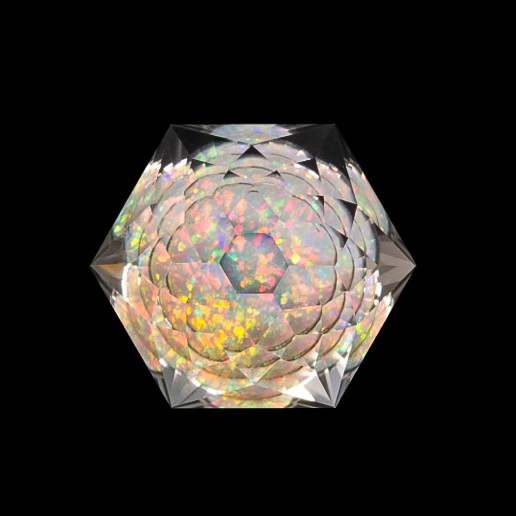
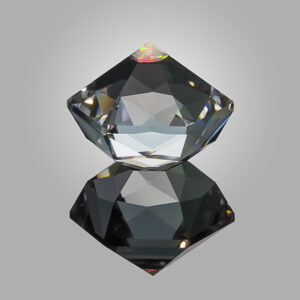
Faceted quartz can create remarkable optical effects, especially when paired with colorful opal. Inspired by Earl Montgomery’s Space Gems, the Galaxy Gem combines a precisely faceted quartz gemstone with a small opal insert set into a concave culet. The result is a composite gemstone that can magnify, focus or create a kaleidoscope-like view of the opal’s play-of-color.
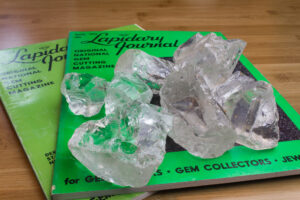
Montgomery’s Space Gems first caught my attention on the August 1972 cover of Lapidary Journal, with the process for creating them appearing in the October 1973 issue. More than 50 years later, I wondered what might happen if the concept were adapted to modern faceting equipment and techniques. Using clear optical quartz, pinfire opal and an ULTRA TEC Fantasy machine, I developed the Galaxy Gem as a faceted quartz tribute to Montgomery’s original design.
Faceted Quartz Key Takeaways
- Faceted quartz provides the foundation for a Galaxy Gem, allowing light to travel through the stone and interact with the opal insert.
- Pinfire opal works particularly well because its small, colorful flashes remain visible within the relatively small finished gemstone.
- A concave culet is central to the design, creating the recess needed to fit the opal and producing the Galaxy Gem’s distinctive optical effects.
- Creating a Galaxy Gem involves several lapidary techniques, including faceting, cabbing, concaving, fitting, gluing and re-faceting.
- The quartz and opal must be treated as a composite stone once they are joined, particularly during the final pavilion and crown faceting.
- Different faceting designs produce different optical effects, including magnification, a focused view of the opal or a kaleidoscope-like appearance.
What is a Space Gem? The Inspiration for Galaxy Gems
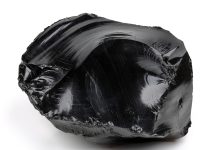
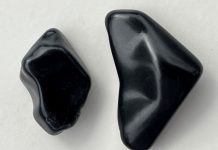
Montgomery’s Space Gem, in the simplest terms, is an opal triplet that has had the top quartz cabochon carved with recesses and set with opal to represent the varieties and vastness of our cosmos. Using optical quartz, opal cabochons and chips, backed with black obsidian, Montgomery both sculpts and paints a miniature of the grandest galaxies and planets.
I was intrigued by the Space Gems’ beauty and originality. The process that he used to carve and set the Space Gems was fascinating. I started thinking about making some Space Gems myself. I had recently received optical quartz from a colleague and had also just purchased some old stock Mintabie Opal from a 1970’s collection, along with some black jade from a lapidary estate. When reviewing Montgomery’s process, I was presented with an interesting dilemma. Fifty years after the article on Space Gems, the world of lapidary techniques and equipment had changed dramatically. I would need to learn these early methods or use the modern tools I have in my lapidary studio.
While I was contemplating Space Gems, I was working with my ULTRA TEC Fantasy machine and experimenting with stone combinations inspired by Henry Hunt’s gemstone carving books. One afternoon, while I was faceting some optical quartz as a design prototype, the idea of a faceted Space Gem came to me. I started by experimenting with various materials and designs.
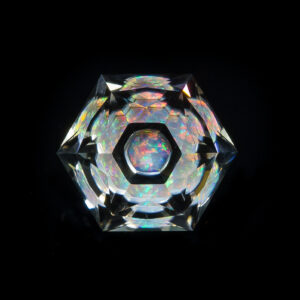
The design evolved and the result can be seen in the pictures in this article. It was the inspiration of Montgomery’s original Space Gems and the capabilities of the new ULTRA TEC Fantasy machine that led to this beautiful gemstone design that I call Galaxy Gems as a tribute to Montgomery’s original Space Gems.
Designing a Faceted Quartz Galaxy Gem
The Galaxy Gem is a faceted gemstone with a concave culet that has an inserted opal cabochon. Creating a Galaxy Gem is a long process of faceting, cabbing, gluing and re-faceting.
The most critical decision in developing the Galaxy Gem was the selection of materials. For me, the clarity of colorless quartz and the pinfire color of the opal had to be the highest grade that I could locate. Choosing to use natural and old stock materials in my inventory was also a major factor. I selected a very clear quartz that was sold under the label of “old stock military grade optical quartz” and opal that was sold under the label of 1970’s Mintabie Opal. I chose opal that is known as pinfire, which has very small brilliant dots of various colors.
Faceted Quartz Prototype Gems
The second critical decision was the gem design. Eight prototype gems were selected for various design considerations. The Galaxy Gems can provide three beautiful effects based on the faceted design of the quartz. Faceting the gem in various designs can either focus the view on the opal centered in the gem, give the opal a kaleidoscope view, or act as a magnifying glass. It is also possible to combine the different attributes by modifying the design parameters to complement the opal’s play of color and create a unique stone every time it is cut.
The gem faceting design can be selected from your favorite cuts. Given that the process of cutting the gem is somewhat involved, I would recommend starting with a facet design that you are comfortable cutting. Stay in the 10 to 12 mm size of finished stone for your first Galaxy Gem.
How to Make a Faceted Quartz Galaxy Gem
Faceted Quartz Rough Selection
Remember that the quartz needs to be as clear and colorless as possible to allow the opal to be viewed. I found that pinfire opal works the best due to the concentration of different colors in a stone this small. I suggest avoiding broad flash material. Because the opal part of the Galaxy Gem is very small, I used trimmings from my finest opal cabochons.
Preforming Faceted Quartz
On the cabbing machine wheels, preform the quartz and opal blanks. Dop the quartz on the faceting dop and dop the opal on a small faceting dop. Preform again on the wheels, holding them by the dops.
Faceting the Quartz Pavilion
Insert the quartz in your faceting machine and cut the pavilion to 1,200 grit.
Put the quartz on a tabling adapter and cut a culet (pavilion table) to size. The opal insert in the gem does not have to be large when compared to the overall size of the finished gem. The quartz will act as a magnifying glass, and if the opal is too large, it will look more like a traditional doublet design.
You could simply polish the culet and attach a flat polished opal to the bottom of the gem; however, the technique and design of concaving the culet is what makes this gem so visually unique. I use the ULTRA TEC Fantasy machine for concaving the culet and recommend the flat approach if you do not have an ULTRA TEC Fantasy machine.
Concave Culet
Leave the gem in the faceting mast and move the mast to the Fantasy machine. Set the stone at 90 degrees and use a 600-grit metal ball tool and oil lubricant in the Fantasy machine to cut a rough concave half-sphere into the culet of the quartz.
This is a step that takes careful alignment and a slow approach to get right. Concave the culet directly in the center and cut to a depth that removes 80% of the flat culet,leaving a rough concave dimple in the bottom of the pavilion.
Opal Cabochon
It is now time to prepare the opal for the fitting process. Cab the opal to a rough dome using a 600-grit on a wheel until it is 15% larger than the culet dimple.
Fitting the Opal
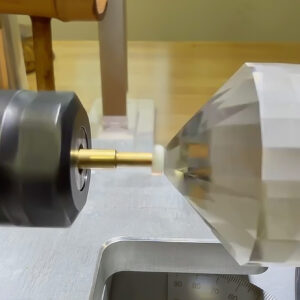
In this process, I use the ULTRA TEC Fantasy machine, V5 faceting machine and the Rotator Kit. The V5 is set at 90 degrees and holds the quartz gemstone. The index is locked into free rotation mode. Place the dopped opal into the Fantasy Machine and align it with the concave culet of the quartz gemstone. The Fantasy machine reciprocating mechanism should be in the locked position.
Turn on the Fantasy (lowest speed) and Rotator (half speed). You want the opal and quartz to rotate in opposite directions.
Place a small amount of diamond paste and a drop of Snake Oil in the concave culet of the quartz gemstone.
Gently move the quartz into the rotating opal and let the two stones begin to carve each other. Be careful to keep the stones lubricated with diamond paste and oil. This is a slow process. Do not run the opal at a speed greater than one on the Fantasy Machine. Gently move the quartz into and away from the opal, allowing for a slow carving process. Too much pressure will ruin the opal by heating it and cracking it.
Continue the carving/polishing process through the following grits. Use 1,200 for the carving process. You should have a matte surface with no rings in the opal or quartz. This can take up to an hour; go slowly. 3,000 and 8,000 are used for pre-polish and 14,000 for polish.
Gluing
Remove the quartz and opal from the machines and place them in a transfer jig. Clean both stones with alcohol. I use HXTAL NYL-1 Epoxy Adhesive for my gluing process. Mix your favorite lapidary epoxy and fill the quartz dimple. Make sure the opal has a perfect fit while the glue is setting. Press the two stones together to remove any air bubbles.
Follow the epoxy instructions for curing. Be patient, you are going to put a lot of heat and pressure on this stone in the next faceting step.
Pavilion Reprise
Remove the opal dop by gently heating the dop. Place the quartz dop back on the faceting mast and recut the pavilion at 1,200 grit being careful to leave as much opal as possible. I have been known to make a miscalculation or cut and facet too deep, which lead to the complete loss of the opal. Keep in mind that you should treat the two stones as a whole at this point in the process. Cut and polish the pavilion and girdle as you would on a non-composite stone.
Transfer
Using your transfer jig, transfer your stone. Use a large dop to cover most of the pavilion to help remove the dop after the crown is finished. Use glue for dopping. Do not use wax. You want to keep the opal clean from wax and dopping glue.
Crown
Cut and polish the crown per your design.
Removing the Dop
This can be tricky, given that you have a composite stone with an epoxy seam. Heat or solvents can detach the opal if you are not careful. Use acetone to remove the dop by hanging the dop in the acetone just at the level of the top of the dop, leaving the opal out of the acetone. I find HXTAL NYL-1 Epoxy Adhesive holds up better than most adhesives when temporarily exposed to acetone.
Do not leave the gem in the acetone too long. Check it frequently. Try to gently pull the dop off periodically. Do not let the stone detach from the opal and drop into the acetone. Then, clean the gem and enjoy your creation.
Frequently Asked Questions
What is a Galaxy Gem?
A Galaxy Gem is a faceted quartz gemstone with a small opal insert set into a concave culet. The design was inspired by Earl Montgomery’s Space Gems, but adapts the concept for modern faceting equipment and techniques.
What type of quartz is best for a Galaxy Gem?
Use quartz that is as clear and colorless as possible. High clarity allows the opal insert and its play-of-color to remain visible through the finished faceted quartz.
What type of opal works best?
Pinfire opal works particularly well because its small, colorful flashes remain concentrated and visible in the small opal insert. Broad-flash opal is less suitable for this design.
What is a concave culet?
A concave culet is a recessed, curved area cut into the bottom of a gemstone rather than a traditional flat or pointed culet. In a Galaxy Gem, the concave culet provides the space for the opal insert and contributes to the stone’s optical effects.
Can you make a Galaxy Gem without a concave-faceting machine?
Yes. A flat polished opal can be attached to the bottom of the quartz instead, although the concave culet is a key part of the Galaxy Gem design and creates its distinctive appearance.
How long does it take to fit the opal?
The fitting and polishing process can take up to an hour. The quartz and opal need to be worked slowly with proper lubrication to avoid heating or cracking the opal.
Faceted Quartz Final Thoughts
Creating a Galaxy Gem brings together traditional lapidary skills with the capabilities of modern faceting equipment. From selecting exceptionally clear quartz and colorful pinfire opal to carefully cutting the concave culet and fitting the two materials together, every step affects the optical result. The finished gem is both a tribute to Earl Montgomery’s Space Gems and an exploration of what is possible when faceting techniques are applied to a new design.
Want to deepen your gemstone knowledge? Subscribe to Rock & Gem magazine for expert insights, collecting tips and discoveries delivered to your inbox and mailbox. Faceted gemstones story and photos by Mark Oros.