Asteroid Types and Composition
NASA has been studying asteroids for decades. It has categorized three different types of these interplanetary rocks, based on their composition.
C-type (Carbonaceous)
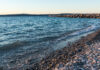
C-type asteroids are the most common and among the darkest asteroids. They are rich in carbon and are thought to contain clay and silicate minerals, like those found in beach sand. Many are found in the outer regions of the main asteroid belt. They are considered some of the most primitive objects in the Solar System.
S-type (Silicaceous)
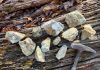
The S-type is the most common type of asteroid on the inner side of the Asteroid Belt. These asteroids contain silicate materials and nickel-iron metal. NASA estimates S-types at about 17% of asteroids.
M-type (Metallic)
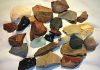
M-type asteroids are relatively rich in metal, particularly iron and nickel. They are less common than C-type and S-type asteroids. They are concentrated mainly in the middle regions of the main asteroid belt. Some M-type asteroids may be remnants of the metallic cores of larger bodies that were heated enough to melt and differentiate, causing dense metals to sink toward the center. Others may have more complex compositions and origins. Their metal-rich nature makes M-type asteroids especially useful for studying how planetesimals developed internal layers during the early Solar System.
Where Asteroids Are Found
Asteroids are also categorized based on their location within the Solar System.
Main Asteroid Belt
The Main Asteroid Belt is the region of the Solar System where most known asteroids orbit the Sun, between Mars and Jupiter. It contains an estimated 1.1 to 1.9 million asteroids larger than 1 kilometer (0.6 miles), along with millions of smaller bodies.
The material in the belt is leftover debris from the early Solar System that never became part of a planet. Jupiter’s strong gravity disrupted the process of planet formation in this region. This increased the speed and energy of collisions among the growing bodies. Rather than combining efficiently into a planet, much of the material was broken apart and remained as smaller objects.
The asteroids we see today have continued to evolve through collisions, impacts and other processes over billions of years. As a result, the Main Asteroid Belt preserves a mixture of relatively primitive material and fragments of larger bodies that experienced heating, melting and differentiation. Studying these asteroid belt rocks gives scientists a window into the materials and processes involved in the formation of the planets, including Earth.
Trojans
Trojans aren’t simply outside the Main Asteroid Belt; they’re asteroids that share a planet’s orbit around the Sun and cluster near stable Lagrange points. Jupiter has the largest known population. Trojan populations are also associated with Mars, Neptune and one was even discovered orbiting with the Earth in 2011. Gravitational and orbital forces keep the asteroids from striking the planets they travel with.
Near-Earth Asteroids
Asteroids whose orbits take them close to the Earth are called Near-Earth asteroids. The ones that cross the Earth’s orbit are also referred to as Earth-Crossers.
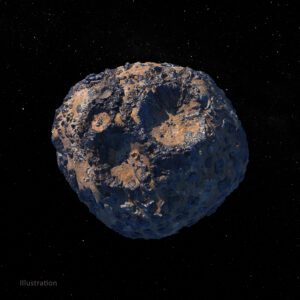 Psyche. NASA
Notable Asteroids
NASA and other space agencies have studied many of the larger and more unusual asteroids to learn about their composition, geology and history. Asteroids are generally named by their discoverers. Proposed names are reviewed and approved by the International Astronomical Union’s Committee on Small Body Nomenclature.
Some asteroids have attracted particular scientific interest because of their size, unusual composition, distinctive geology or importance to our understanding of the early Solar System.
Psyche
Shaped somewhat like a giant potato, Psyche is a large, metal-rich asteroid measuring about 173 miles (280 kilometers) at its widest point. Radar and optical observations indicate that its surface contains a mixture of metal and silicate materials, along with large crater-like depressions.
Psyche is particularly interesting because it may be the exposed remnant of a differentiated planetesimal—the type of body that helped build the rocky planets. NASA launched the Psyche spacecraft in 2023 to investigate the asteroid’s composition, interior structure and history. The spacecraft is expected to arrive at Psyche in 2029 and spend about two years studying the asteroid from orbit.
Donaldjohanson
Donaldjohanson is an approximately 5-mile-long (8-kilometer) asteroid with an unusual elongated shape. Scientists believe it is an elongated contact binary, formed when two smaller bodies came together and remained in contact.
The asteroid is also scientifically important because its complex geology may preserve evidence of the collisions and accretion processes that shaped the early Solar System. NASA’s Lucy spacecraft made a close flyby of Donaldjohanson on April 20, 2025, capturing images and collecting data about its surface and shape.
Vesta
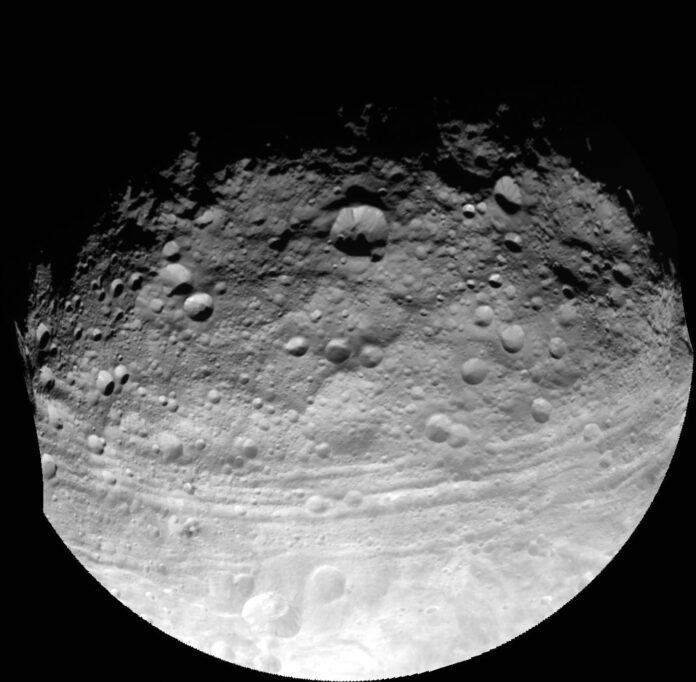
One of the largest objects in the Main Asteroid Belt, Vesta measures about 326 miles (525 kilometers) across and accounts for nearly 9% of the total mass of the asteroid belt. Unlike most asteroids, Vesta underwent extensive internal differentiation and developed a crust, mantle and core.
Vesta’s surface contains both bright and dark materials, including deposits created by impacts. Scientists have also linked the howardite, eucrite and diogenite (HED) groups of meteorites found on Earth to Vesta. These meteorites are thought to have been blasted from Vesta by a major impact roughly a billion years ago, giving scientists actual samples of material from this ancient asteroid.
Eros
About 10 miles (17 kilometers) long, Eros is a Near-Earth asteroid rather than a member of the Main Asteroid Belt. It became the first asteroid to be orbited by a spacecraft when NASA’s NEAR Shoemaker entered orbit around it in 2000. In 2001, the spacecraft made the first successful landing on an asteroid.
The mission provided detailed information about Eros’s surface, composition and geology. Its instruments continued operating after landing, allowing scientists to collect additional data from the asteroid’s surface and demonstrating the value of studying these small planetary bodies up close.
Asteroid Impacts on Earth
About 66 million years ago, an asteroid roughly 6 miles (10 kilometers) wide struck the region of what is now Mexico’s Yucatán Peninsula. The resulting Chicxulub impact contributed to the extinction of about 75% of marine and land animal species, including the nonavian dinosaurs.
Since the discovery of this cataclysmic event, NASA scientists have been studying the skies in the hopes of detecting the next large asteroid that will strike the Earth—an inevitable certainty.
Planetary Defense Coordination Office
In 2016, an agency called the Planetary Defense Coordination Office (PDCO) was established at NASA to manage the ongoing efforts of finding, tracking and understanding asteroids that may pose a hazard to Earth. The PDCO focuses on Near-Earth Objects (NEOs), asteroids that come within 30 million miles of the Earth’s orbit. With the assistance of the NEO Surveyor, an infrared telescope scheduled to launch into orbit in 2027, NASA will be better able to detect difficult-to-see asteroids that may pose a threat to Earth.
How NASA Can Deflect an Asteroid
What happens if NASA detects an asteroid headed for our planet? In 2022, the agency successfully altered the orbit of a small asteroid named Dimorphos by using a spacecraft for direct impact. Part of the Double Asteroid Redirection Test (DART) mission, the Falcon 9 rocket was deliberately crashed into Dimorphos, causing the asteroid to change its orbit.
Although scientists believe it’s unlikely a large asteroid will strike Earth in the next 100 years, NASA continues to research ways to detect and deflect potential threats to our planet.
|
Asteroid Rocks That Reach Earth
An object is a meteoroid before entering the atmosphere; the streak of light produced as it passes through the atmosphere is a meteor; a surviving fragment that reaches the ground is a meteorite. (The study of meteorites is meteoritics.) Burning brightly as they streak across the sky, most disintegrate well before they hit the surface of the Earth. But in some cases, a remnant of the meteor makes its way to the ground intact, becoming a meteorite.
Nearly 50,000 meteorites have been discovered on Earth, with 99.8% of them being remnants of one of the thousands of asteroids that orbit the Sun. (The other 0.2% came from Mars and the Moon.) Ranging anywhere in size from a pebble to a fist, these pieces of space rock are typically smaller than a football field when they strike the Earth’s atmosphere, and a lot smaller by the time they hit the ground.
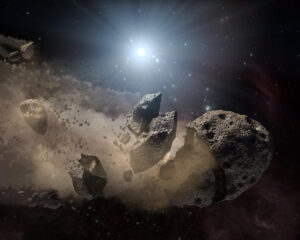 An asteroid bites the dust around a dead star. NASA
Three Different Types of Meteorites
Unlike Earth rocks, meteorites contain some of the original materials that caused planets to form in our Solar System. They typically have a melted exterior appearance and are shiny, the result of their super-hot trip through Earth’s atmosphere.
Three different types of meteorites are found on Earth: iron, stony and stony-iron meteorites. Most meteorites fall into the stony category and are mostly made up of silicate minerals. Iron meteorites are believed to be from melted asteroid cores, while stony-irons contain iron-nickel metal and silicate minerals. Scientists can compare meteorites with observations of asteroids to determine which types of asteroids are their likely parent bodies.
Scientists study meteorites to learn more about the birth of the Solar System, and even about the origins of life itself. In 2015, NASA discovered that organic compounds found in DNA and RNA have origins in some of the chemicals discovered in meteorites. Other researchers have since learned that some 4.5 billion-year-old meteorites once contained liquid water and complex organic substances necessary for the creation of life. All this and other similar discoveries have led to theories that life on Earth had its origins in outer space, specifically from one of those spinning rocks we know as asteroids.
Frequently Asked Questions About Asteroid Belt Rocks
What are asteroid belt rocks?
Asteroid belt rocks are the rocky, metallic and carbon-rich materials that make up asteroids in the main asteroid belt between Mars and Jupiter. Many are remnants of material left over from the formation of the Solar System about 4.6 billion years ago.
What are asteroid belt rocks made of?
Asteroid belt rocks have different compositions. C-type asteroids are generally carbon-rich and contain clay and silicate materials; S-type asteroids contain silicates and nickel-iron; and M-type asteroids are primarily metallic.
Are asteroid belt rocks the same as meteorites?
Not exactly. A meteorite is a piece of space rock that survives passage through Earth’s atmosphere and reaches the ground. Most meteorites found on Earth originated as fragments of asteroids, making them valuable samples of asteroid material.
Why are asteroid belt rocks important?
Asteroid belt rocks preserve evidence from the early Solar System. Studying their composition and geology helps scientists understand how planetesimals formed, how collisions changed them and how the rocky planets—including Earth—developed.
How old are asteroid belt rocks?
Many asteroid belt materials formed about 4.6 billion years ago, when the Solar System was forming. Some asteroids have also experienced later melting, collisions and other geological processes that changed their original materials.
Can asteroid belt rocks hit Earth?
Fragments from asteroids can reach Earth as meteorites, and some asteroids have orbits that bring them near or across Earth’s orbit. NASA monitors near-Earth asteroids and develops planetary-defense technologies to identify and respond to potential impact hazards.
Final Thoughts
Asteroid belt rocks are more than fragments of ancient material circling the Sun. They are surviving pieces of the Solar System’s formative history. Their minerals, metals, textures and collision scars record processes that also shaped the planets.
Meteorites give scientists an opportunity to study some of this material directly in laboratories, while spacecraft such as NASA’s missions to Vesta, Psyche and other asteroids reveal how these small worlds evolved. Together, these studies help scientists reconstruct how planetesimals formed, collided and eventually contributed to the larger bodies of the Solar System.
In that sense, the rocks of the asteroid belt offer something Earth’s constantly changing surface cannot: a preserved record of the raw materials and violent processes that helped build our planet.
Want to deepen your gemstone knowledge? Subscribe to Rock & Gem magazine for expert insights, collecting tips and discoveries delivered to your inbox and mailbox. Asteroid Belt Rocks story by Audrey Pavia