
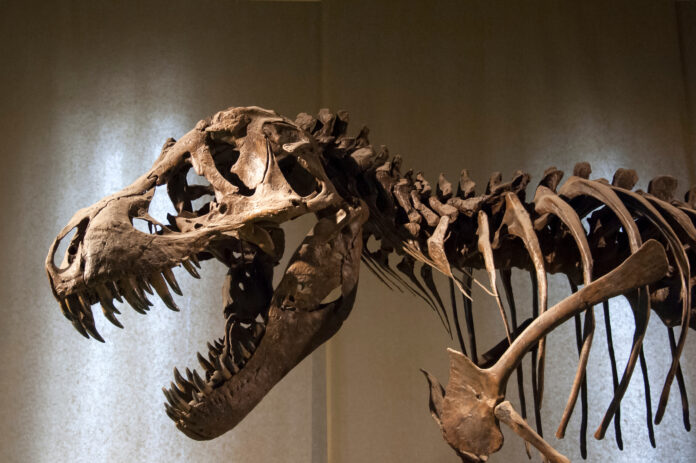
Looking for a handy list of state dinosaurs? We’ve got you covered! This list of state dinosaurs highlights the official dinosaur designations and the fascinating stories behind them. New types of dinosaurs are always being discovered as scientists dig for dinosaur bones. It’s fun to see who made the list.
In 2022, Massachusetts became the latest state to announce an official dinosaur. Podokesaurus holyokensis (fleet-footed lizard) was discovered in 1910 in western Massachusetts by Mount Holyoke College professor Mignon Talbot. This find made her the first woman in America to find, discover, name and describe a dinosaur!
The following list of state dinosaurs includes every state that has officially designated a dinosaur or dinosaur-related fossil. Not every state has an official dinosaur. For instance, Montana has a dinosaur trail, but not a state dinosaur. Find out who made the cut and why.
List of State Dinosaurs: Key Takeaways
-
- This list of state dinosaurs includes every U.S. state with an official dinosaur designation.
- Some state dinosaurs are known from fossils discovered within state borders, while others were selected because of important fossil tracks or historical significance.
- Massachusetts became one of the newest additions to the list when it named Podokesaurus holyokensis its official state dinosaur in 2022.
- Several states recognize famous dinosaurs such as Stegosaurus, Triceratops and Dilophosaurus.
- Many states, including Montana, have significant dinosaur fossils but have not designated an official state dinosaur.
Arizona
Sonorasaurus thompsoni (2018)
This “Sonoran lizard” was named after geology student Richard Thompson. He didn’t rely on trace fossils to identify his find; instead, he found a nearly complete skeleton weathering out on a rock wall in an unexplored region of the Sonoran Desert in southern Arizona in 1994. This brachiosaurus was almost named “Chihuahuahsaurus,” but paleontologist Ronald Paul Ratkevich with the Arizona-Sonora Desert Museum thought that made this dinosaur sound like a tiny dog.
Arkansas
Arkansaurus fridayi (2017)
In 1972, circling vultures led Locksburg, Arkansas, service station owner Joe B. Friday to some odd bones poking out of a gravel ditch after local roadwork. He dug them up – three claws, four phalanges, and three metatarsals – to display in his station. While on display, they caught the attention of paleontologist, Dr. James H. Quinn, who determined them to be related to Ornithomimus and presented them at the 1973 Geological Society of America Meeting. Before Quinn could formally name his six- to 15-foot-tall omnivore (plant and meat eater), he died while fossil prospecting in Nevada. The bill to name Arkansaurus fridayi as the State dinosaur was proposed by high school student Mason Cypress Oury.
California
Augustynolophus morrisi (2017)
California is known for the La Brea Tar Pits and the dinosaur fossil finds there. This dinosaur combines the names of the Augustyn family (friends of the Los Angeles County Museum) and paleontologist William Morris, with dinosaur relative, Saurolophus. Discovered in the Moreno Formation, the only known specimens of this herbivorous hadrosaur have been found in California, making it the perfect official state dinosaur.
Colorado
Stegosaurus (1982)
Since 1982, Stegosaurus, the “covered lizard,” has technically been the official state fossil, not dinosaur, of Colorado. The first (1876) stegosaurus fossils were found in Colorado and the Denver Museum of Nature & Science even displays a skeleton unearthed by a local teacher and Canon City High School students. The brain in the head of this 10-ton giant was the size of a walnut, but research suggests a second, larger brain was in its… hindquarters!
Connecticut
Dilophosaurus wetherilli (2017)
This “two-crested lizard” was among the earliest large predatory dinosaurs, thanks to its serrated teeth. It is the largest known North American land animal of its time. Today, it enjoys top billing among Jurassic Park characters, where a smaller version was given the fictional ability to spit venom and expand its neck frill. It was designated the state dinosaur of Connecticut based on tracks found there.
Delaware
Dryptosaurus aquilunguis (2022)
This “tearing lizard” lived over 60 million years ago. It was a two-ton carnivorous dinosaur that dominated the late Cretaceous period. Named by Othniel C. Marsh in 1877, Dryptosaurus is among the first theropods known to science.
Maryland
Astrodon johnstoni (1998)
This dinosaur’s scientific name, Astrodon, means “star tooth.” Found in 1859 by John D. Latchford in his open iron ore pit near Prince George’s County, this plant-eating sauropod is the second dinosaur species ever identified in the United States. In 1998, it was named after Baltimore Dental College professor Christopher Johnston, who sectioned the first Astrodon johnstoni tooth and discovered the star pattern inside.
Missouri
Hypsibema missouriensis (2004)
Originally called Neosaurus missouriensis, then Parrosaurus missouriensis, one thing is sure: Missouri loves its 10-foot-tall, three-ton, duck-billed, plant-eating state dinosaur. The first bones – 13 vertebrae of a tail – were found in 1942 while digging a family cistern near Glen Allen. It marked the first and only dinosaur remains found in Missouri. When House Bill 1209 went into effect in 2004, Missouri became the sixth state to have an official dinosaur, and in 2008, a full-size H. missouriensis went on display at the Bollinger County Museum of Natural History.
New Jersey
Hadrosaurus foulkii (1991)
This duckbilled dinosaur was found by John Hopkins in 1858 while digging in a Haddonfield marl pit. More than 75 million years old, it became the first dinosaur species identified in North America from more than teeth. Thanks to write-in campaigns by Mrs. Berry and her fourth-grade class at Strawbridge Elementary School in Haddon Township, Hadrosaurus was named the state dinosaur in 1991.
Oklahoma
Acrocanthosaurus atokensis (2006)
This “high-spined lizard” lived across North America during the Early Cretaceous period. Fossil remains of the spiny predator have ranged from Maryland to Wyoming. At roughly 40 feet in length and weighing in at about four tons, Acrocanthosaurus was the largest theropod in its ecosystem. Its name comes from the Greek words for “thorn” and “lizard,” and Atoka County in Oklahoma, where the first fossils were found. The largest and most complete skeleton, nicknamed ‘Fran,’ was recovered from the Antlers Formation of Oklahoma and now resides in the North Carolina Museum of Natural Sciences.
Texas
Sauroposeidon proteles (2009)
When the first fossil remains of this “lizard earthquake god” and the last known North American sauropod were found in 1994, they were so old and unusual in size that they were misidentified as petrified wood. Further analysis has since ranked it among the longest (110 feet), heaviest (60 tons), and tallest (55 feet) of all known dinosaurs. The reference to earthquakes comes from the notion that its weight was so great it must have made the ground shake as it walked.
Utah
Utahraptor ostrommaysorum (2018)
Its name means “Utah’s predator,” and this Early Cretaceous period carnivore was roughly the size of a modern grizzly bear. The first fossils were found in 1975 near Moab but didn’t gain attention until 1991, when a large foot claw was uncovered in Gaston Quarry in Grand County. Originally to be named after film director Steven Spielberg, Ostrommaysi was chosen instead, in honor of paleontologist John Ostrom and Chris Mays, founder of robotics effects company Dinamation International.
Wyoming
Triceratops horridus (1994)
Named for its “three-horned face,” this frilled herbivore was among the last non-avian dinosaurs to disappear during the Cretaceous-Paleogene Extinction 66 million years ago. The first fossils of this dinosaur superstar, who has appeared in films and on postage stamps, were misidentified as belonging to a very large and unusual bison. Six years before becoming Wyoming’s State Dinosaur, it was named the State Fossil of South Dakota.
How States Choose Official Dinosaurs
Official state dinosaurs are typically selected because of their connection to a state’s fossil history. In many cases, the dinosaur was discovered within the state’s borders or is represented by important fossil finds found there. Some state dinosaurs are chosen through legislative action, while others gain support through grassroots campaigns led by students, educators and local paleontology enthusiasts. As this list of state dinosaurs shows, each designation reflects a unique piece of scientific and cultural history.
Why Don’t All States Have Official Dinosaurs?
Although dinosaur fossils have been discovered across much of the United States, not every state has adopted an official dinosaur. Establishing a state dinosaur generally requires legislation and public support, so many states with significant fossil discoveries have simply never pursued the designation. Montana, for example, is famous for producing some of the world’s most important dinosaur fossils, yet it does not have an official state dinosaur. As interest in paleontology continues to grow, this list of state dinosaurs may expand as additional states make official selections.
FAQ: List of State Dinosaurs
How many states have official state dinosaurs?
As of publication, 13 states have designated an official state dinosaur or dinosaur-related fossil. Additional states may adopt official dinosaurs in the future.
Which state was the most recent to name an official dinosaur?
Massachusetts named Podokesaurus holyokensis its official state dinosaur in 2022, making it one of the newest additions to the list of state dinosaurs.
What was the first state to adopt an official dinosaur?
Colorado was among the earliest states to recognize a dinosaur fossil when it designated Stegosaurus as its official state fossil in 1982.
Does every state have an official dinosaur?
No. Many states with significant dinosaur discoveries have not designated an official dinosaur. Montana, for example, is famous for dinosaur fossils but does not currently have a state dinosaur.
What is the most famous dinosaur on the list of state dinosaurs?
Some of the best-known dinosaurs on the list include Stegosaurus (Colorado), Triceratops (Wyoming) and Dilophosaurus (Connecticut), all of which have appeared in museums, books and popular media.
Why do states choose official dinosaurs?
States often select official dinosaurs to celebrate important fossil discoveries, recognize local paleontological history and encourage interest in science and natural history.
List of State Dinosaurs: Final Thoughts
From giant sauropods and horned herbivores to swift predators, this list of state dinosaurs highlights the remarkable fossil discoveries that have shaped our understanding of prehistoric life. While only a handful of states have officially adopted a dinosaur, each designation reflects a unique piece of local history and scientific discovery. As paleontologists continue to uncover new fossils, the list of state dinosaurs may continue to evolve, giving future generations even more prehistoric stories to explore.
This list of state dinosaurs article previously appeared in Rock & Gem magazine. Click here to subscribe! Story by L.A Sokolowski.