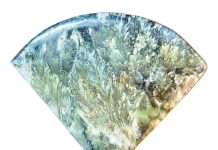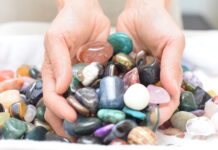

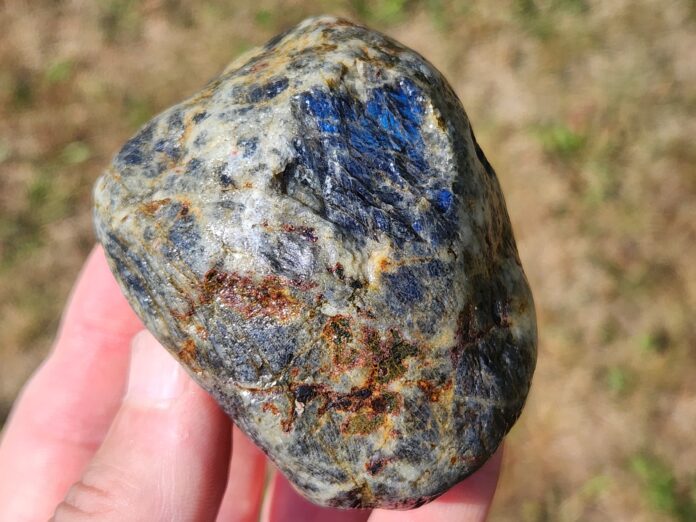
Labradorite is a variety of plagioclase feldspar that is dark gray to black in ordinary or low light, but it often has a brilliant play of colors when the right surfaces are exposed to sunlight. These colors result from a type of iridescence that occurs in labradorite feldspar, so it is often referred to as labradorescence. The colors can be vibrant and include blue, green and gold, and the colors shift as the mineral is moved. Labradorite with good color, also known as schiller, is a highly desirable gemstone.
Key Takeaways
- Labradorite is a plagioclase feldspar known for its iridescent “labradorescence.”
- Northern New York’s Ausable River system exposes labradorite-bearing anorthosite from the Adirondacks.
- The best collecting conditions are low water and strong sunlight, which reveal blue flashes in river cobbles.
- Upper Jay and Jay (Ausable River) are accessible public sites where float material can be found in streambeds.
- Most collectible pieces are small cobbles or fragments, often less than an inch across.
- Labradorite’s color effect is caused by internal lamellae that scatter and reflect light at different angles.
The Feldspar Group
Feldspars make up nearly 60% of the Earth’s crust and are important rock-forming minerals. Virtually all rocks, except for carbonates and other precipitate rocks, have some percentage of feldspar. Feldspars are silicate minerals, and they are primarily silicon, oxygen, aluminum, sodium, potassium and calcium.
Feldspars are divided into two main groups — alkali feldspars and plagioclase feldspars. Alkali feldspars are potassium and sodium aluminum silicates and include minerals such as orthoclase, microcline and sanidine. Alkali feldspars are commonly found in granite, syenite and pegmatite.
Labradorite Mineralogy
Plagioclase feldspars are sodium and calcium aluminum silicates. They form a continuous series of solid solutions between albite, which is the sodium end-member, and anorthite, which is the calcium end-member. Plagioclase feldspars are prevalent in basalt, gabbro and anorthosite. Key members include albite, oligoclase, andesine, labradorite, bytownite and anorthite. Plagioclase feldspars are generally gray to greenish-dark gray.
Moonstone, sunstone, and labradorite are the main feldspar gemstones. Labradorite gets its play in colors from mineral layers that separated as the rock cooled from the original melt. These layers, known as lamellae, have slightly different refractive indices, and light that enters the crystal is subject to multiple reflections, which yield the colors seen in labradorite.
Labradorite Occurrence
Labradorite was known to the ancient Inuit people of the Arctic, who noted its resemblance to the Northern Lights. In 1771, a Moravian missionary in Nain, Jens Havens, sent some of the colorful stones to Germany. They were called “Labrador stein,” and some pieces were also sent to England, where they were called “Labrador stone” or “firestone.” The German geologist Abraham Werner thought they were a new mineral species, and in 1820, the French mineralogist François-Sulpice Bedant determined the rocks were feldspars with the characteristics of albite and anorthite and named the rock “labradorite.”
Many attempts were made to quarry labradorite, but the remote locations of the quarries and harsh weather made it difficult. The first reported attempt at commercial quarrying was in 1896, and the last operating quarry, which was in Nain, closed in 2010. The mining and collecting activities at Tabor Island, which was likely the original source of labradorite, are strictly controlled by the Labrador Inuit Association. These locations are remote and can only be reached by boat or helicopter.
Global Sources of Labradorite
While its name is from Labrador, labradorite is found worldwide. Notable occurrences are in Norway, Finland, Iceland, China, Australia, Slovakia, Poland, Mexico, Italy, Russia and Madagascar. Ironically, Madagascar labradorite is often sold in Canada and marketed as labradorite from Labrador. While the Madagascar labradorite is also a similar feldspar with color, it is not from Labrador. If you purchase any labradorite, be sure to stick with a reputable dealer and be aware that it may not be from Labrador.
In the United States, labradorite is found in California, Oregon and northern New York. Oregon occurrences are reportedly mainly sunstone, which is desirable but not exactly labradorite. However, Northern New York has many sites with labradorite. While it is not comparable to the quarry sources in Labrador and Madagascar, it is more accessible and relatively easy to find.
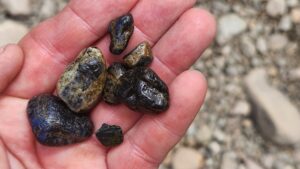
Ausable River Labradorite Geology
The Ausable River drains the northeastern Adirondacks before emptying into Lake Champlain and flows through some of the most scenic parts of the Adirondacks. The river drains many sections of Adirondack bedrock, including the Marcy Massif. The Marcy Massif is primarily anorthosite, which is an intrusive rock that is mainly calcium plagioclase feldspar. The Marcy Massif has sections with the right composition to form labradorite.
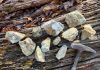
Finding labradorite with good colors is easy in parts of the Ausable River and many of the streams that drain the Adirondacks. The rocks with labradorite are the loose cobbles and rocks that line the streambed and banks of the Ausable River and creeks where it has flowed through the Marcy Massif and related rocks. The labradorite-bearing rocks are generally rounded and light to dark gray, and you can often see distinct plagioclase phenocrysts in the rocks. While the rocks are found throughout much of the Ausable River, it can be challenging to find a safe place to park and access areas for collecting, and not every section of the river has the right rocks.
Collecting Labradorite at Upper Jay
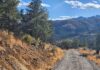
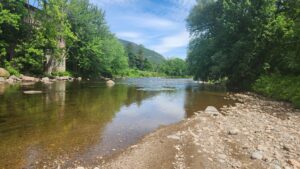
In June 2024, I visited some key locations for labradorite. The first location was at Upper Jay. State Highway 9N crosses the Ausable River at Upper Jay, and there is a parking area next to a cafe. I parked near the river and walked down to the bank, which had a broad expanse of rounded rocks, many of which were anorthosite pebbles and cobbles.
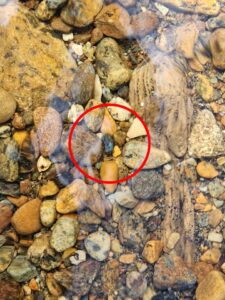
I watched several YouTube videos on collecting labradorite in the Ausable River. They suggested the best way to find labradorite was to walk in the shallow parts of the river and look for flashes of blue color when the sunlight was on the water. Fortunately, the sun was very bright, and I quickly found many pieces of labradorite with flashes of blue. They were easy to spot, and the water was shallow. The pieces were usually small and it was hard to find many that were larger than an inch.
Spotting Labradorite in the River
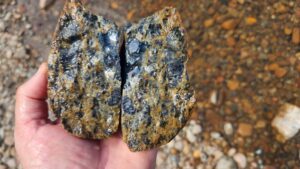
I later explored the rocks on the bank. Labradorite is easy to spot out of the water, as it typically forms large, rounded gray rocks with large phenocrysts of plagioclase. I broke apart several large pieces in search of the blue flashes. Unfortunately, most of the rocks were just dark gray plagioclases and did not have colors. I
t took considerable effort to find rocks on the bank with color, but I was able to find some pieces. In nearly all cases, the blue was limited to small individual minerals in the rock. It was much easier to find pieces in the river, although these were smaller than the larger rocks on the riverbank. Nature did its work in breaking apart the rocks and polishing them in the river, and the sunlight quickly revealed which rocks had color.
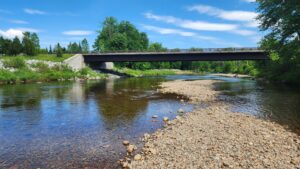
Collecting Labradorite at Jay Bridge
I then went to the locality at Jay, which is featured in many YouTube videos. This area is also just off State Highway 9N and is at the site of the Jay Covered Bridge. Parking on the north side of the bridge is limited, so I parked on the south side of the bridge, which is the site of a park and has much more parking. The site is also known for Jay Falls, which is a series of small waterfalls just upstream of the bridge. This is a popular swimming area, so during the summer, you can expect a lot of traffic.
The collecting at Jay is like that at Upper Jay, and the best collecting is downstream of the bridge. I saw several families on the shoreline. Many of them were also looking for labradorite. I quickly found several small pebbles with blue flashes and walked downstream to sections where the loose rocks formed small islands. I broke apart several of the large rocks and found many with blue color. Unfortunately, many rocks did not have any color and it took some effort to find good pieces.
Other Labradorite Collecting Sites in New York
The Ausable River locations are easy to access, but there are additional locations in northern New York to find labradorite. If you can find parking, other parts of the Ausable River will likely yield labradorite, provided you are in an area with the right rocks. Other localities include the headwaters of the Hudson River upstream from the trailhead at Upper Works near Tahawus, the north bank of The Branch (actual river name) east of Blue Ridge Falls on Blue Ridge Road (State Highway 84), and the base of Roaring Brook Falls on Roaring Brook near State Highway 73.
All these places are along water, so you must be careful if you are with children or anyone prone to falling. The sites have slippery rocks, and it is easy to fall if you are not careful. You should not plan your visits during high water, ice or snow. You also must have strong sunlight to see the flashes of blue. If the day is slightly cloudy, you will not find anything. Likewise, if you visit the sites late in the day and the sun is low or obscured by woods, you will not be able to see the flashes of blue.
Labradorite Collecting Coordinates (Adirondacks)• Ausable River, Upper Jay o Parking: 44°20’08.2”N 73°46’30.4”W o Collecting (both sides of bridge): 44°20’09.2”N 73°46’31.1”W • Ausable River, Jay o Parking: 44°22’20.5”N 73°43’29.2”W o Collecting (downstream of covered bridge): 44°22’22.4”N 73°43’29.0”W • Upper Works, Hudson River: o Parking: 44° 05’ 10.5”N 74° 03’ 20.0”W o River Section (upstream of Upper Works): 44°05’22.9”N 74°03’22.0”W • Blue Ridge Road o Parking: 43°57’23.7”N 73°45’49.9”W o Collecting (on banks of The Branch): 43°57’23.1”N 73°45’50.0”W • Roaring Brook Falls: o Parking: 44° 09’ 01.0”N 73° 46’ 03.0”W o Collecting (base of falls): 44° 09’ 01.0”N 73° 45’ 39.0”W |
Frequently Asked Questions
What is labradorite?
Labradorite is a variety of plagioclase feldspar that shows a color-shifting optical effect called labradorescence.
Where can you find labradorite in New York?
Notable locations include the Ausable River at Upper Jay and Jay in the Adirondack region of northern New York.
Why does labradorite flash blue and green?
The effect comes from microscopic layers inside the crystal that reflect and refract light differently.
Is labradorite easy to collect in rivers?
It can be found in certain streambeds, but visibility depends heavily on sunlight, water level, and experience spotting color flashes.
Is New York labradorite gem quality?
Most material is small and fragmentary, but it can show attractive blue flashes when properly oriented.
Final Thoughts
These localities make great day trips, and you can visit multiple sites in one day as they are in the same region. Start early and make sure you have bright sunlight. If not, there are many other rockhounding sites in the Adirondacks to visit that do not depend on perfect weather and low water.
This story about labradorite from the AuSable River appeared in Rock & Gem magazine. Click here to subscribe. Story and photos by Robert Beard.