
Presidents and geology may not be a pairing most people expect. But several U.S. presidents have had a direct connection to rocks, fossils, and the study of the Earth.
From a first president who recorded limestone and rugged terrain in his land surveys, to a third president who studied Ice Age fossils and debated the identity of a giant ground sloth, to a 20th-century president trained as a geologist, U.S. presidents have repeatedly engaged with the natural sciences in ways that shaped both personal interests and public policy. Add to that a conservation-minded president who helped protect millions of acres of public land, and another who established the National Park Service, and a clear pattern emerges: presidents and geology have long intersected in the United States.
These connections are not always well-known. But they reveal how closely presidents and geology have been tied throughout American history.
Presidents and Geology Key Takeaways
- Several U.S. presidents had meaningful connections to geology, fossils, and earth science, even without formal scientific careers.
- George Washington’s early work as a surveyor included detailed observations of terrain and rock formations.
- Thomas Jefferson studied Ice Age fossils, including Megalonyx, and contributed to early American paleontology.
- Herbert Hoover was a trained geologist who built an international career in mining engineering and resource extraction.
- Theodore Roosevelt’s conservation efforts helped preserve vast public lands with significant geological features.
- Woodrow Wilson signed legislation that helped establish the National Park Service, which protects many fossil-bearing sites today.
- Together, presidents and geology interests have influenced exploration, science, and land conservation in U.S. history.
George Washington’s Early Surveying Work
George Washington (1789-1797) had no formal education in science, but what he did have was experience. His first job out of school, in 1747 at age 16, was as a surveyor on the western frontier. For three years, Washington kept a diary of his survey work, with detailed references to prominent rocks and limestone “…on the side of a Hill in a very stony ground, swampy, a rock ridge.’ He later applied what he learned to his agricultural management at his home, Mount Vernon.
Thomas Jefferson and Early Fossil Discoveries
Thomas Jefferson (1801-1809) mentioned geography and geology in his 1787 Notes on the State of Virginia. He commissioned both the Lewis and Clark expedition to the Pacific Northwest and Zebulon Pike (as in “Pike’s Peak”) to explore the Great Plains.
“The movements in nature,” Jefferson wrote in 1799 in Transactions of the American Philosophical Society, “are in a never-ending circle.”
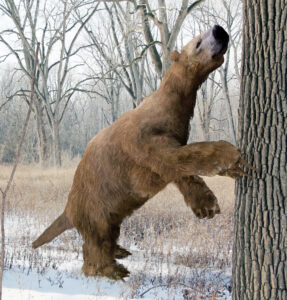
That same year, Jefferson reported on the discovery and excavation of bones from a limestone cavern in Greenbrier County, in what was then Virginia and is now West Virginia. He thought the fossil Magalonyx (“great claw”), belonged to a creature three times the size of an African lion. But after presenting his findings in Philadelphia, while president of the American Philosophical Society, Jefferson reconsidered and declared it to be part of a giant ground sloth, Megatherium, and not a lion.
When elected President in 1801, Jefferson brought his fossil collection to the White House. He dedicated an entire room to spread out and study his Big Bone Lick (Kentucky) collection. This likely included bones and teeth of Pleistocene mammoths and mastodons.
Today, the bones that Jefferson attributed to a giant prehistoric lion have been assigned to Megalonyx jeffersonii, or ‘Jefferson’s ground sloth.’ They are part of the Thomas Jefferson Fossil Collection in Philadelphia at the Academy of Natural Sciences.
Herbert Hoover: Geologist and Mining Engineer
Herbert Hoover (1929-1933) was the only U.S. President with a formal education in geology. A geology major and part of Stanford University’s first graduating class, Hoover worked his way through school by typing papers for its first professor. This professor was John Caspar Banner, a noted geologist who had discovered bauxite in Arkansas in 1887. Banner gave Hoover his first summer job. Hoover mapped terrain in the Ozark Mountains and Yosemite National Park. Here he met his future wife and only female geology student at Stanford, Miss Lou Henry.
Hoover grew a beard to look more mature and stretched the truth about his age. At 23 years old, Hoover convinced the British mine engineering firm Berwick Moreing and Company, Ltd., to hire him to go to Western Australia during its gold rush.
There, Hoover earned a reputation as the ‘doctor of sick mines,’ by improving their production. In 1905, he founded Australia’s Zinc Corporation and the ‘Lyster Process’ of flotation to separate zinc and lead. In 1909, Hoover and his wife published Principles of Mining: Valuation, Organization and Administration: Copper, Gold, Lead, Silver, Tin and Zinc, which stood for decades as the standard textbook on mining engineering. Their book was awarded the first gold medal from the Mining and Metallurgical Society of America and is still available online from the Gutenberg Project at www.gutenberg.org/ebooks/26697.
Theodore Roosevelt and Conservation of Natural Lands
Few could match Theodore Roosevelt (1901-1909) when it came to a passion for the natural world. The National Geographic Society calls his permanent preservation of public lands as national parks, forests, game and bird preserves, “his most lasting and significant legacies to the world.”
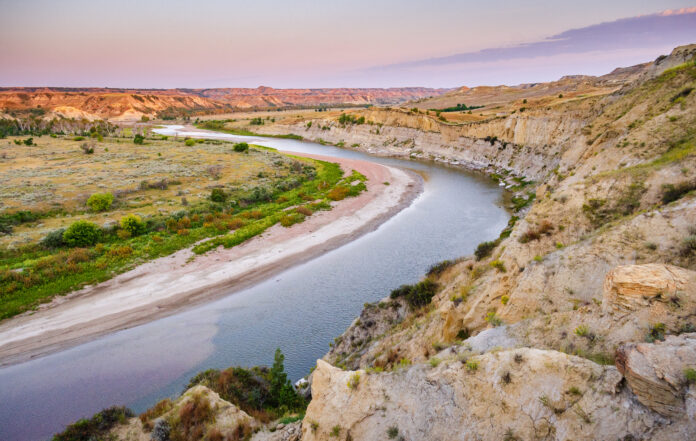
Theodore Roosevelt National Park in North Dakota continues that legacy of geologic information in the North Dakota Badlands, where petrified wood filled with quartz growth rings can still be seen, and where lightning strikes and prairie fires ignite coal beds, resulting in hardened, iron-oxidized sediment known as clinker or “scoria.”
“The Bad Lands,” Roosevelt said, “grade all the way from those that are almost rolling in character to those that are so fantastically broken in form and so bizarre in color as to seem hardly properly to belong to this earth.”
Woodrow Wilson and the National Park Service
On August 25, 1916, the 28th U.S. President, Woodrow Wilson, established the National Park Service to “conserve the scenery and natural and historic objects and wildlife therein, and to provide for the enjoyment of the same in such manner and by such means as will leave them unimpaired for the enjoyment of future generations.”
That same year, the Organic Act directed parks to conserve their natural objects, including fossils. Today, more than 280 National Park Service areas preserve fossils, including at least 16 established wholly or in part because of their fossils.
Want to learn more? The complete Merriam, Dan (2012) “U.S. Presidents and their Geological Thinking,” The Compass: Earth Science Journal of Sigma Gamma Epsilon: Vol. 84: Issue 2, Article 3 is available free with open access at: https://digitalcommons.csbsju.edu/compass/vol84/iss2/3.
Presidents and Geology Frequently Asked Questions
Which U.S. president was a geologist?
Herbert Hoover is the only U.S. president with formal training in geology. He studied the subject at Stanford University and later worked in mining and resource engineering around the world.
Did any U.S. presidents collect fossils?
Yes. Thomas Jefferson studied and collected fossils, including remains later identified as Megalonyx jeffersonii, a giant ground sloth from the Ice Age.
Which presidents were involved in conservation?
Theodore Roosevelt is best known for conservation, helping establish national parks, forests, and wildlife preserves across the United States.
Did early presidents have any interest in geology?
Yes. George Washington worked as a surveyor in his early career and recorded detailed observations of terrain, soil, and rock formations.
How are U.S. presidents connected to national parks and fossils?
Woodrow Wilson signed the Organic Act that helped establish the National Park Service in 1916, which now protects hundreds of sites with geological and fossil resources.
Presidents and Geology Final Thoughts
While few U.S. presidents are remembered primarily as scientists, many have engaged deeply with geology, fossils, and the natural world in ways that influenced both their personal interests and national policy.
From George Washington’s early surveying notes to Thomas Jefferson’s fossil studies of Megalonyx, from Herbert Hoover’s career as a mining geologist to Theodore Roosevelt’s sweeping conservation legacy and Woodrow Wilson’s establishment of the National Park Service, each example reflects a different way earth science has shaped leadership.
Together, these stories show that presidents and geology in the United States have never been confined to laboratories or field notebooks. It has influenced exploration, land use, scientific thinking, and the preservation of public lands still studied and enjoyed today.
For rockhounds and fossil enthusiasts, that legacy is still visible—embedded in the landscapes these presidents helped document, study, and protect.
This article about presidents and geology was written for Rock & Gem magazine. Click here to subscribe. Story by LA Berry.