
How is opal formed? It begins when water carrying dissolved silica moves through cracks, cavities and other open spaces in rock. Over time, the water evaporates or drains away, leaving behind silica that can harden into one of the world’s most unusual gemstones.
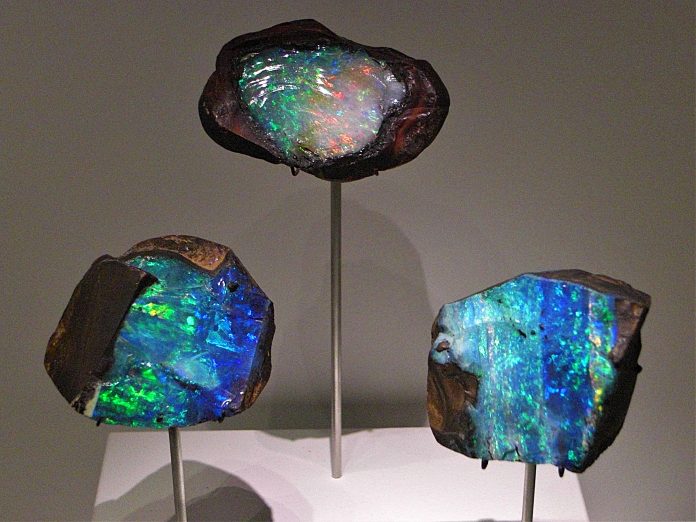
Twist a precious opal in your hand and you may see flashes of red, blue, green and gold. Those colorful fireworks aren’t caused by dyes or pigments. They’re the result of opal’s remarkable internal structure and the way it interacts with light.
How is Opal Formed? Key Takeaways
- Opal forms when silica-rich water fills cracks, cavities or other spaces in rock and leaves behind deposits of hydrated silica.
- Precious opal displays flashing rainbow colors called play-of-color, while common opal does not.
- Tiny, regularly arranged silica spheres inside precious opal diffract light and create its shifting colors.
- Opals can have different body colors, patterns and levels of durability.
- Some opals are natural, while others may be treated, assembled from multiple materials or manufactured in a laboratory.
What Is Opal and How Is Opal Formed?
At its heart, opal is just like quartz. Both are made of silicon dioxide (tiny bits of glass). Opal has a special twist. It holds water!
Because of that water, it can’t grow into perfect crystals like quartz does. Instead, rain or groundwater picks up lots of tiny silica grains as it moves through rocks. When this silica-rich water cools, it turns into a jelly-like gel that oozes into holes or gaps and slowly dries and hardens into opal.
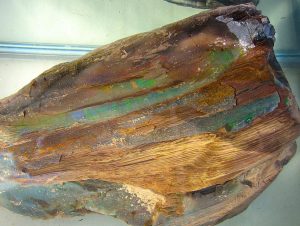
Those cavities can be in soft sandstone or in bubbles left when lava cooled into basalt. In Australia, opal has even filled in spaces where ancient sea reptiles’ bones or clam and belemnite shells once were, making gorgeous fossils.
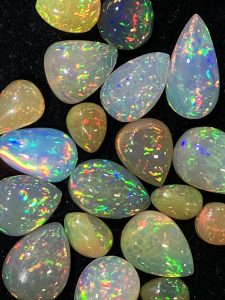
Beware the Blah!
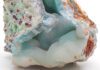
Not all opal is brilliant. Most of it is common opal, also called potch, and is rather blah. It is opaque and milky white, although impurities can stain it most any color. It does have a pearly sheen referred to as opalescence.
How is Opal Formed? Fun Facts
- Opal is the October birthstone.
- In ancient times—and for 2,000 years— Slovakia was a major source of precious opal; today, that would be Australia and, increasingly, Ethiopia.
- Opal was a symbol of power, good luck, and fortune in ancient Rome and was considered a lucky stone in medieval Europe.
- Due to the misfortune an opal brings in Sir Walter Scott’s novel Anne of Geierstein (1829) it became an unlucky stone in Europe and sales plummeted until Queen Victoria took a fancy to it as supplies poured in from Australia.
- Opal is the national gemstone of Australia. Per legend, the Creator came to Earth on a rainbow. Where his foot touched ground, stones came alive with all the colors!
- Two U.S. states have designated opal as their state gemstones: Nevada’s Virgin Valley black fire opal and Mississippi’s green opal.
Why Does Precious Opal Show Color?
The best precious opal is transparent and sparkles with brilliant multi-colored flashes. Why? It all comes down to the refraction of light. White light is composed of waves of many colors. The internal structures of gemstones can interfere with the white light and break it into color waves, absorbing some, emitting others.
Precious opal does have a structural element. Small silica spheres diffract and scatter light waves entering and exiting the stone. Small gaps between spheres mean blues and greens emerge; larger gaps yield yellows, oranges and reds. Those colors shift when viewed at different angles. This is called play-of-color. White light enters; rainbows exit!
Precious opal has color bars, or areas stacked with lattices that hold the play-ofcolor. The thicker and wider the bars, the deeper and more extensive the play-of-color and the more valuable the stone. The most desirable has a full rainbow play-of-color seen across the entire stone.
Opal Patterns• Harlequin – A checkerboard pattern of diamonds or squares, often of multiple colors. • Flagstone – Similar to a checkerboard, but with irregular shapes. • Pinfire – Tiny, densely packed pinpricks of color. • Ribbon – Color in broad stripes and bands. • Flash – Flashes, often of a single color, streak across a stone. |
White or Black: Which is the Better Opal?
White opals have a milky white body tone and are the most common precious opals. Black opals have a gray to black body tone; the darker, the better. They’re considered more valuable than other opal hues because the black tone dramatically highlights flashing colors brilliantly. Think fireworks blasted in the night rather than daylight.
Opal Challenges
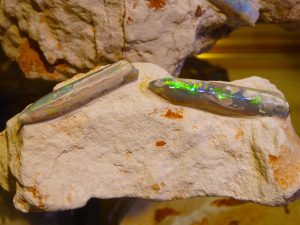
Precious opal is soft (Mohs 5.5-6.5) and easily scratched. Play-of-color may be hair-thin and/or unpredictably spaced. This can be easy to grind away.
An opal’s water content can vary from 3% to 25% and make opals unstable. Some lose their color and “craze” as they dry or when subjected to heat generated by sanding and polishing. Fortunately, many are fairly stable and hold their color. It was common in Australian opal fields to leave freshly dug opals under the sun to see which would prove stable for jewelers.
Altered, Assembled and Manmade Opals
Opals are so valued that folks try to enhance or improve upon nature. Sometimes white opal is treated with sugar, sulfuric acid and heat to make it appear more like black opal.
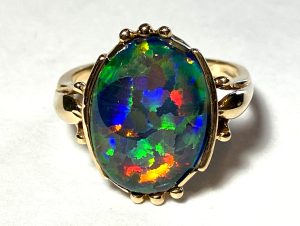
Some opal is delicate, so it’s either glued to a backing or capped with quartz or glass. This is called a doublet and is considered an assembled opal. White opal set on a black backing of onyx, black jade, obsidian, or jet can end up resembling black opal. Spencer opal from Idaho comes in super-thin layers, so folks go one step further. They sandwich that thin opal between a dark backing and a domed quartz cap, producing an opal triplet. The backing provides strength and a black tone, the opal provides color and the domed cap provides protection and magnifies playof-color. The result? A gemstone with the beauty of black opal available at a fraction of the cost.
While altered and assembled opals contain natural opal, manufactured opal is all manmade. Gilson opal is produced in a lab using the same chemistry that formed natural opal. It’s usually easy to spot a synthetic because the color spots often look like large flakes.
FAQs About How Opal Is Formed
How is opal formed?
Opal forms when silica-rich water moves into cracks, cavities or other open spaces in rock. As the water evaporates or drains away, it leaves behind silica deposits that can gradually harden into opal.
Why does precious opal show so many colors?
Precious opal contains tiny silica spheres arranged in a regular pattern. When light passes through and around these spheres, it diffracts, separating into flashes of different colors called play-of-color.
What is the difference between precious opal and common opal?
Precious opal displays play-of-color, or flashes of shifting rainbow colors. Common opal, also called potch, does not show play-of-color.
Is opal a crystal?
No. Unlike minerals such as quartz, opal does not have the orderly crystal structure of a crystalline mineral. It is a form of hydrated silica.
Why do some opals crack or craze?
Opal contains water, and some varieties can become unstable as their water content changes. This may cause tiny cracks called crazing to develop, especially in opals that are less stable.
How is Opal Formed? Final Thoughts
From silica-rich water moving through rock to tiny spheres that bend light into flashes of color, opal is a gemstone with some remarkable science inside. The next time you see a precious opal, move it gently and watch its play-of-color come alive. Those tiny flashes may look like fireworks—but the real story behind them began underground, long before the gemstone was ever discovered.
Want to discover more amazing rocks, minerals, fossils and gemstones? Subscribe to Rock & Gem magazine for stories that explore the science, history and wonder of the natural world. Story and photos about how is opal formed by Jim Brace-Thompson