
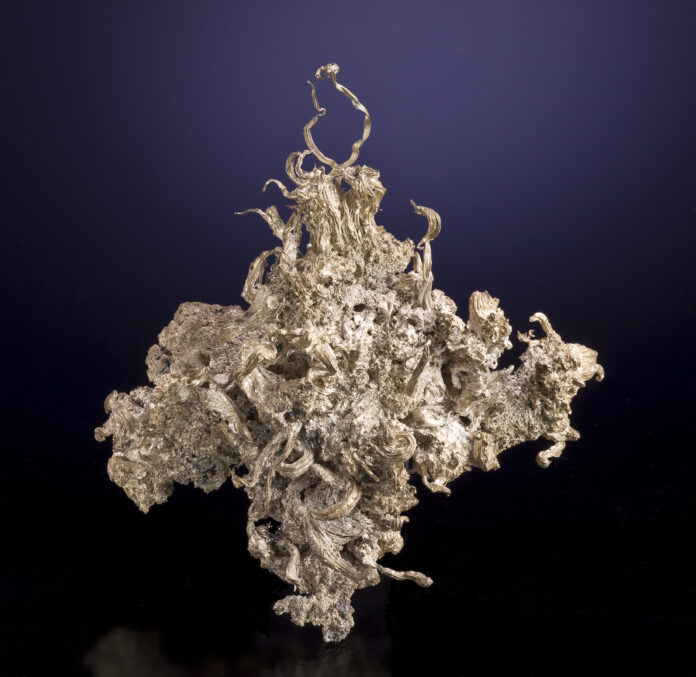
Silver (Ag) is a native element and one of the most recognizable precious metals, prized for its bright metallic luster, malleability and conductivity. Although widely used in jewelry, coins and electronics, naturally occurring silver is relatively rare. It forms in hydrothermal veins and other ore deposits, sometimes appearing as delicate wires, branching crystals and irregular masses embedded in rock. With atomic number 47, silver belongs to the transition metals on the periodic table. Its chemical symbol, Ag, comes from argentum, the Latin word for silver.
Key Takeaways
- Silver is a native element: It occurs naturally as a metallic element, although much of the world’s silver is extracted from silver-bearing ore minerals.
- Silver forms in hydrothermal deposits: Hot, mineral-rich fluids deposit silver in veins and other geological settings as they cool.
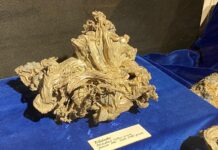
- Native silver is relatively rare: It can appear as wires, branching dendrites, plates and irregular masses, often darkened by tarnish.
- Silver has several important ore minerals: Argentite, proustite and pyrargyrite are among the minerals associated with silver deposits.
- Silver has many modern uses: Its excellent electrical and thermal conductivity makes it important in electronics, solar panels and other technologies.
Historic Silver
Few metals have shaped human history like silver. Mined for over 5,000 years, it has always dazzled with its mirror-bright shine, softness under the hammer and sheer versatility. The earliest workings in Anatolia and the Aegean, around 3000 B.C., produced a metal that quickly became a marker of wealth and power.
By the Classical world, silver’s destiny was clear: coinage. The famous Athenian owl tetradrachms, struck from the veins at Laurion, paid for temples, warships and the foundations of the empire. Rome followed and the denarius became a symbol of Roman reach, spreading silver coinage across Europe and beyond. Saxony’s Freiberg district followed and Bolivia’s mighty Potosí, poured out silver on a scale the world had never seen.
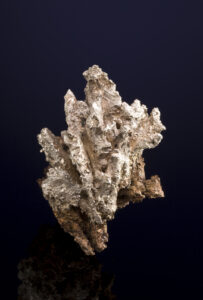
Joe Budd Photo
Silver Formation & Occurrence
Silver forms when hot, mineral-rich fluids move through fractures in rock, depositing metals in the final stages as they cool. These hydrothermal veins often develop in volcanic or tectonic regions where heat and pressure drive mineralization.
Silver commonly appears alongside other metallic minerals such as galena (lead sulfide), sphalerite (zinc sulfide), and chalcopyrite (copper iron sulfide). It also frequently partners with gold. In many deposits, the two metals occur together, alloyed in electrum or intergrown within the same veins.
Silver occurs in a wide range of geological settings. Major deposits are found in Mexico, Peru and Bolivia, as well as in the western United States, particularly in Colorado, Nevada and Arizona. It is also mined from polymetallic veins and replacement deposits in China, Australia and Poland, and from classic vein systems like Kongsberg, Norway, where silver crystallizes as striking wires and branching masses.
Native Silver: Properties & Appearance
Native silver is pure metallic silver. It is rare, even rarer than finding native gold, according to Bob Jones, longtime mineral expert. “How many times have you heard of someone picking up a shiny silver nugget? Even when native silver is found, it may not look much like its natural shiny white color, thanks to its tarnish. It is mostly black. You simply don’t find native silver scattered about, causing a silver rush to happen and prompting people from all over the world to flock to the destination to mine silver.”
When native silver is found, it appears as wire-like crystals, branching dendrites or thin plates embedded in host rock. More commonly, silver is found in ore minerals such as argentite (Ag₂S), proustite (Ag₃AsS₃) and pyrargyrite (Ag₃SbS₃), which are prized by collectors.
The silver used in everyday items is generally not native silver; it is extracted from ore minerals or recycled from other metals through smelting and refining.
Silver Uses & Value
Silver’s story isn’t done yet. It is the most conductive of all metals, making it indispensable for electronics, solar panels, and clean-energy technologies. Demand is rising fast (as is its price!), and geologists and engineers now see silver as a critical material for powering a low-carbon world.
Today, although silver is no longer used in everyday money, collectors fuel value in ancient and modern coins while natural specimens, including branching wires from Kongsberg, curling crystals from Batopilas, and lustrous masses from Freiberg are sought after by rockhounds.
Lore and Metaphysical Meaning
In metaphysical circles today, silver is said to enhance reflection, psychic sensitivity and connection to lunar rhythms. It is also used to celebrate a 25th wedding anniversary.
Frequently Asked Questions About Silver
Is silver a mineral?
Silver is a native element classified as a mineral when it occurs naturally in crystalline form. It belongs to the native elements mineral class and has the chemical formula Ag.
Where is silver found naturally?
Silver occurs in hydrothermal veins, replacement deposits and other mineralized geological settings. Important silver-producing regions include Mexico, Peru, Bolivia, the western United States, Australia, China and Poland. Norway’s historic Kongsberg district is particularly famous for its native silver specimens.
What does native silver look like?
Native silver can appear as thin wires, branching dendrites, plates, irregular masses and crystalline aggregates. Fresh surfaces are silver-white with a metallic luster, but exposure to sulfur compounds often causes tarnishing that darkens the specimen.
Is native silver rare?
Yes. Although silver is mined worldwide, native silver is relatively uncommon. Most commercial silver is recovered from silver-bearing minerals or produced as a byproduct of mining other metals, including lead, copper and zinc.
What minerals contain silver?
Important silver-bearing minerals include argentite (Ag₂S), proustite (Ag₃AsS₃) and pyrargyrite (Ag₃SbS₃). Silver also occurs in association with minerals such as galena, sphalerite and chalcopyrite.
Silver remains an important metal both underground and above ground. Its unusual geological occurrence, distinctive physical properties and association with a variety of ore minerals make it an interesting subject for mineral collectors. From delicate native silver wires to the historic mining districts that produced some of the world’s finest specimens, silver offers a connection between mineral formation, mining history and the materials that continue to shape modern technology.
This story previously appeared in Rock & Gem magazine. Click here to subscribe. Story by Dr. Stuart Mills and Pam Freeman.