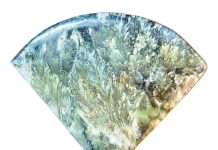

Mineral properties can produce some of nature’s most surprising effects, from rocks that attract magnets or glow under ultraviolet light to gemstones that appear to contain stars, cat’s eyes or even double images. Many of these properties are not only fascinating to observe but also fun to demonstrate and share. To explore them, I’ve pulled together a series of demonstrations I’ve dubbed “The Amazing Mineral Magic Show.” Try them with rock club kids, gem show visitors, students during classroom visits or families at an attention-grabbing Science Night booth.
Mineral Properties: Key Takeaways
- Mineral properties can create surprising visual and physical effects. Some minerals are magnetic, fluoresce under ultraviolet light, split light into two images or reflect light in patterns that resemble a cat’s eye or star.
- Many mineral properties make great hands-on demonstrations. Magnetite, fluorescent minerals, calcite, tiger’s eye, ulexite and pumice can all help illustrate scientific principles in memorable ways.
- Light plays an important role in many special mineral properties. Fluorescence, phosphorescence, triboluminescence, birefringence, chatoyancy and asterism all involve the way minerals absorb, emit, transmit or reflect light.
- Mineral structure affects what we see. Crystal structure, inclusions, aligned fibers and gas bubbles can give minerals their distinctive properties and unusual effects.
- You can turn mineral science into an interactive experience. A collection of specimens and simple demonstrations can become an “Amazing Mineral Magic Show” for classrooms, rock clubs, gem shows and science events.
Magnetism: Feel the Pull!
We’ve all had fun with magnets. Place them near a steel surface, and they literally jump from your hand. They attract and repel other magnets, letting you flip one around with another without them touching. Magnets perform such stunts because they produce a field of force—a magnetic field—caused by the movement of electrons.
Magnetic minerals have a common denominator: iron. But not all iron minerals are magnetic. To illustrate, set a compass on a table and pass a chunk of hematite over it. Nothing happens. Pass magnetite over it, and the compass needle goes wild. Magnetic minerals come in two basic sorts. Most common are those attracted to a magnet, with magnetite as the prime example. A second is naturally magnetized. That is, it’s a magnet itself, as with a variety of magnetite called lodestone. Show kids how magnets stick to both magnetite and lodestone, but only lodestone picks up paperclips.
Magnetic Mineral Experiments
Have more fun by stacking ring magnets on a stick to demonstrate levitation. Another great tool is a pair of woofers yanked from discarded speakers. Woofers contain powerful magnets. I’ve used them for “Bridging the Grand Canyon of Magnetism” (try to build a bridge between two woofers using washers). And for “Dancing Magnets” (stack ball magnets atop a woofer and make them wiggle by waving another magnet above them).
Black sand, like that found in gold panning placer deposits, is composed largely of magnetite grains. Use it for several fun activities. For instance, place a cartoon of a bald man on the bottom of a pan, sprinkle in a bit of black sand, and by moving a magnet from beneath the pan, kids can give the man hair and a beard. I call this demo “Magnetic Barbershop.”
For another demo, dubbed “Find Fuzzy,” fill jars with black sand and see if kids can tempt shy little Fuzzy to emerge from the sand by running a magnet up the side of the jar. Assemble black sand, hematite, magnetite, lodestone and magnets of all sorts, then start experimenting to find fun ways to play.
Fluorescence: Rocks that Glow From Within!
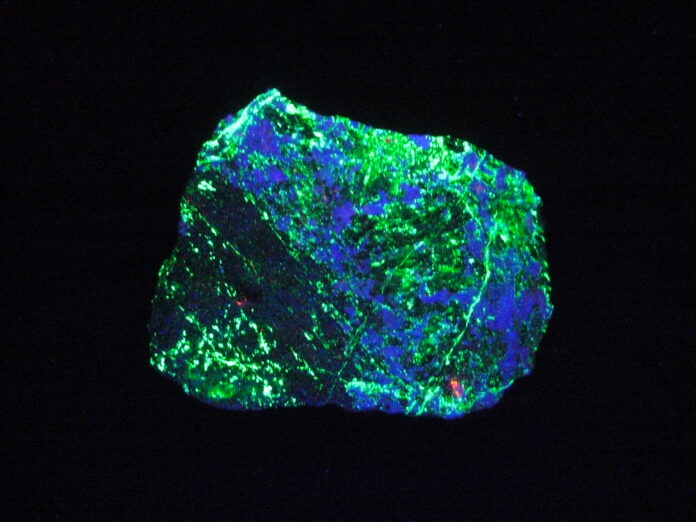
Light moves in waves and comes in different forms depending on the wavelength. We’re most familiar with visible light. Ultraviolet (UV) light moves in waves too short for human eyes to detect. We can see its effects with certain minerals. What appears to be a black and white rock in visible light may glow bright orange and green under UV light. Or a mineral of one color under visible light may appear a different color; green fluorite turns blue. Still other minerals stay the same color but appear more vivid, as with red ruby. In all these instances, under UV light, the minerals seem to glow from within.
English scientist Sir George Stokes first described this phenomenon in 1852. He worked with fluorite, so he called the effect “fluorescence.” Some minerals will absorb UV light, then emit longer, visible light waves, which we see as colors. At the atomic level, UV light causes electrons in some molecules to jump to a higher energy level. In falling back to their normal level, they give off the extra energy in the form of visible light in varied colors.
More Minerals That Glow and Change Color
Kids are especially wowed when, right before their eyes, they see an otherwise dull rock transform into brilliant colors upon waving a UV lamp over it. In fact, the late, great Bob Jones said a fluorescent mineral display during a school museum field trip forever turned him on to the world of minerals.
As you play with fluorescent minerals, you’ll find still more magical properties. Some, like pink Mexican calcite, momentarily hold a faint glow after a fluorescent lamp is switched off. This is called phosphorescence or afterglow. Other minerals, like hackmanite, fade under daylight exposure only to regain brighter colors with UV exposure. This property of changing color intensity with changes in light radiation is called tenebrescence.
Triboluminescence: Put a Spark in the Dark
“Triboluminescence” is a ten-dollar word. Kids (and adults) may need help pronouncing it: tri΄-bō-lu-mə-nə΄-səns. Tribo comes from a Greek word meaning “to rub.” Luminescence is from the Latin word for “light” and is defined as low-temperature emission of light. Thus, triboluminescence is low-temperature light emitted when two materials are rubbed together.
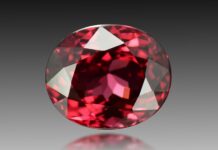
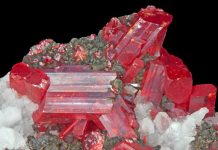
In a darkened room, triboluminescence can take the form of spark-like flashes observed in minerals such as corundum (ruby and sapphire) when a hard point is dragged across their surfaces.
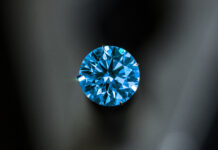
Diamond cutters report occasionally seeing a diamond glow while a facet is being ground. Scientists haven’t fully explained this optical phenomenon, but they believe it’s caused by the separation and reunification of electrical charges at a molecular level when bonds are broken by scratching.
Because rubies, sapphires and diamonds are hard to come by, demonstrate this effect by rubbing together two quartz crystals in a darkened room. This works best with big specimens. Rub two faces together or rub the edge of one crystal back and forth along the flat face of the other crystal.
Birefringence: Double the Fun
“Birefringence” is another long, fancy word. A simpler term is “double refraction.” Draw a line on paper. Place a certain kind of clear crystal over the line, gaze through the crystal and you’ll see two lines! How does that happen?
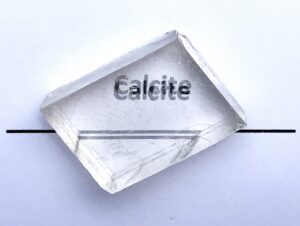
When we direct our eyes at that line, light bounces off the paper and into our eyes, allowing us to perceive the single line. As light travels through certain crystals, the crystal structure splits the light into two rays traveling at slightly different velocities. When they bounce into our eyes, we see a double line, even though our brains know it’s really just one. Pretty freaky!
The mineral most commonly associated with double refraction is calcite, particularly clear rhombohedral calcite crystals known as Iceland spar. You’ll find specimens at nearly every gem show and rock shop.
Chatoyancy: It’s the Cat’s Meow
Some gemstones wink like a cat’s eye or twinkle like a star. Both effects are thanks to chatoyancy, which derives from the French word chatoyer, meaning to shimmer. When these gemstones are rounded and polished, bright light will be reflected as a single thin ray, looking much like a cat’s eye, so chatoyancy sometimes goes by “cat’s eye effect.” It’s caused by inclusions, or minerals enclosed within another mineral. Light entering the host mineral reflects off included minerals.
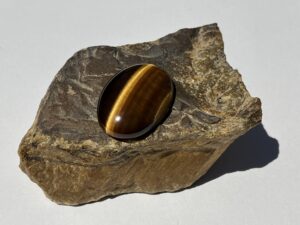
eye effect. Jim Brace-Thompson
When inclusions are fibrous and run parallel to one another, they produce a single line of reflected light running perpendicular to the direction of the fibers. A spool of sewing thread illustrates. Under a light, you’ll see a vertical line running perpendicular to the wound thread. Chatoyancy is enhanced if the stone is rounded, concentrating the light, just as with our spool of thread.
Chatoyant Minerals
Two good minerals for illustrating chatoyancy are golden tiger’s eye quartz and gray-blue hawk’s eye quartz. You can also observe the effect with common fibrous minerals such as satin-spar gypsum or ulexite.
The Greek word aster means “star,” and asterism refers to a luminous star-like pattern appearing on the surface of a gemstone as a result of reflected light. Asterism is similar to cat’s eye. Like cat’s eye, it’s caused by included fibers that run parallel to one another, producing a single line of reflected light. If bundles of such fibers are oriented in two directions, they’ll produce two intersecting eyes, resulting in a four-rayed star.
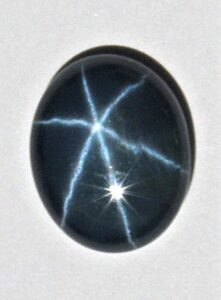
in three directions. Jim Brace-Thompson
Oriented in three directions at 120 degrees to each other, as may happen within hexagonal corundum or quartz crystals, rutile bundles will create three eyes, or a six-rayed star. Gemstones most associated with asterism are star rubies and sapphires, but there are also Idaho star garnets, rose quartz and more.
Ulexite and Natural Fiber Optics: Turn on the “TV Stone”
Near Boron, California, is an immense open-pit mine where borate minerals have been dug since the 1800s for practical applications like laundry detergent. These minerals were concentrated in a basin as ancient lakes dried up in the desert. One of those borate minerals is ulexite. It’s composed of long, thin crystals that might grow as cotton-like puffballs or, more commonly, as blocky masses of fibrous veins with crystals tightly aligned side-by-side.
To demonstrate a neat special effect, use a rock saw to cut a chunk of ulexite perpendicular to those crystal bundles at the top and bottom, then polish both ends. Now have kids place that chunk over a picture. The picture will appear on the top surface of the ulexite, like an image transmitted to a television screen. The individual crystals making up the block of ulexite act like fiber-optic cables. Each transmits light from the bottom surface of the stone to the top surface, thus producing the unique optical property that earned ulexite its nickname “TV stone.”
Pumice Mineral Properties: The Rock That Floats
Both obsidian and pumice are volcanic glass formed from magma that cooled so quickly that no mineral structures were able to form. But pumice is glass that was pumped full of gases while still red hot and molten, making a frothy mass like the foam atop a mug of root beer.
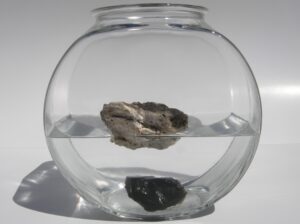
Drop a piece of volcanic glass in the form of obsidian into a fishbowl to show how—as we all know—rocks sink in water. Then, take a piece of volcanic glass in the form of pumice and drop it in. This rock floats. To show why, give kids magnifying glasses to see all those tiny holes created by gas bubbles when the pumice was a hot froth.
To further explain and illustrate, use popcorn. A hard, solid popcorn kernel sinks in water, like obsidian. But apply heat to that kernel and the tiny amount of water inside converts to steam until the kernel pops into a fluffy white bit that floats like pumice.
More Mineral Properties to ExploreHere, in brief, are other special effects to consider for your mineral magic show. Play-of-Color: This phrase describes the vivid multicolored dance across an opal as it’s twisted and turned under light. Adularescence: Labradorite and moonstone feldspars exhibit a milky luster that’s been compared to the moon’s reflection on water. Iris or Rainbow Effect: Some banded agates, when sliced ultra-thin and lit from below, exhibit the colors of the rainbow in a gorgeous, iridescent display. Singing Rocks: Zeolite minerals, like clinoptilolite, are filled with microscopic pores. This makes them great for water filtration. It also makes them great singers. Placed in a bowl with a little water, they crackle and hum and soon begin to whine. |
Frequently Asked Questions About Mineral Properties
What are mineral properties?
Mineral properties are the physical and optical characteristics that help describe and identify a mineral. Some properties, such as hardness, color and luster, are commonly used for identification, while others—including magnetism, fluorescence and birefringence—can produce especially surprising effects.
What minerals are magnetic?
Magnetite is one of the best-known magnetic minerals. Some magnetite is attracted to a magnet, while naturally magnetized magnetite, called lodestone, acts as a magnet itself.
Why do some minerals glow under UV light?
Some minerals absorb ultraviolet light and release some of that energy as visible light, producing the colorful effect known as fluorescence. Certain minerals may also continue glowing briefly after the UV light is removed, a property called phosphorescence.
What causes the cat’s-eye effect in minerals?
The cat’s-eye effect, known as chatoyancy, occurs when light reflects from parallel fibrous inclusions or structures within a mineral. When the stone is cut and polished into a rounded surface, the reflected light can form a bright line resembling a cat’s eye.
What is birefringence?
Birefringence, also called double refraction, occurs when light traveling through certain crystals splits into two rays. When you look through a suitable clear crystal, such as calcite, a single object or line can appear doubled.
Why does pumice float?
Pumice contains countless tiny holes created by gas bubbles in molten volcanic material. These spaces make pumice much less dense than a solid piece of volcanic glass, allowing some pieces to float on water.
What is “TV stone”?
“TV stone” is a nickname for fibrous ulexite. When the aligned fibers are cut and polished properly, they transmit light from one end of the specimen to the other, allowing an image beneath the stone to appear on its upper surface.
Mineral Properties That Seem Like Magic
Mineral properties offer plenty of opportunities to turn geology into a hands-on experience. Whether you are watching magnetite respond to a magnet, seeing an ordinary-looking rock glow under UV light or discovering how ulexite can transmit an image, each effect reveals something about a mineral’s composition or structure. Gather a few specimens, experiment with their properties and create an Amazing Mineral Magic Show of your own.
Want to discover more fascinating mineral properties and the science behind rocks, minerals and gemstones? Subscribe to Rock & Gem for expert collecting tips, mineral identification, lapidary techniques, rockhounding destinations and more. Mineral properties article by Jim Brace-Thompson.