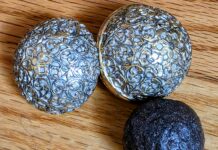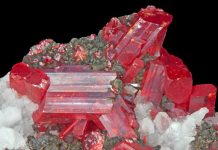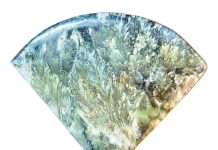

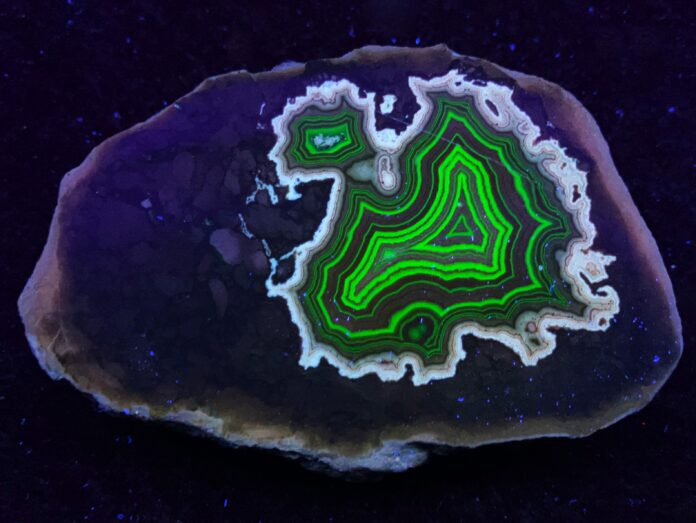
A fluorescent agate offers collectors a hidden bonus: It glows under ultraviolet light. Agates are considered a “gateway rock” in the collecting world because they are widespread, easy to find and usually inexpensive to purchase. They also come in the full color spectrum and can contain wonderful patterns and inclusions. Get a fluorescent agate, however, and you may end up with a “twofer” for your collection—one beautiful specimen in ordinary light and another under UV.
Key Takeaways
- Fluorescent agates glow under ultraviolet light, revealing colors that may not be visible in ordinary light.
- Not all agates fluoresce, and some varieties are more consistently fluorescent than others.
- Sweetwater agates, Dryhead agates, Laguna agates and several other varieties are known for fluorescence.
- Short-wave and long-wave UV light can produce different results, depending on the specimen.
- Trace impurities called fluorescent activators cause the glow; in some green fluorescent agates, the activator is associated with uranyl ions.
- Fluorescent agates can add another dimension to a rock collection and may even reveal hidden features in specimens you already own.
What Is an Agate?
Technically speaking, agate is a cryptocrystalline variety of quartz (silicon dioxide) known as chalcedony. Cryptocrystalline means the crystals composing it are so tiny that no distinct crystal patterns are visible even at high magnification.
Agate forms when minerals in water slowly build up inside spaces in other rocks—like tiny cracks, gas bubbles, or holes in lava and limestone. Over time, these minerals harden into beautiful layers of stone. Sometimes agate forms in even rings, and other times it looks cloudy, mossy, or full of colorful patterns. The colors come from tiny bits of other materials, like metal oxides, that mix in while the agate is growing.
Which Agates Fluoresce?
Even bland and drab agates can hold an inner beauty that glows under UV light. Fluorescence itself is a rare phenomenon. It’s said that only 10 to 15% of all minerals that have been identified fluoresce. Fluorescent agates are even more rare. Some, like Sweetwater agates, always fluoresce under UV light; others, like most Lake Superior agates, do not. Most often, the colors range white to yellow, orange, green, and blue.
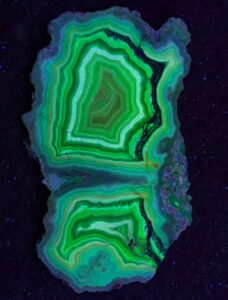
Types of Fluorescent Agates
Here’s a list of some of the more famous places to find fluorescent agates.
- Sweetwater moss agates from Wyoming
- Chalcedony desert roses from California and Arizona deserts
- Patagonian agates, particularly Crater agates but also Condor agates
- Graveyard Point seam agate from the Idaho/Oregon border
- Dryhead agate from Montana’s Pryor Mountains
- Laguna agates from Chihuahua, Mexico
- Baker Ranch thundereggs from Deming, New Mexico
- Youngite agate from Guernsey, Wyoming
What is Fluorescence?
Fluorescence happens when a mineral glows a different color under ultraviolet (UV) light than it does in normal light. Light comes in different kinds of waves — infrared, visible, and ultraviolet. We can only see visible light with our eyes. UV light has waves that are too short for us to see, but we can see its effects with some special minerals. These minerals absorb the invisible UV light and then give off longer light waves that we can see — that’s what makes them glow with bright colors!
Short-Wave vs. Long-Wave UV Light
UV light is usually divided into short-wave and long-wave. Which works best? It depends on the rock or mineral you’re examining. In general, I’ve found short-wave works best with fluorescent agates, but some will change color if you switch to long-wave. So, you’ll want lamps that allow for both.
What Makes an Agate Fluoresce?
When an agate glows under UV light, it’s not the agate that’s fluorescing; it’s usually a trace amount of an impurity that’s fluorescing. Such impurities are known as fluorescent activators.
When I say “trace amount,” I really do mean just a trace. The percentage of the activator can be very, very small, indeed. Sometimes it’s as low as one part in ten thousand or even one part in 10 million. Usually, it’s about 0.1%. Some fluorescent agates will glow only one color, while others, especially banded agates, may glow different colors, with different activators in the different bands.
The three most important activators are manganese, rare earths and uranium. In agates, the activator is usually very slight traces of uranium, or the uranyl ion, which produces a green glow.
Is Uranium in Fluorescent Agate Dangerous?
Chris Clemens, a retired research scientist, conducted a study involving 16 uranyl-activated green fluorescent specimens from his personal collection. He measured radioactivity with a Geiger counter and reported that even chalcedony specimens glowing the brightest green “did not emit detectable levels of radioactivity.” In fact, of all the rocks he tested, “few emitted radioactivity above background.” His conclusion? “With infrequent handling and safe storage, natural radioactive minerals do not usually pose much risk.”
Rather than take Clemens’ word for it, I tried my own experiment. A friend of mine has a Geiger counter, and he hovered it over my fluorescent agates. Some did produce an occasional click or two, but that was it. As a sort of control, we compared it to my granite countertop (not a blip) and to my thumbnail radioactive autunite. The clicking went off the charts as the needle swung wildly. Sweetwater agates, which are highly fluorescent, are said to contain more uranyl ions than other agates, so we especially turned our Geiger counter on them. Yes, a click or two, but it barely registered, and the needle didn’t even move.
What Causes Other Fluorescent Colors?
White, yellow, and light orange are quite common in agates. What causes those colors? Unfortunately, the books I’ve consulted don’t say. I guess they don’t consider those colors to be as dramatic for photos as the green glow emitted by Sweetwater or Dryhead agates. There was one report that calcite inclusions might cause red or orange fluorescence. I’ve also seen online discussion threads suggesting hydrocarbons or manganese for producing those yellow and orange glows, but they all end with the writer professing, “I really don’t know.” Maybe it’s an opportunity for you to someday write your own book on this subject!
How to Find Fluorescent Agates in Your Stash
Use a fluorescent lamp to check out your own collection and see if you have any agate “twofers.” How many of your specimens glow and in how many colors and shades? What difference does long-wave versus short-wave UV lighting make?
If agates in your area are fluorescent, get yourself a portable UV lamp, preferably with both short and long wavelengths, and go agate hunting at night. Check with local rock clubs or local rock shops to find the best locations. Be careful, though, if you live in the desert. Scorpions beautifully glow blue-green under UV light, so watch what you reach for!
Warning! Do not look into the UV light. Short-wave can “sunburn” your skin and eyes, so you should limit the time spent with UV light. It’s better to be safe, not sorry. And then? Have fun!
Frequently Asked Questions
Do all agates fluoresce?
No. Fluorescence is uncommon among agates, and even within a particular variety, specimens may respond differently under ultraviolet light. Some varieties, such as Sweetwater agates, are especially well known for fluorescence.
What color do fluorescent agates glow?
Fluorescent agates can glow white, yellow, orange, green or blue under UV light. A single banded agate may even display more than one fluorescent color if different trace impurities are present in different layers.
What makes an agate fluoresce?
The fluorescence usually comes from trace impurities called activators rather than from the chalcedony itself. In some green fluorescent agates, uranyl ions are believed to be responsible for the glow.
Do I need short-wave or long-wave UV light to find fluorescent agates?
It depends on the specimen. Some fluorescent agates respond more strongly to short-wave UV light, while others may fluoresce differently under long-wave light. A UV lamp that provides both wavelengths can help collectors compare the results.
Are fluorescent agates radioactive?
Some fluorescent agates contain trace amounts of uranium-related compounds, but fluorescence does not automatically mean a specimen presents a radiation hazard. As with any mineral specimen, sensible handling and storage practices are recommended.
Can I look for fluorescent agates at night?
Yes. A portable UV lamp can help you search for fluorescent agates after dark. Take appropriate precautions when using UV equipment, watch your surroundings and avoid looking directly into the UV light.
Fluorescent Agate Conclusion
Fluorescent agates prove that there can be more to a specimen than meets the eye. A rock that appears ordinary in daylight may reveal an entirely different personality under ultraviolet light, glowing in unexpected colors or displaying patterns hidden from view. Whether you already collect agates or are just getting started, shining a UV light on your specimens may uncover a few surprising “twofers.”
Discover more rocks, minerals, gems and the science behind the natural world. Subscribe to Rock & Gem for collecting tips, field guides, lapidary projects and new discoveries from the world of geology. Fluorescent agate story by Jim Brace-Thompson.