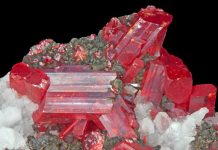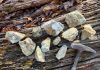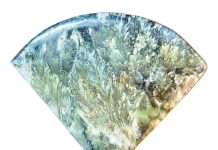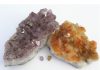

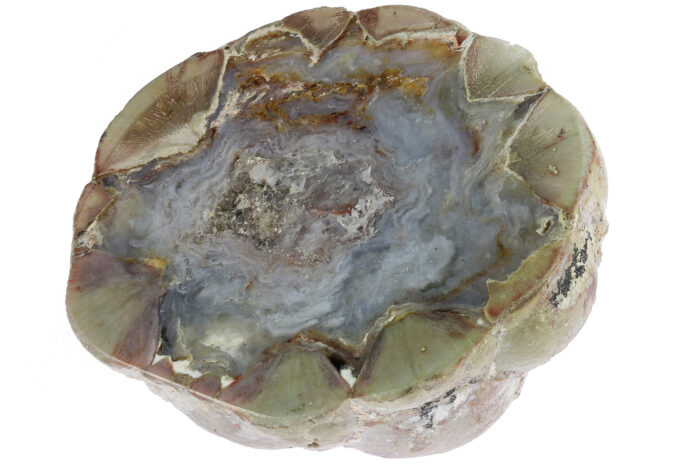
What do emerald, coal, marble, galena, agate and serpentinite have in common? Geologically and mineralogically speaking, not much. Yet all share membership in a rather elite club composed of state rocks, minerals and gemstones. They are “geosymbols” that legislators have formally designated as their states’ official earth materials.
Every state except North Dakota has at least one of these state rocks, minerals and gemstones. Nineteen states have two geosymbols, while fifteen have three. Among the better-known examples are California gold, Missouri galena and Arizona turquoise. Lesser-known geosymbols include Delaware sillimanite, Oregon awaruite and Rhode Island bowenite.
Considered collectively, the list of 97 official state rocks, minerals and gemstones paints an interesting cultural, historical, mineralogical and economic picture of the states themselves—and of the nation as a whole.
Key Takeaways
- State rocks, minerals and gemstones—often called geosymbols—are official earth materials designated by U.S. states.
- Every U.S. state except North Dakota has at least one geosymbol, and many have multiple.
- The system began in 1965 when California designated gold as its state mineral and serpentinite as its state rock.
- States typically choose geosymbols based on geology, economic history, cultural identity or local significance.
- Industrial materials such as coal, granite and limestone are often named as state rocks. State minerals range from metals like gold and copper to collector minerals like wulfenite and rhodochrosite.
- State gemstones are the most diverse category, including precious stones, agates, fossils and even organic materials like pearl and coral.
- Some designations have sparked debate or revision due to classification issues or mineralogical misunderstandings.
- The full list of geosymbols reflects the geological diversity and regional history of the United States.
A Geosymbol History
State symbols, beginning with flowers, first appeared in the 1890s. By the 1920s, naming state birds had become trendy. Since then, states have designated everything from reptiles, animals, insects and fish to fruit, dogs, sandwiches and even cookies as official symbols.
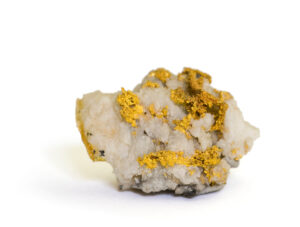
But the mineral world was neglected until 1965, when the California legislature designated gold as its state mineral and serpentinite as its state rock.
The First State Rocks and Minerals
As the historical foundation of California, gold needed little explanation. But not so with serpentinite. Relatively common in California but otherwise rather rare, serpentinite is a metamorphic rock that occurs near tectonic-plate subduction zones and thus, as geologists suggested, was a fitting representation of California’s turbulent tectonic history.
California’s designation of these first two geosymbols had many positive consequences. It promoted interest in the state’s history, geology and mineral resources, while instilling pride in residents and attracting a good deal of national media attention.
Early Adoption Beyond California
Within months, four other states followed California’s lead. Illinois, in honor of the historic production of the Illinois-Kentucky Fluorite District, made fluorite its state mineral, while Oregon designated the thunder egg, a type of geode popular with collectors, as its official rock. Ohio then selected its colorful Flint Ridge flint, a resource long quarried by Native Americans, as its state gemstone, while Michigan named Petoskey stone, a collectible fossilized coral, as its state rock.
But that was just the beginning. In 1967, Arkansas, home to superb rock-crystal sources in its Ouachita Mountains, chose quartz as its official mineral. The Razorback State also designated bauxite, the aluminum ore once regionally mined, as its official rock, and made diamond its official gemstone in a salute to its Crater of Diamonds State Park.
Within three years, 22 states had jumped on the bandwagon to formally designate 36 official geosymbols. And there would be many more to come.
State Rocks
State rocks are arguably the least glamorous of the three geosymbol classes, and also one that has led to confusion. Legislators, sometimes unaware that minerals are naturally occurring elements or chemical compounds and that rocks consist of two or more minerals, occasionally use the words interchangeably.
Today, 29 states have named 30 official rocks, roughly half being major industrial resources. Coal, with its huge economic impact, has fittingly earned state rock status in West Virginia, Utah and Kentucky. Four states claim granite as their state rock—New Hampshire, South Carolina, and Wisconsin for their granite quarries, along with Maine for its gemstone-rich granite pegmatites.
Economic and Common State Rocks
Limestone, used as both dimensional stone and as a feedstock for making cement and lime, is the official rock of four states— Illinois, Kansas, New Hampshire and South Carolina. Marble, which is metamorphosed limestone, is honored in Vermont, Colorado and Alabama. As the only state with two official state rocks, Vermont also recognizes slate. Nevada’s official rock is sandstone, not for its economic importance, but because it hosts the state’s huge deposits of disseminated gold.
Unusual and Unique State Rocks
Among the lesser-known state rocks are Missouri’s mozarkite (a portmanteau of the abbreviation for Missouri, OZARKs, and “ite” for “stone”), a colorful, quartz-based rock popular among lapidaries; Virginia’s nelsonite, an igneous rock once mined for its titanium content; Oklahoma’s barite rose, clusters of barite and sand resembling rose petals; and Massachusetts’ puddingstone, a sedimentary conglomerate seen in gravestones and rock walls throughout the Boston area.
Perhaps the most unusual state rock is Rhode Island’s cumberlandite, an iron-rich, slightly magnetic igneous rock found only on a four-acre site once mined for iron for forging cannon in the 1700s.
Other state rocks include Iowa’s geode, Montana’s and Mississippi’s petrified wood, Nebraska’s prairie agate, and Texas’ petrified palmwood. Because all essentially consist of quartz, many geologists continue to suggest that they would be more properly categorized as state minerals rather than state rocks.
State Minerals
Twenty-eight states boast 29 official minerals. Oregon lists two, both rare and not found elsewhere in the nation: oregonite, a nickel-iron arsenide named for the state, and awaruite (locally known as josephinite), a natural, nickel-iron alloy. Legislators designated both as “twin state minerals” in 2013, “to promote education through the earth sciences, encouraging curiosity and study.”
Among the state minerals are three metals: gold, silver and copper. Gold is the official mineral of Alaska, California and North Carolina, which all hosted historically significant gold rushes. Nevada’s official mineral, silver, recognizes its frontier-era Comstock mines, while Texas honors silver as its official “precious metal” to call attention to its long-producing Presidio Mine. And Utah, home to the world-class Bingham Canyon copper mine, has fittingly chosen copper as its official mineral.
Metallic and Ore State Minerals
Among the major ore minerals, galena (lead sulfide) is the official mineral of three lead-producing states—Missouri, Kansas and Wisconsin. Hematite, the primary ore of iron, is Alabama’s state mineral.
Collector and Specialty State Minerals
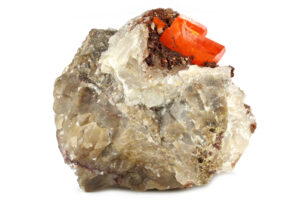
Mineral collectors are familiar with such state minerals as Arizona’s wulfenite, Colorado’s rhodochrosite, Connecticut’s almandine (garnet), Georgia’s staurolite, New Hampshire’s beryl, and Oklahoma’s selenite (gypsum).
Rare and Unusual State Minerals
Among the more unusual state minerals are Massachusetts’ babingtonite, a slightly magnetic calcium iron magnesium silicate; Delaware’s sillimanite, an aluminum silicate; Rhode Island’s bowenite, a hydrated magnesium silicate and semi-precious gemstone similar to jade; Vermont’s talc, another hydrated magnesium silicate with many industrial uses; and New Jersey’s franklinite, a fluorescent zinc iron oxide and former source of zinc found only in the Garden State.
State Oddities
The list of state rocks, minerals and gemstones is not without its quirks. In 1970, a year after NASA’s Apollo 11 spacecraft launched from Florida’s Kennedy Space Center to make its historic lunar landing, Florida legislators designated moonstone, a potassium feldspar with a pearly, moon-like play of light, as its official gemstone, a move intended to draw attention to the state’s prominent role in lunar exploration. Yet moonstone occurs neither in Florida nor on the moon.
Although South Dakota did host a historic gold rush, the yellow metal is not its state mineral. Instead, in 1988, legislators designated “Black Hills Gold” as the Mount Rushmore State’s official jewelry. This was because Black Hills Gold, a South Dakota-based commercial jewelry maker, originally used only gold from the state’s legendary, but now closed, Homestake Mine in Lead.
Texas is the only state with an official gemstone cut—the Texas Lone Star Cut. This round cut reflects a five-pointed star and is used on blue topaz, the state gemstone. And Colorado is the only state in which the colors of its official rock, mineral, and gemstone match those of our national flag—red rhodochrosite, white marble and blue aquamarine.
While Massachusetts’ official state rock is puddingstone, the Bay State also names granite as its State Building and Monument Stone to honor it while differentiating it from puddingstone. The State Historical Rock is the celebrated granite boulder known as Plymouth Rock. The State Explorer Rock (Dighton Rock) is a 40-ton sandstone boulder inscribed with petroglyphs and an attraction at Dighton Rock State Park, while the State Glacial Rock, a 140-ton conglomerate boulder also known as “Rolling Rock,” is a glacially transported “erratic” displayed in the city of Fall River as a monument to the state’s geological history.
Precious and Well-Known State Gemstones
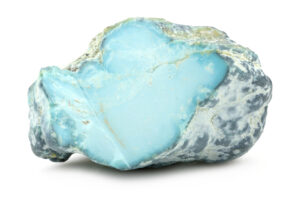
Of the three geosymbol classes, gemstones— minerals or petrified materials that, when cut and polished, can be used in jewelry—are the most glamorous. Of the 41 state gemstones, three are precious: Arkansas diamond, Montana sapphire and North Carolina emerald. Other state gemstones include Idaho star garnet, Colorado aquamarine, New York almandine, South Carolina amethyst, New Mexico turquoise, Maine tourmaline, Utah topaz and Texas blue topaz. Opal is the official gemstone of Mississippi, while Nevada’s is Virgin Valley black fire opal. Alaska and Wyoming both claim nephrite jade as their state gemstone.
Agates and Chalcedony State Gemstones
Agate’s popularity as an official gemstone (and sometimes an official mineral) is reflected in Minnesota’s Lake Superior agate, South Dakota’s Fairburn agate, Maryland’s Patuxent River agate, Kentucky’s Kentucky agate, and Montana’s Yellowstone River agate, the latter known for its dendritic inclusions of black manganese oxide.
Organic and Unusual State Gemstones
Among the state gemstones are four materials of marine or riverine origin. Kentucky and Tennessee both honor freshwater pearl, while Hawaii celebrates black coral, West Virginia fossil coral, and Louisiana cabochon-cut oyster shell.
Among the least familiar state gemstones is Michigan’s pumpellyite, a complex hydrated silicate also known as chlorastrolite and Michigan greenstone; collectors prize its distinctive green color and “alligator-skin” patterns.
Controversies Over State Rocks and Minerals
First state rock ever—California’s serpentinite—has fallen out of favor in some quarters. One of its mineral components is chrysotile, a type of asbestos and now a proven carcinogen. In the early 2000s, several cancer-awareness organizations petitioned California to remove serpentinite as its state rock. Geologists opposed the move, arguing that casual exposure to serpentinite is not at all harmful. Although the bill died in committee in 2010, the controversy remains.
Corrections and Updates
Legislators continue to designate new geosymbols while correcting old errors. As one example, Tennessee’s state rock had been agate since 1969. But in 1979, legislators also named limestone as a state rock, an oversight originating from the confusing use of the words “stone,” “rock” and “mineral” in the formal resolutions. In 2011, Tennessee correctly reclassified agate as its state mineral while retaining limestone as its official rock.
In 1998, Kentucky designated coal, which is technically a rock, as its state mineral—an error rooted in the Bluegrass State’s legal classification of coal as a mineral resource. Then in 2000, the public clamored to honor Kentucky agate, a colorful, semiprecious gemstone. But Kentucky already had a state gemstone (freshwater pearl). So, by default, Kentucky agate became the state rock.
Legislators recently set the record straight, retaining coal as the official rock and making Kentucky agate the official mineral.
The most recent additions to the geo-symbol club were made in 2023 when granite pegmatite became Maine’s state rock, franklinite New Jersey’s state mineral, and Mississippi opal Mississippi’s state gemstone.
Frequently Asked Questions
What are state rocks, minerals and gemstones?
State rocks, minerals and gemstones are officially designated earth materials chosen by U.S. states to represent their geology, history or natural resources. Collectively, they are sometimes called geosymbols.
How many states have official rocks, minerals or gemstones?
All U.S. states except North Dakota have at least one geosymbol. Many states have two or three, resulting in dozens of officially designated rocks, minerals and gemstones nationwide.
What was the first state rock or mineral?
California was the first state to designate geosymbols in 1965, naming gold as its state mineral and serpentinite as its state rock.
What is the difference between a state rock and a state mineral?
A state rock is made of two or more minerals combined into a solid mass, while a mineral is a naturally occurring inorganic substance with a defined chemical composition and structure.
Why do states choose official rocks and minerals?
States choose geosymbols to highlight local geology, mining history, cultural identity and natural resources, often to promote education and state pride.
What is the most common state rock?
Coal, granite and limestone are among the most commonly designated state rocks due to their widespread geological presence and economic importance.
What is the most popular state gemstone?
Agates are among the most frequently designated state gemstones, especially varieties tied to specific localities such as Lake Superior agate and Yellowstone River agate.
Can a state have more than one official rock, mineral or gemstone?
Yes. Some states designate multiple geosymbols, and Vermont is the only state with two official state rocks.
Final Thoughts
To date, only 15 states have filled all three geosymbol slots, which leaves 50 slots unfilled nationally—an opportunity for teachers to encourage students to research their state’s mineral resources, select appropriate candidates, and garner public support to petition their state legislators who could then formally designate new official state rocks, minerals and gemstones—adding to a list that already reflects remarkable cultural, historical, mineralogical and economic diversity.
This story about America’s state rocks, minerals and gemstones previously appeared in Rock & Gem magazine. Click here to subscribe. Story by Steve Voynick.