
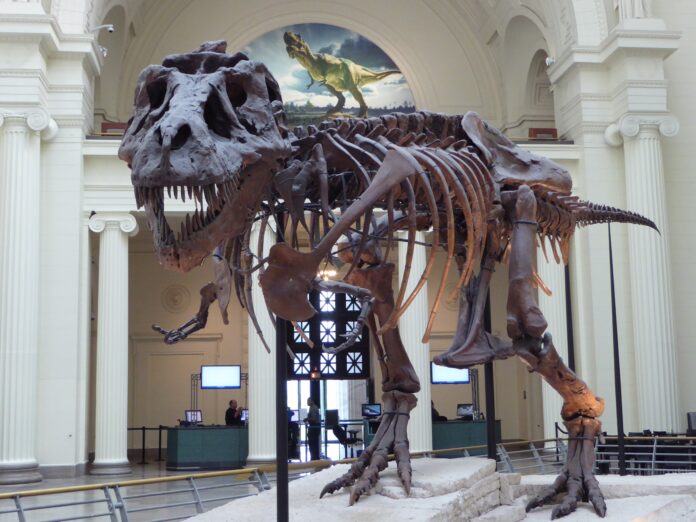
Dinosaur names often seem long, strange, and difficult to pronounce—but there’s a fascinating system behind them. Scientific names like Tyrannosaurus rex aren’t random; they follow a structured set of rules that help scientists classify and describe ancient life. Where do these names come from, and why do they use two parts? Let’s take a closer look at how dinosaurs are named and what those names actually mean.
Key Takeaways
- Dinosaur names follow a scientific system called binomial nomenclature, which uses a two-part Latin or Greek naming format (genus and species).
- Formal dinosaur names are governed by the International Code of Zoological Nomenclature, which sets strict rules for naming new species.
- A newly named dinosaur must be based on a holotype, a single reference specimen stored in a museum or research collection.
- Most dinosaur names are built from Greek or Latin word roots that describe features, locations, or people.
- Dinosaur names often reflect appearance, discovery location, or honor a person, and sometimes combine multiple elements.
- Once published, dinosaur names follow the principle of priority, meaning the first valid name usually stands.
- Not all named dinosaurs are valid—some are later reclassified, renamed, or considered duplicates or juvenile forms.
How Dinosaur Names Are Made Official
There are no stringent rules governing so-called common names; for instance, calling a critter a bull frog. But designating a formal scientific name is another matter altogether. Going back to 1895, we’ve had an International Commission on Zoological Nomenclature. Using the International Code of Zoological Nomenclature, they are the ultimate arbiters in establishing that a scientific name is valid for animals, both living and fossilized. (There’s a separate commission and code for naming plants.)
This effort goes back to 1735, when Swedish biologist Carl Linnaeus noted confusion and duplication in efforts to catalog Earth’s creatures. So he devised binomial nomenclature, first used in his most famous work, Systema Naturae. This was the origin of the two-part genus and species system we use today. Both words are italicized, with the genus name capitalized.
How New Dinosaur Names Are Approved (Holotypes)
To create a new genus/species, you first need to determine if your critter is indeed new to science; that it’s newly discovered or previously undescribed. You also need a holotype, or “type specimen,” that can be kept forever as a reference in a museum or other repository. Next, you need to publish a paper in a peer-reviewed journal, telling what you’ve found, where it was found, who found it, and the name you propose. A name can’t be offensive and should be “euphonious.” That is, ideally, the name should be compact and pronounceable, so proposing a name like Supercalifragilisticexpialidocious marypoppina just might get rejected. Or maybe not.
Why Dinosaur Names Use Greek and Latin
Scientific names may look strange to English readers because they are often put into Greek or Latin forms. For centuries, the study of Greek and Latin was integral to a classical Western education, and they constituted the languages of scholarly discourse. Thus, these two ancient languages were incorporated by Western scientists into efforts to standardize science terminology begun by Linnaeus. (By the way, Linnaeus’s real name was Carl von Linné, which he “Latinized” in his writings as Carolus Linnæus.)
Common Word Roots in Dinosaur NamesA table in Myrna Martin’s book Dinosaurs: Hands-on Activities shows root words from Latin or Greek and their meanings in English. Check it out! Here are some examples she gives: cephalo (head) donto (teeth) micro (small) mimus (imitator) pseudo (false) |
What Dinosaur Names Actually Mean
Sometimes, a dinosaur is given a descriptive name highlighting a distinctive feature like a crest. Sometimes, it’s named after the place where it was found. Other times, it’s named to honor a person. Such honorary names are called eponyms, and there’s one catch: you can’t name your fossil after yourself! Finally, sometimes, it’s a combination of two of these. Whichever form is taken, the chosen words are often put into Latin or Greek; for instance, a fossil named to honor Charles Darwin goes by Darwinius. Here are examples of these naming protocols.
The Name Reflects a Place
- Afrovenator abakensis – “African hunter from Abaka” reflects the Abaka area of Niger, where this dino was found in Africa.
- Mamenshisaurus constructus – “Mamenshi lizard from construction” is named for a highway construction site near Mămingxī Ferry Crossing in China.
The Name Reflects a Description
- Brachypodosaurus – This stegosaur from India is a “short-footed lizard.”
- Heterodontosaurus – Unlike most dinosaurs, “different-toothed lizard” had three distinctly different types of teeth in its jaws.
The Name Honors a Person
- Lambeosaurus – “Lambe’s lizard,” honors paleontologist Lawrence Lambe.
- Herrerasaurus – The name of this dinosaur from Argentina—one of the oldest of all dinos—honors Vicorino Herrera, the goat herder who discovered it.
The Name Reflects a Place and a Person
- Utahraptor ostrommaysi – “Utah’s predator” comes from Utah and honors paleontologist John Ostrom and the founder of Dinamation, Chris Mays.
- Abydosaurus mcintoshi – “Abydos lizard” was found in Abydos, Egypt, and the species name honors the late Jack McIntosh, a sauropod expert.
The Name Reflects a Description and a Person
- Maiasaura peeblesorum – “Good mother lizard of the Peebles” nested & took care of its young; the Peebles family owned the land where it was discovered.
- Gigantosaurus carolinii – Auto mechanic and amateur fossil hunter Rubén Carolini discovered South America’s “most gigantic lizard.”
The Name Reflects a Description and a Place
- Spinosaurus aegyptiacus – “The spiny lizard of Egypt” has become a rock star in the world of dinosaur enthusiasts.
- Beipiaosaurus inexpectus – “Beipiao’s unexpected lizard,” found near the Chinese city of Beipiao, sports unexpected features like feathers and a toothless beak.
Finally, a name can express a bit of whimsy. Take Irritator challengeri. The species name honors a fictional person (Professor Challenger of Arthur Conan Doyle’s book, The Lost World), and the genus name conveys the irritation felt by paleontologists upon discovering the skull’s snout had been elongated with plaster by the dealer who sold it to them.

When Dinosaur Names Change or Get Replaced
Sometimes, a paleontologist gives a new name to a dinosaur that’s already been named. This often happens when only partial skeletons or even just a single bone have been found, and the pieces later come together when more complete specimens are uncovered. Per the “Principle of Priority,” the first name published in a scientific journal gets precedence, so any later name/s would be dropped.
Also, animals often change as they grow. Paleontologist Jack Horner believes some small dinosaurs that have been given new names may actually be juvenile forms of adult dinosaurs already named. He thinks as many as a third of all dinosaurs may be examples of different growth stages. For example, in 2009, he suggested two dinos—Dracorex hogwartsia and Stygimoloch spinifer—might actually be younger forms of the already named Pachycephalosaurus wyomingensis.
A questionable name is “nomen dubium.” That’s Latin for “doubtful name.” Other names, called “nomen rejectum,” get outright rejected. One publication noted 1,401 dinosaur species had been named between 1824 and 2004. However, many of those names have been rejected over the years, and by most estimates, there are currently about 700 valid non-avian dinosaur species contained within about 300 genera.
Frequently Asked Questions
Why do dinosaur names sound so complicated?
Most dinosaur names are formed using Latin or Greek roots, which were historically used as the international language of science. These roots allow scientists worldwide to understand descriptive meanings consistently.
Who decides what a dinosaur is named?
A paleontologist who discovers and describes a new species proposes the name, but it must follow rules set by the International Code of Zoological Nomenclature and be published in a peer-reviewed scientific journal.
Why do dinosaurs have two-part names like Tyrannosaurus rex?
This comes from binomial nomenclature. The first word is the genus (group), and the second is the species. Together, they create a unique scientific identifier.
Can someone name a dinosaur after themselves?
No. Scientific naming rules discourage or prohibit naming species after yourself, though others may name species in your honor.
Do dinosaur names ever change?
Yes. If new evidence shows two named dinosaurs are the same species or different life stages of the same animal, the older published name usually takes priority.
What does Tyrannosaurus rex mean?
It translates to “tyrant lizard king,” combining Greek-derived words that describe its size, dominance, and classification.
Try Naming a Dinosaur Yourself
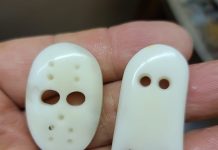
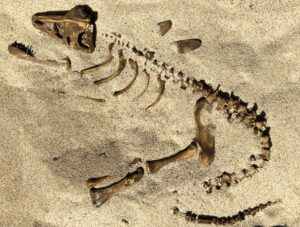
I end with a challenge. I’ve created a fake dinosaur. Your task? Develop genus and species names using the info you’ve learned. Here’s background to spark ideas. It’s a small, made-up dino skeleton crafted from chicken bones and shark teeth embedded in sand and was uncovered by a guy named Jim in a garage in Ventura, California.
What genus and species names would you give it? Compose your scientific name in English, then use a program like Google Translate to cast it into Latin or Greek and see which sounds “euphonious.” If you belong to a rock club that uses the kids’ Badge Program of the American Federation of Mineralogical Societies (www.juniors.amfed.org/fra-badgeprogram), you can check off a point toward earning a Fossils badge. Go for it and have fun!
Learn MoreMany websites contain lists of dinosaur names. Here are just two. See if you can find more! • Wikipedia’s list of dinosaur genera: https://en.wikipedia.org/wiki/List_of_dinosaur_genera • In 1995, George Olshevsky published a dinosaur genera list online, which was considered the closest thing to an “official” list of dinosaurs. |
This story about dinosaur names appeared in Rock & Gem magazine. Click here to subscribe. Story and photos by Jim Brace-Thompson.