
Landscaping with stone takes on new meaning in central Montana, where the line between geology, art, and design begins to blur. Walking through these spaces, it’s striking to see how plants and stone naturally intertwine. It’s even more compelling when that same relationship is intentionally shaped in public installations and private gardens. In Great Falls, artist Mike Hollern builds landscapes where Ice Age rock, native plants, and sculptural metal elements are woven into a single living composition.
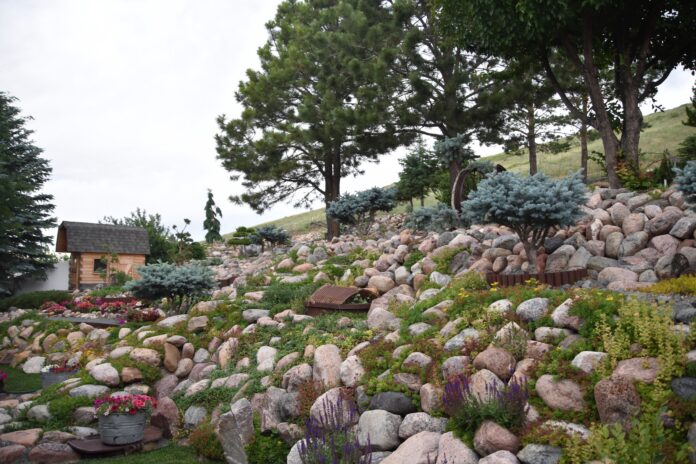
A lifelong resident of Central Montana, Mike used what was on hand to create practical, yet eye-catching, landscapes. At his first house near the Dearborn River south of Great Falls, he built terraces out of the blocky, igneous rock to create an interesting visual effect. Little did he know, these were the first steps in a lifelong vocation.
Landscaping with Stone Key Takeaways
- Landscaping with stone in central Montana reflects both geology and design, where Ice Age deposits and volcanic rock naturally shape the visual landscape.
- Artist Mike Hollern transforms glacial erratics, shonkinite, and fieldstone into structured landscape art, blending natural history with human design.
- The region’s stone is not decorative alone—it is functional, durable, and locally sourced, often repurposed from agricultural land clearing.
- Plant selection is critical in Montana’s extreme climate, where wind, drought, and temperature swings require hardy, adaptive species.
- Hollern’s approach blends stone, metal, water, and sculpted evergreens into living installations, creating landscapes that evolve.
- Rock gardens in this context are less about ornamentation and more about integrated ecological and artistic systems shaped by place.
A Central Montana Artist Shaping Landscape with Stone
The Dearborn River area lies within the 40-mile-long, 20-mile-wide Adel Mountain volcanic field, which is well known for the igneous rock that formed during the late Cretaceous Era. Situated where tectonic plates met, the Earth’s crust was thinner, providing a pathway for magma to rise to the surface, sometimes bursting forth and creating dikes, laccoliths and volcanic deposits.
The chunky blocks were handy for stacking, but Mike found his preferred stone medium while working in his steep backyard. Since then, he has expanded his use of rocks beyond mere terracing, incorporating them into his artistic projects.
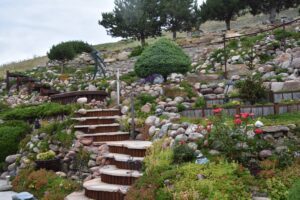
“All the ones over here,” he says, pointing to the features that adorn the parking area at Kobe Japanese Steak House and SpringHill Suites, “are glacial erratics. The glaciers brought them down.”
Ice-Age Stone: Glacial Erratics in the Landscape
The pink granite and gneiss found in large boulders and smaller specimens of this glacial till most likely originated in Saskatchewan and were once encased within the Laurentide Ice Sheet during the Late Pleistocene Era. The ice sheet extended between Fort Benton and Great Falls. Roughly 23,000 years ago, the ice sheet dammed the Missouri River, forming Glacial Lake Great Falls, which additionally transported materials.
The glacial till, typically composed of pink potassium feldspar, granite, basalt, and other metamorphic rock from the ancient Canadian Shield, was deposited in Central Montana as the ice melted. The specimens stand out from the characteristic limestone and shale that are common in many parts of this area.
From Farm Fields to Landscaping with Stone
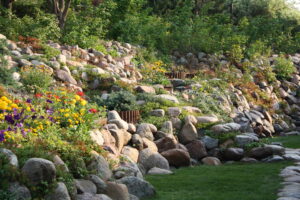
Mike says the vast majority of what he’s been using over the past three decades was pulled from fields and dumped in piles or in coulees along the prairie. He says farmers cleared the fields after WWII, when large equipment was often more available to move these massive rocks.
His farmer friends are more than happy to have him haul away these blade-breaking obstacles. “I try to pick up the worn and weathered-looking ones,” he says. “You shoot for the lichen, too.”
The crustose lichens, the low-growing types that seem to be painted on the rock, add another layer of character to the stone, and Mike does his best to use it to his visual advantage.
Shonkinite: Montana’s Rare Volcanic Stone
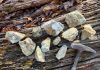
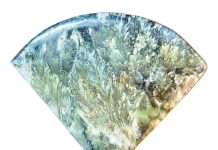
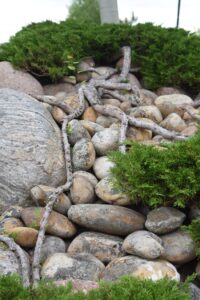
Mike also likes using shonkinite, a rare and regional, potassium-rich, igneous rock. It was initially identified in the area known as the Shonkin Sag, the wide, deep channel carved by the catastrophic release of Glacial Lake Great Falls, near the Highwood Mountains. Shonkinite forms during volcanic activity when magma intrudes into native sedimentary rock. It is not quartz because it is silica-poor, but the material gathers potassium feldspar and dark green augite during its formation. It is a dense, durable rock often used as railroad ballast because it won’t break down, despite heavy use and harsh conditions.
It’s also beautiful. Shonkinite is typically coarse-grained and dark grey. Its distinctive feature is the speckling from the augite (pyroxene). It is striking when it forms the impressive laccoliths, the magma columns that make up the perimeter of many of the buttes in Central Montana. Even small pieces are eye-catching. It’s also a nice contrast to the pinks and green granite, along with the other glacial specimens Mike uses in his work.
Landscaping with Stone in Montana’s Extreme Climate
Rock is the foundation of his work, but he takes great care and pride in what plants he uses and how he forms them for each rock feature. Unlike many commercial plantings, which offer the same dozen shrubs, trees, and perennials as every other local business, Mike chooses varieties that will withstand the elements and grow well, along with cooperating with a bit of training.
“You’re in Great Falls, one of the most difficult places in the United States to grow anything,” he says. He points out the wintertime temperature fluctuations that can bounce from 60°F to -30°F, and back again within days. The constant wind that once caused “prairie madness” is equally frustrating when it batters new plants.
Water is also always an issue. Receiving between 12 to 15 inches of precipitation each season, providing enough water is critical. Over the years, he’s tried numerous trees and shrubs and has learned which look great and will most likely survive, while maintaining the look he strives to achieve.
“The great gardens in Europe are not about the flowers,” he says. “They’re about evergreens that are sculpted.”
Training Evergreens into Living Sculpture
One of his most striking displays was at his own home over a decade ago, where he created a pathway through an aisle of pruned buffalo berry (Shepherdia argentea) reminiscent of a stroll through Italy. This native shrub of the plains grows to about 12 feet high, is very cold-hardy, and tolerates dry conditions.
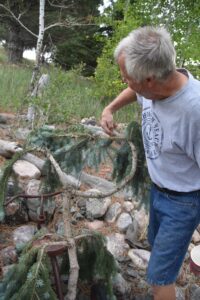
Mike says he also likes ‘Blue Star’ junipers, several dwarf Mugo pine varieties, and stately ponderosa pines that take on new form as they are shaped into art.
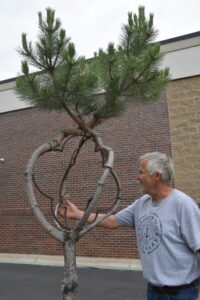
Instead of simply installing them in the landscape, when Mike plants the trees and shrubs, they are carefully planned and meticulously pruned into creative forms. After planting, Mike pins the branches in place and trims them, shaping them to fit his vision. He says that the Mugo pines do particularly well with the Bonsai-type training, because of their sturdy trunks.
Where Rock, Metal, and Plants Intertwine
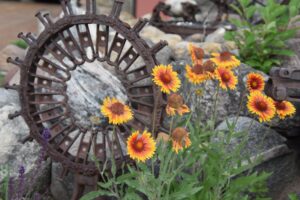
The third piece in these living sculptures incorporates metal into the overall look. Metal wheels, loops, and industrial-looking elements are a surprisingly natural fit with the stone and plantings. Mike bends the metal into shapes to guide the trunks and branches. After years of training and maturation, the shrubs, rocks,and metal appear to have grown together. It’s unique to look through a loop in a trunk or fan blades encased in conifer branches as if it grew that way.
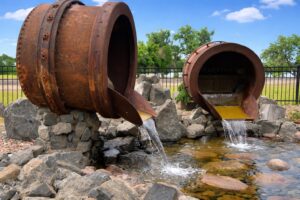
At one of the water features at SpringHill Suites, he used tanks to spill water into the rock-rimmed pond, but they look like something that came out of the former Anaconda Smelting Company, which was the industrial heart of Great Falls for over 80 years.
“I added the rings and the interior work (and) spouts. They are meant to resemble molten steel pouring out of a vat, as you would imagine might have been part of the old refinery. Many people have asked if I got them from an old foundry,” he says.
Shrubs & Vines in Landscape Design
The evergreen shrubs and trees offer a beautiful palette throughout the winter and summer. During the warm months, Hollern adds flowers to provide vibrance to the landscape. Not surprisingly, sedum is a staple of these rock gardens. It thrives tucked in between the rocks with very little additional water.
Even though these gardens are highly stylized, they’re still practical. Mike says squash plants thrive among the warm rocks.
The vines spread and take advantage of space and sunshine.
In reality, one of the most significant challenges in any Montana garden is reducing evaporation and retaining precious moisture. Mike points out, “The rocks absorb the heat and dissipate it.” He says he’ll lift a rock, and it is perfectly damp underneath, even when the summer heat makes the air feel like a convection oven.
Landscaping with Stone Frequently Asked Questions
What is landscaping with stone?
Landscaping with stone refers to the use of natural rock as a structural and aesthetic foundation in outdoor design. In central Montana, it often involves locally sourced materials such as glacial erratics and volcanic rock that naturally shape the terrain.
What makes Montana stone unique for landscaping?
Montana stone includes glacial deposits, volcanic formations, and ancient metamorphic rock. These materials vary in color, density, and texture, making them both durable and visually distinctive for landscape design.
What are glacial erratics?
Glacial erratics are large rocks transported and deposited by glaciers during the Ice Age. In central Montana, many originate from the Canadian Shield and differ dramatically from the surrounding local bedrock.
What is shonkinite?
Shonkinite is a rare, dark igneous rock found in central Montana, formed from volcanic activity. It is dense, durable, and often used in construction and landscaping due to its strength and unique speckled appearance.
Are rock gardens practical in Montana’s climate?
Yes. Rock gardens are particularly well-suited to Montana because stone helps retain heat and moisture in the soil while reducing evaporation—an important advantage in dry, windy environments.
How are plants used in landscaping with stone?
Plants are carefully selected for resilience and often trained or shaped over time. Evergreens, native shrubs, and drought-tolerant perennials are commonly used to complement stone structures.
Is this type of landscaping purely decorative?
No. In many cases, including Mike Hollern’s work, landscaping with stone is both functional and artistic—helping manage terrain, water retention, and microclimates while also creating sculptural landscapes.
Conclusion
Mike’s installations are quintessentially Montanan, intertwining rock, plants, metal, and oftentimes, water into unexpected formations. The good news is Mike is far from finished. With his keen mind and a propensity for beauty, along with a limitless supply of rocks that migrated hundreds of miles during the last ice age, Mike’s creative formations delight everyone who takes a moment to notice the intricacies of his wildly creative landscape.
This story about landscaping with stone appeared in Rock & Gem magazine. Click here to subscribe. Story by Amy Grisak.