
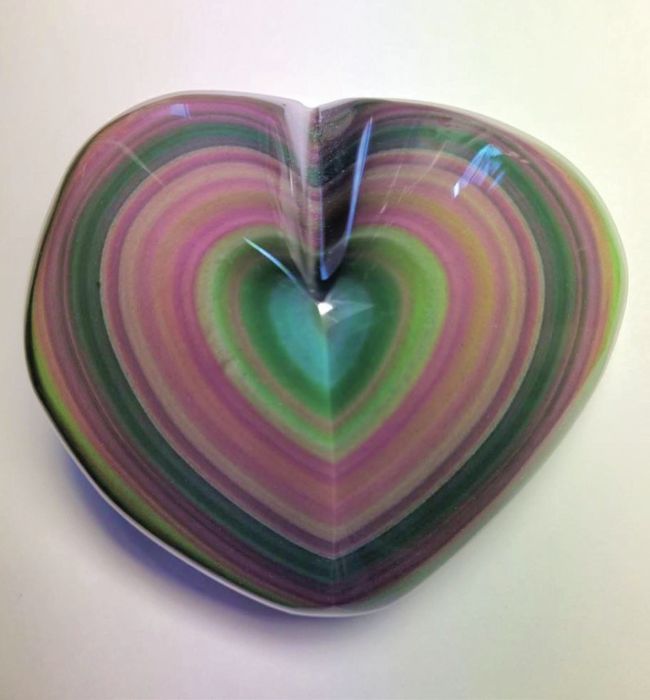
Mexican obsidian from Jalisco State is among the most colorful and beautiful volcanic glass found anywhere in the world. Created by a massive volcanic eruption 95,000 years ago, these extensive deposits include rainbow, silver sheen, snowflake, spiderweb, pure black and gold sheen obsidian in a wide variety of colors and qualities. The volcano also created soils ideal for growing Blue Agave, the source of the region’s famous tequila. The tequila is a bonus, but the remarkable obsidian captures the heart of lapidarists.
The gem-quality obsidians mined in this area west of Guadalajara include rainbow, silver sheen, snowflake, spiderweb, pure black and gold sheen. These varieties can be found isolated from other types or found near each other. Each variety occurs in a range of qualities for lapidary use, with the highest qualities being among the finest of anywhere obsidian is found.
Bruce McKay
Mexican Obsidian: Key Takeaways
- Mexican obsidian from Jalisco State includes rainbow, silver sheen, snowflake, spiderweb and gold sheen varieties.
- Jalisco obsidian formed from volcanic eruptions about 95,000 years ago.
- Rainbow obsidian gets its colors from microscopic hedenbergite crystal formations.
- Silver and gold sheen obsidian contains stretched microbubbles that reflect light.
- The Magdalena region is one of Mexico’s best-known obsidian and fire opal mining areas.
- Most Jalisco obsidian is mined by open-pit trenching and finished by skilled lapidary artists.
- Medium-grade obsidian is exported worldwide, while top-grade material is used for artisan carvings and jewelry.
How Mexican Obsidian Formed
The volcano here blew up and remained active for 65,000 years, with a magma chamber remaining deep below, waiting to create more obsidian. Obsidian forms later in the stages of a volcanic eruption after the main eruption has blown or poured out the majority of its magma. The remaining magma is silica-rich in content, and if it cools quickly after reaching the surface, it forms volcanic glass. The various forms of obsidian with optical effects such as rainbow or sheen are caused by different compositions of obsidian.
Silver and Gold Sheen Obsidian
Silver or gold sheen obsidians get their sheen from microvesicles that are gas or glass-filled. These started as bubbles in the molten volcanic glass, and as it flowed, the bubbles were stretched out parallel to each other. These masses of skinny bubbles reflect light in bright flashes of silver or gold color. The effect is like shining a light on a Christmas tree with too much tinsel on it.
Snowflake Obsidian
Snowflake obsidian is an opaque black glass with white spots that resemble snowflakes. This obsidian gets its distinctive white spots from inclusions of cristobalite, a high-temperature polymorph of quartz. It can be difficult to get an even polish on the snowflake material from this area, as the white flakes do not polish gracefully. Obsidian often has small white lumps embedded throughout the glass. These lumps, called phenocrysts, do not take a polish and can ruin an otherwise beautiful glass surface. Phenocrysts crystallized before the obsidian cooled, the hot glass providing a molten environment where crystallization could occur. These scourges of the lapidarist are usually crystals of quartz, feldspar or amphibole.
Rainbow Obsidian
Rainbow obsidian from this area has tiny internal phenocrysts rather than large visible ones. These microscopic phenocrysts are made up of hedenbergite crystals elongated in parallel rows. These parallel rows break light up into colors through thin film interference, creating a wide range of colors. Obsidian glass often has banding and some banding will have more hedenbergite than others.
Freshly mined obsidian always has an oxidized surface that prevents the cutter from seeing into the stone. By observing flow lines on the exterior of the rough material, the cutter chips a window to expose the internal bandings and decides where to cut to showcase the best banding zone for color or sheen. In rainbow obsidian, the stones are slabbed or ground parallel to the flow lines, with the best optical effects perpendicular to the bandings. Because the flowing lines are not always perfectly parallel, it takes the skills of the lapidarist and some luck to get the most out of every piece.
Spiderweb Obsidian
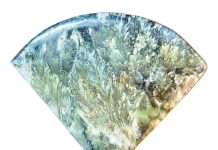
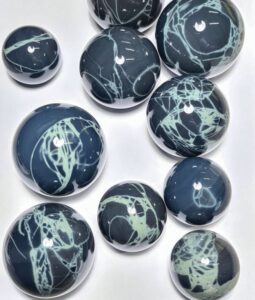
Spiderweb obsidian is created by magic. It is an opaque black or grey-black with swirls of olive green webbing through it. Spiderweb obsidian looks like a flowing brecciation, but mostly like the volcano was expressing its innermost artist. This is a very rare obsidian and is difficult to obtain in the rough.
Bruce McKay
Mexican Obsidian Mining Operations
Alfredo Baños Nieves and his two minority partners are the producers of the largest quantity of quality Jalisco obsidian. They produce over 20 tons of medium and high-grade obsidian per year. The high-grade is used in their lapidary production facility at the company’s work studio and headquarters in Guadalajara. Medium-grade is shipped in containers overseas, mostly to China, and low-grade is left at the mine as backfill.
To reach his main mines, Alfredo heads west from Guadalajara on Highway 150. As soon as the highway gets out of town, every square meter of ground is planted in Blue Agave. The agave is planted right up to the edge of the pavement and covers the sides of every overpass. The highway cuts through hills, and the walls of the roadcuts are pockmarked with obsidian.
Obsidian Near Tequila and Magdalena
After passing the town of Tequila, he turns off the highway and drives into the town of Magdalena. This busy little town is the center of both the obsidian and opal mining in Mexico. The Mexican fire opal production has been greatly reduced in recent years, but miners are still known to sell rough material out of their pickups in the town square over the weekends. Around the town square are multiple shops that specialize in fire opal and jewelry created using the local opal.
Silver Sheen Mining Areas
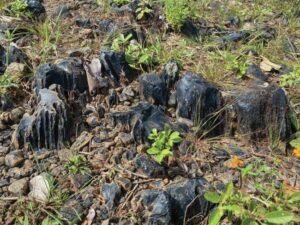
Heading south from Magdalena, the road cuts through Blue Agave fields on the way to the village of El Trapiche. The agave cactus plants along the road grow up through dirt that is full of cuttable obsidian. At the end of the fields lie the mining claims that produce silver sheen and snowflake obsidian. Deep open pits in the red soil produce top-quality silver sheen and a medium-quality snowflake. In the areas that have not yet been dug, obsidian is everywhere in solid outcrops and scattered loose across the ground. Some of the loose obsidian has a surface texture that resembles natural charcoal, looking like the leftovers of a campfire.
Alfredo Baños
The La Revoltosa Rainbow Mexican Obsidian Mine
At the very top of Mt. San Andrews, elevation 2000 meters, lies the La Revoltosa Mine. This is the source of the top-grade rainbow obsidian from the Jalisco area. The mine has sleeping quarters, a kitchen, a bathroom and a generator for lights and television. Miners start mining after the rainy season, working from November through June, five to six days per week.
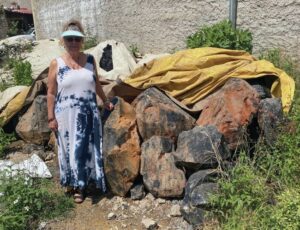
The Mexican obsidian here is solid black or rainbow. This rainbow obsidian flashes bright colors over its surface, multiple colors that show intense depth of color. A stone carved out of this will show one brilliant color after another as the bandings are exposed. It comes out of the ground from fist-sized pieces up to massive 200-kilo boulders.
How Rainbow Obsidian Is Extracted
The top of Mt. San Andrews is a forested area with a mix of oak and pines and an open understory that is easy to walk through. A 100-meter walk reaches the summit, which provides wide views down into the countryside. The miners try to avoid cutting trees, but as they chase seams of good material, sometimes the trees get in the way. The mine is mostly trenching, up to 10 meters deep. After cutting a trench, the miners search the walls for quality material.
The Mexican obsidian stones come out of the soil easily here and the miners pluck pieces from the trench walls to test for quality. They use one piece of obsidian to chip off windows on the face of the freshly mined material, creating a view down into the stone. As they find quality material, they will cut in the direction of the flow that produced it, sometimes in trenches that wander through the woods, sometimes opening up into large open pits.
The trenching is done with a large backhoe and the extraction of individual pieces is done by hand. The backhoe is driven up to the mine each season in a day-long drive, which can’t be done until the road dries out following the rainy season. A dump truck is loaded with the material worth keeping and the stones are transported to Guadalajara.
Rare Spiderweb and Gold Sheen Deposits
Other obsidians, such as the spiderweb and golden sheen, come from mines further away from the main mines. The spiderweb obsidian occurs over 10 kilometers away from the silver and rainbow mines. The golden sheen is from a deposit even further away and, like the spiderweb, does not come out in large quantities.
Bruce McKay
Processing Mexican Obsidian
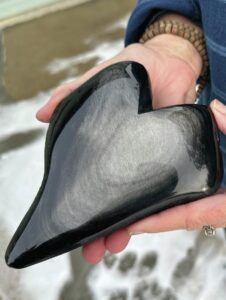
Alfredo has several storage areas where he keeps an inventory of 10 tons. The workshop has a small crew that cuts the material into spheres, sculptures, mirrors, and small items for sale, such as organic shapes and hearts that highlight the brilliant colors.
Cutting and Polishing Obsidian
Each work station has a strong vacuum hose pulling the dust away since a lot of dust is created as the grinding and sanding are all done dry. Initial grinding is done with angle grinders, drop saws and lapidary wheels. Sanding is done on eight-inch expandable drums. The polishing process is proprietary.
Exporting Mexican Obsidian Worldwide
The main source of income for the mines is shipping the medium-grade material overseas in containers. The customers are primarily in China and India, where lapidary shops produce a wide range of products. This export business allows Alfredo to do the artisan cutting he does at his Guadalajara cutting factory, using the top-grade material.
Selling Mexican Obsidian at Tucson and Denver Shows
For over 30 years, Alfredo and his father, before him, have been selling their obsidian products at the Denver and Tucson shows, usually selling out all of their stones. In Tucson, Alfredo has a booth at the GIGM Show at the Red Lion. Alfredo can be reached on Facebook on two pages: Obsidian House and The Obsidian World. He can be reached on WhatsApp at 1-915-342-0536.
Frequently Asked Questions: Mexican Obsidian
What is Mexican obsidian?
Mexican obsidian is natural volcanic glass formed by rapidly cooled lava. Mexico is famous for producing colorful varieties, including rainbow, silver sheen and spiderweb obsidian.
Where is Jalisco obsidian found?
Jalisco obsidian is mined in western Mexico near Guadalajara, Tequila, Magdalena and the village of El Trapiche.
What causes rainbow obsidian colors?
Rainbow obsidian gets its colorful flashes from microscopic hedenbergite crystals arranged in thin parallel layers that reflect light.
What is silver sheen obsidian?
Silver sheen obsidian contains tiny stretched gas bubbles inside the volcanic glass that create a reflective metallic appearance.
Is spiderweb obsidian rare?
Yes. Spiderweb obsidian is considered one of the rarer obsidian varieties because it occurs in limited deposits and is difficult to obtain in large quantities.
How is obsidian used?
Obsidian is used for jewelry, carvings, spheres, cabochons, sculptures and decorative lapidary work. Historically, it was also used for cutting tools and arrowheads.
Is obsidian a mineral?
No. Obsidian is classified as volcanic glass because it lacks the crystal structure required to be considered a true mineral.
Mexican obsidian from Jalisco offers some of the most striking volcanic glass found anywhere in the world. From brilliant rainbow flashes to shimmering silver sheen and rare spiderweb patterns, each variety tells part of the story of the massive volcanic forces that shaped this region thousands of years ago. Today, skilled miners and lapidary artists continue transforming these ancient volcanic treasures into polished works of art prized by collectors around the world.
This story about Mexican obsidian appeared in Rock & Gem magazine. Click here to subscribe. Story by Bruce McKay.