
Trilobite fossils are among the most recognizable remnants of ancient marine life. They offer a window into oceans that existed hundreds of millions of years ago. These remarkable specimens tell a story of evolution, survival, and extinction long before humans appeared on Earth.
Trilobites were arthropods with segmented bodies, paired jointed legs, and a hard exoskeleton. Their modern relatives include insects, spiders, millipedes, and crustaceans.
In southwestern Ohio, these ancient creatures once thrived in the Ordovician seas that covered much of the region. Isotelus trilobites lived, died, and were preserved in what are now the state’s rocks, cliffs, quarries, and streambeds.
The name Isotelus comes from Greek—isos meaning “equal” and telos meaning “end.” It was first described by John Locke in 1838 during some of the earliest formal geological studies of Ohio.
Key Takeaways
- Trilobite fossils are the preserved remains of extinct marine arthropods that lived hundreds of millions of years ago in ancient oceans.
- They are closely related to modern arthropods such as insects, spiders, crustaceans, and millipedes.
- Trilobites had segmented bodies, jointed legs, and a hard exoskeleton that commonly fossilized after molting.
- Ohio, especially the southwestern regions, was once covered by the Ordovician Sea, making it a rich source of trilobite fossils today.
- The Isotelus trilobite is one of the most well-known species found in Ohio and is also the state’s official state fossil.
- Trilobites are important “index fossils,” meaning they help geologists determine the relative age of rock layers.
- Complete trilobite fossils are rare; most finds are partial exoskeletons or disarticulated segments.
Body Segments of Trilobite Fossils
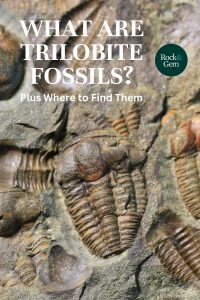
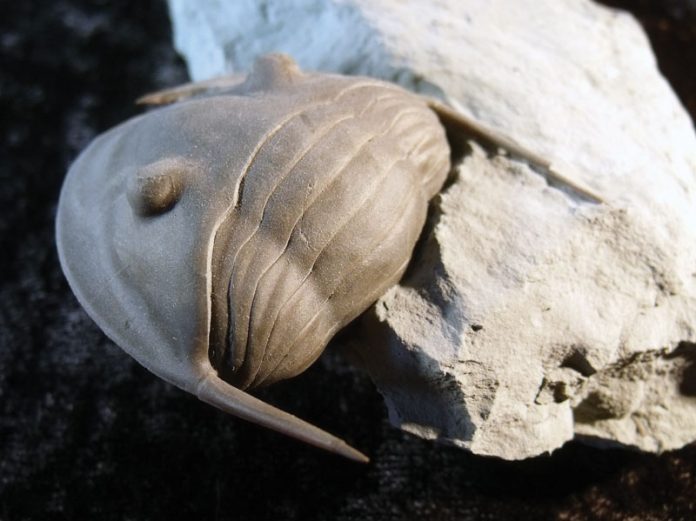
The name trilobite derives from the three distinct body divisions or lobes running vertically through the body. There is one central or axial lobe with two pleural lobes on either side. It is also divided into three ways horizontally into the head section or cephalon, the body section or thorax and the tail section or pygidium.
Some species had long projecting spines emanating from various segments. In the case of Isotelus, it had long spines radiating backward from the sides of the head section, called genal spines. The head and tail sections were solid shields while the body was made up of individual segments, each with a corresponding pair of legs and gill branches.
Trilobite Fossil Armor and Defense
Some species had as few as two body segments, while others had as many as 60. Isotelus had eight body segments. With these segments, the trilobites were able to “enroll” or roll up their bodies, much like the modern-day pill bug or roly-poly. It is with this action called conglobation that they were able to pull the soft body tissues in for protection from danger.
They were covered by a thick exoskeleton, a skeleton on the outside of the body protecting the soft tissues, including legs, gill branches and antennae. It also protected them from danger, be it storms or predators.
How Trilobite Fossils Form
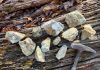
It is this exoskeleton that is found as a fossil. To grow, trilobites would have to shed or molt their exoskeleton. While molting, they would grow a bit and then the new exoskeleton would harden and they would continue on their way. In many cases, it is discarded and disarticulated sections of the exoskeleton that are found as fossils.
Complete trilobites are not that common.
Trilobite Fossils and Daily Life
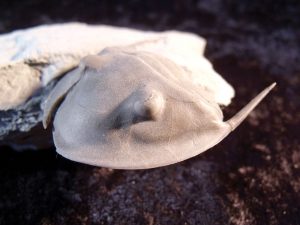 Trilobites were the first major creatures on Earth with complex eyes and many lenses. The eyes were generally crescent-shaped and sat high on the head section. As such it can be imagined they had nearly 360-degree vision. Some species had thousands of lenses in each eye. Some species were blind and had no eyes.
They were creatures that scurried about on the ocean floor, eating decaying plant and animal material much as their relatives, the horseshoe crabs, lobsters and shrimp do today. They had a mouthpart called a hypostome on the underside of the head section. One could almost imagine them as an undersea vacuum cleaner.
Trilobite Fossils as Index Fossils
To date, there have been over 20,000 species named and described from the Cambrian Period, some 521 to 252 million years ago, when the Permian mass extinction erased almost 90% of life on Earth. They ranged in size and shape from just under a quarter-inch to just over two feet long. They were quite a resilient and diverse group of creatures.
Trilobites are a well-known index fossil that can generally date the age of the rocks. Certain trilobites can be found in rocks of a certain geological age and no other; they are an index of the age of rocks.
Ohio’s State Trilobite Fossil
School children played a major role in having this magnificent trilobite designated as the State Fossil of Ohio. After students learned of a large Isotelus being found at Huffman Dam near Dayton in 1919, third and fourth-grade students and teachers lobbied for the designation. But it wasn’t until June 20, 1985, that Ohio House Bill 145 finally designated the Isotelus as Ohio’s State Invertebrate Fossil.
Other states have designated various species of trilobites as their state fossil — Pennsylvania has chosen Phacops rana, and Wisconsin has chosen Calymene celebra.
Where to Find Trilobite Fossils in Ohio
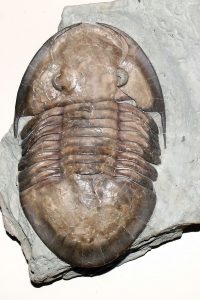 Isotelus trilobites and Isotelus pieces can be found in several locations in Ohio, including Trammel Fossil Park. One of the most popular areas is along Caesar Creek State Park southeast of Dayton. There are restrictions, and a fossil collecting permit must be obtained from the park office before heading to the large spillway, where many fossils can be found.
Frequently Asked Questions
What are trilobite fossils?
Trilobite fossils are the preserved remains or impressions of extinct marine arthropods that lived in Earth’s oceans from over 500 million to about 250 million years ago. They are commonly found as mineralized exoskeletons.
Where are trilobite fossils found in Ohio?
In Ohio, trilobite fossils are commonly found in Ordovician-aged rocks, particularly in southwestern areas such as Caesar Creek State Park, quarries, streambeds, and exposed shale and limestone formations.
How old are trilobite fossils?
Most trilobite fossils date back to the Paleozoic Era, roughly 520 to 250 million years ago, with many Ohio specimens originating from the Ordovician Period.
Why are trilobites important as index fossils?
Trilobites evolved rapidly and existed for long stretches of geologic time, with distinct species tied to specific time periods. This makes them useful for dating rock layers.
What is the Isotelus trilobite?
Isotelus is a large trilobite genus commonly found in Ohio. It is notable for its size and is the official state fossil of Ohio.
Are complete trilobite fossils common?
No. Complete trilobite fossils are relatively rare because their exoskeletons often broke apart during molting or decay. Most fossil finds are partial remains.
Trilobite fossils offer a remarkable connection to an ancient world when shallow seas covered what is now Ohio. From their distinctive three-lobed bodies to their role as important index fossils, these ancient arthropods continue to fascinate collectors and scientists alike. Whether found in a quarry, creek bed, or protected park site, each trilobite fossil provides a small but vivid glimpse into life more than 400 million years ago.
This story about trilobite fossils previously appeared in Rock & Gem magazine. Click here to subscribe! Story and photos by Joseph “PaleoJoe” Kchodl.