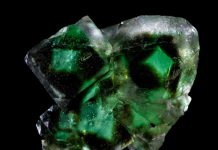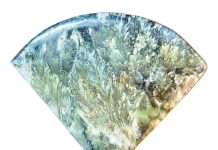

Ithaca, Greece, is famous as the legendary homeland of Odysseus, the hero of Homer’s epic poem The Odyssey. Beyond its connection to ancient mythology, this Ionian island reveals a remarkable geological landscape. It has been shaped by millions of years of natural processes. Near the village of Anogi, towering limestone monoliths rise from the rocky terrain. The monoliths are part of the Kefalonia and Ithaca UNESCO Global Geopark. These unusual formations connect the island’s geology with its rich archaeological record, local traditions, and the enduring legends of Odysseus.
The natural outcrop of limestone monoliths near Anogi is known as Geosite Number 41. It is located at an elevation of about 1,800 feet. Scattered across the landscape, these formations create a dramatic rocky terrain shaped by karst processes. Their unusual forms have become intertwined with ancient Greek legends, local traditions, and the island’s verified archaeological history.
Ithaca and its monoliths are receiving renewed attention with Christopher Nolan’s film adaptation of The Odyssey. The movie stars Matt Damon as Odysseus and Anne Hathaway as Penelope, bringing the legendary journey home after the Trojan War to a new generation. Beyond the myths, the real island reveals a fascinating story of geology, history, and human connection. Here’s more about the natural formations and the legendary landscape of Odysseus’ homeland.
Key Takeaways
- Ithaca, Greece, is a mountainous Ionian island known as the legendary home of Odysseus from Homer’s The Odyssey.
- The monoliths near Anogi are natural limestone formations created by karstification, the gradual dissolution of limestone by water.
- The island’s unusual rock formations are part of the Kefalonia and Ithaca UNESCO Global Geopark.
- Ithaca’s geology, archaeology, and mythology are closely connected, with evidence of ancient settlements dating back thousands of years.
- Visitors can explore natural landscapes, archaeological sites, and museums that reveal the island’s long history.
Ithaca, Greece, Monoliths: Natural Rock Formations vs. Ancient Megaliths
Monoliths are natural geological rock formations made out of a single massive block of stone. The term monolith comes from the Greek words ‘monos,’ meaning ‘single,’ and ‘lithos,’ meaning ‘stone.’
A megalith is a very large stone constructed or put in place by people, especially by ancient civilizations. Examples, such as the Stonehenge megaliths or the Cyclopean Walls, were often arranged in a significant, purposeful, monumental manner. The root ‘mega’ refers to something huge, gigantic or abnormally large.
Monoliths are considered natural menhirs or long stones. The term menhir refers to a standing stone or an upright lith. It is adopted from the Brittonic languages (men = stone + hir = long). But it actually applies mainly to stones emplaced in the ground by humans.

Ithaca, Greece: The Legendary Island of Odysseus
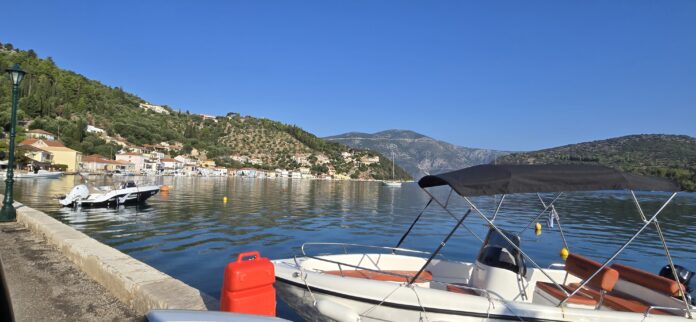
Ithaca is located in the Ionian Sea, Greece’s western body of water, northeast of the island of Kefalonia. It administratively belongs to the Prefecture of Kefalonia and is one of the seven Ionian Islands. Ithaca is easily reached by large ferries from the island of Kefalonia.
Ithaca, or Ithaki in today’s Greek language, is a mountainous island, mostly covered by limestone. Its highest peak is Mount Niritos at over 2,000 feet. Much of the coastline is steep and rocky, with isolated beaches and crystal-clear seas. This idyllic island is covered by dense olive groves, which produce excellent olive oil. Quaint villages are nestled up on the hills. The capital of Ithaca and its main port is the picturesque town of Vathy (deep), built amphitheatrically around a deep and sheltered bay.
Due to Odysseus’ wanderings, the Island of Ithaca has become synonymous with the love one feels for their birthplace and the nostalgic yearning for those living far away in foreign lands. World travelers explore its mythical essence, untouched wilderness, wildlife, and rich history with several archeological sites and museums.
The Limestone Monoliths of Ithaca, Greece
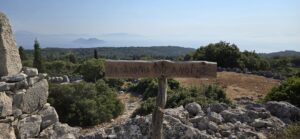
The monoliths of Ithaca are located near the village of Anogi, one of the island’s oldest settlements. The name Anogi means “at the top of the world.” This is fitting for this elevated plateau at the foot of Mount Niritos. The landscape is scattered with unusual limestone formations. These create a dramatic rocky setting reached by a winding paved road that climbs inland from the port of Vathy.
The monoliths were shaped during the Upper Cretaceous period through karstification, the gradual dissolution of limestone by water. They are the insoluble remnants of limestone rock left behind as surrounding material was weathered away. Elongated, smooth, and sometimes naturally standing upright, these formations have inspired local names based on their distinctive shapes and appearances.
Araklis and the Natural Sculptures of Ithaca
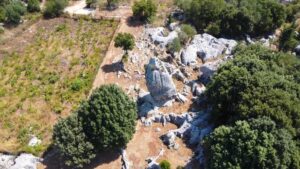
The first view of the scattered monoliths appears at an area known as “Anogi’s Threshing Floors” just before entering the village. A small sign along the road directs visitors toward Araklis, the largest and most impressive of the formations. The monolith’s name is connected to Herakles (Hercules), the ancient Greek hero, reflecting the continuing relationship between the island’s geology and mythology.
Standing 27 feet tall, Araklis has a spindle-shaped form with a sharp peak balanced on a wider pedestal-like base. Its naturally formed grooves and weathered surface appear almost carved, but they are the result of erosion and the long interaction between limestone and water. The formation stands as a striking example of how natural processes can create landscapes that inspire human stories.
More than a dozen additional monoliths are scattered throughout the area. Their unusual shapes have earned them names such as the cobra, dolphins, tulip, Odysseus’ palm, sheikh, seahorse, little turtles, spinning top, and mushrooms. Another notable formation, Kavelaris (“the rider”), was named for its resemblance to an equestrian figure.
Odysseus and Ithaca, Greece: The Island Behind The Odyssey
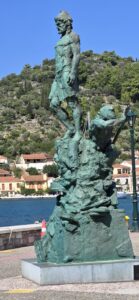
Odysseus is considered one of the bravest Greek leaders who took part in the Trojan War. He was the inventor of the Wooden Horse, which gave the Greeks the victory. We follow Odysseus during his travels first in the Iliad, where Homer tells the story of this charismatic leader, celebrated for his courage, eloquence and shrewdness, and then in the Odyssey, upon his remarkable return voyage from the Trojan War to his island kingdom. His wanderings and adventures after he and his companions sailed from Troy lasted over 10 years and feature some of Greek mythology’s famous legends.
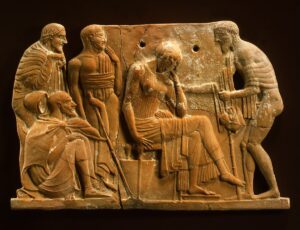
Odysseus’ wife, Penelope, is known as the legendary faithful and patient wife who refused her suitors and conspirators until her husband’s return. Odysseus succeeded at a bending-bow challenge, threw off his disguise as a beggar, and revealed himself to his family. After reuniting with Penelope and his son Telemachos, he defeated the suitors and restored peace to Ithaca. Odysseus is considered the hero of peacetime, an intrepid explorer and celebrated traveler. He is also known by the Roman name Ulysses. Two wonderful terracotta reliefs of Odysseus and Penelope exist from Milos, ca 450 B.C., one at the Louvre Museum in Paris and one at the Metropolitan Museum of Art in New York.
Ancient Ithaca: Archaeology, History and the Search for Odysseus
The island has been inhabited since the late Neolithic period (late 5th/4th millennium B.C.), with a flourishing civilization developing during the Early Bronze Age around 3200 B.C. Ithaca reached prominence during the Mycenaean period (1500 to 1100 B.C.), when the island’s location placed it along important maritime routes connecting the Ionian, Adriatic, and Mediterranean Seas.
Archaeologist Heinrich Schliemann, famous for his excavations at Troy and Mycenae, mistakenly identified the ruins of the ancient city of Alalkomenes, dating from the 6th century B.C., as the city of Odysseus. The prehistoric citadel, known locally as “Odysseus Castle,” is located at Aetos, about 3 miles southeast of the capital city of Vathy.
In northern Ithaca, near the town of Stavros and northwest of the monoliths at Anogi, lies the ancient settlement of Pilikata, dating to the 3rd millennium B.C. Archaeologists believe this area may have been associated with the palace of Odysseus, although the exact location of the legendary king’s palace has not been confirmed.
Archaeological Evidence of Odysseus on Ithaca
Near Exogi, archaeological excavations have revealed what researchers identify as the Odysseion, a sanctuary or hero cult site dedicated to Odysseus. The location, known since the 19th century as “Homer’s School,” has produced flint artifacts and pottery fragments from the Late Neolithic era, along with Bronze Age pottery dating from the late 14th and 13th centuries B.C. Researchers believe the sanctuary played an important role in the religious and civic life of Ithaca during the Hellenistic and early Roman periods.
A terracotta shard from the Cave of the Bay of Polis contains the engraved dedicatory inscription EYCHIN ODYCCEEI (“ex-voto to Odysseus”), dating from the Late Hellenistic era (2nd century B.C.). The artifact, now displayed at the Archaeological Collection Museum in Stavros, is one of several discoveries connecting the island with the worship of Odysseus. Two additional inscriptions bearing Odysseus’ name and a miniature bronze bust depicting the hero further support evidence of an Odysseus cult on the island.
Artifacts from nearby excavations are also preserved at the Archaeological Collection Museum in Stavros, including Hellenistic gold earrings, flint artifacts, pottery, and bronze tripod cauldrons from the Polis Cave Sanctuary (8th–7th centuries B.C.). These cauldrons likely served as offerings or symbols of status rather than everyday objects, reflecting the importance of seafaring and ritual traditions on ancient Ithaca.
Frequently Asked Questions
Where is Ithaca, Greece?
Ithaca is one of Greece’s Ionian Islands, located in the Ionian Sea northeast of Kefalonia. The mountainous island is known for its rocky coastline, olive groves, historic villages, and connection to ancient Greek mythology.
Is Ithaca, Greece, really the island of Odysseus?
Ancient writers identified Ithaca as the homeland of Odysseus, the legendary king and hero of Homer’s The Odyssey. Archaeological discoveries on the island, including sites associated with an Odysseus cult, provide evidence of the island’s long-standing connection to the legendary figure.
What are the monoliths of Ithaca?
The monoliths of Ithaca are natural limestone formations found near the village of Anogi. They were shaped by karst processes, in which water slowly dissolves limestone, leaving behind unusual rock towers and boulders.
Are the monoliths of Ithaca man-made?
No. The monoliths of Ithaca are natural geological formations, not ancient monuments. Their unusual shapes inspired local names and legends, but they were created through natural erosion and limestone dissolution.
What type of rock forms the monoliths of Ithaca, Greece?
The monoliths are made of limestone formed during the Upper Cretaceous period. Over time, water dissolved portions of the limestone, leaving behind the distinctive isolated formations seen today.
Ithaca, Greece, is more than a legendary setting from Homer’s The Odyssey. Its mountains, limestone landscapes, archaeological sites, and unusual monoliths reveal an island shaped by both natural forces and human history. The formations near Anogi demonstrate how geology can become intertwined with local traditions, ancient stories, and the cultural identity of a place. Whether explored through mythology, archaeology, or earth science, Ithaca remains a remarkable example of how landscapes preserve the stories of the past.
Discover more fascinating destinations, minerals, fossils, and geological wonders from around the world in Rock & Gem magazine. Subscribe today and continue exploring Earth’s treasures. Ithaca, Greece, story and photos by Helen Serras-Herman.