

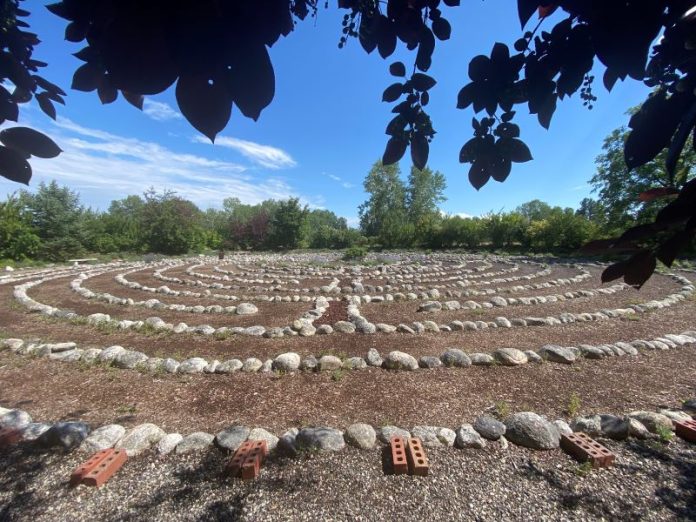
History of the Stone Labyrinth
No one knows when or how labyrinths began. There seems to be an innate connection to human consciousness, regardless of time and culture. The current thought is that some of the earliest examples are found in prehistoric petroglyphs. These are in the provinces of Pontevedra and Vigo in Northwest Spain, with small designs carved into rock outcroppings.
“It has mysterious origins,” says Lisa Gidlow Moriarty, a master labyrinth builder and facilitator, and owner of Paths of Peace in Stillwater, Minnesota. Moriarty also notes they are found throughout the world in almost all cultures. It is fascinating that these societies had no cross-contact and therefore no influence upon each other. However, similar designs are consistent throughout the cultures.
Scandinavia, particularly in Sweden, is known to have hundreds of labyrinths constructed with stones, around 400 to 500 A.D. They were integral in the tribal cultures of the Bronze Age. Lasting centuries, traditions evolved within societies, such as the practice of fishermen walking a labyrinth before heading to sea to confuse any evil spirits, leaving them trapped within the spiral.
Stone Labyrinth Resurgence
Throughout Europe, Medieval labyrinths experienced a resurgence in the twelfth century. During this era, pilgrimages grew in popularity within the Catholic church, but for those who couldn’t travel to Jerusalem or other holy places, walking a labyrinth served as their time of contemplation and prayer. Built around 1200, the famous labyrinth at the Chartres Cathedral in France is an excellent example of this purpose and is a touchstone for those seeking a new path to this day.
While we understand the reason for building labyrinths in cathedrals, experts wonder why prehistoric cultures created these symbols in rock and what they represent. Moriarty says, “Even one of the Nazca lines in Peru is a labyrinth image. It’s part of the mystery. Why are people attracted to this?”
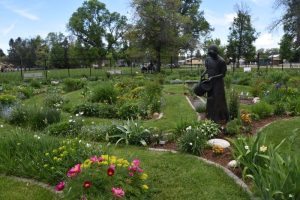
Designing the Redsun Labyrinth
An interest in labyrinths always seems to have a simple beginning. Patty Meyer in Victor, Montana, learned of a canvas labyrinth event in Missoula, but couldn’t make it. Friends who walked the path shared their remarkable experiences, setting her on a course to work with Dr. Lauren Artress, creator of the non-profit organization, Veriditas, author of multiple books on labyrinths, and the veritable godmother of the movement. Meyer joined Dr. Artress at Chartres and ultimately became a facilitator. Then she wanted to build one.
The good news is she had the space —and, most importantly, an industrious and willing husband, Helmut — to create a stone labyrinth that has touched thousands of people for nearly 25 years.
Looking at their property, the Helmuts determined the general area for the labyrinth in their pasture. “Once we decided on that spot, two or three of us dowsed (separately) where to put it, and we all came up with the same spot,” says Helmut Meyer.
Building the Redsun Labyrinth
From there, he scraped off the topsoil, creating a berm around the circle. They covered the area with landscape fabric, determined the center, and, using a tape measure, measured out the design, which was then marked with spray paint.
Designed in the same manner as the eleven-circuit labyrinth in the Chartres Cathedral, at 108 feet in diameter, the Redsun Labyrinth is one of the largest in the country. Meyers intentionally designed the paths to be three feet wide to accommodate wheelchairs. Plus, he notes the wide paths allow two people to pass when multiple people are walking the labyrinth.
Danny, a young man of around 16 at the time, helped them haul approximately 25 tons of fieldstones from the neighboring fields (eventually earning enough money during the project to buy his first truck), and learned how to set them.
“Every rock up there was handled two, three, four times. You want the mossy green and granite look,” explains Meyer. “Each rock would tell us where they wanted to be. They talk to you.” Sometimes this meant hauling them across the labyrinth, but part of the process involved utilizing their intuition to place the rocks properly.
Opening and Public Impact
From its inception, the project took close to five years. Projects involved cutting up large cottonwood trees to outline the area with a three-foot berm; planting hundreds of shrubs and plants (particularly the 200 lavender plants); eventually installing a drip system to eliminate hand watering; and building a fence around the labyrinth to dissuade hungry deer and elk.
The Redsun Labyrinth opened to the public on December 31, 1999 — the infamous Y2K — and was greeted by nearly 350 visitors from all over the region, one woman even driving almost seven hours from Malta, Montana, to attend the event.
Meyer says it was a dry winter that year, and they lined the paths with luminaries welcoming the new year and new century. “We were astonished,” he says. “It’s created its own life over the years. It’s been amazing for a lot of people.”
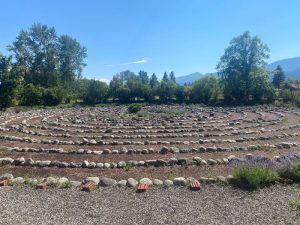
How the Labyrinth Touched Lives
The Redsun Labyrinth was special from the beginning, but Meyer says shortly after its debut, they learned something new about it. “There was a fellow who came a month after it opened to the public,” he says. They had a foot of snow on the ground at that time, so the gentleman left his mother, who couldn’t walk very well, in the car at the gate and headed to the labyrinth.
Meyer says the man didn’t talk much, but when he returned 20 minutes later, he said, “Yup, it’s real. It’s an antenna.” That piqued Meyer’s attention.
“These are granite field stones, and granite has magnetism to it, and this man could sense that magnetism,” Meyer says.
The Redsun Labyrinth remains open to the public and is a testimony to the heart and vision of Patty, who passed in 2015, offering those who visit an opportunity to walk in the peace of this special place.
Why Labyrinths Matter Today
The positive impact of labyrinths ripples through people’s lives when it is most needed. “The interest ebbs and flows, and they become popular when society is going through turmoil and chaos,” says Moriarty. “Teaching people to use the labyrinth for self-control and mindfulness is so valuable for the world today.”
Janice Lewis, an advanced certified labyrinth facilitator through JaniceTime.com in Chicago, where she works extensively with underprivileged groups, oftentimes takes her canvas labyrinth, created by Moriarty, to the Buckingham Fountain, where she invites people to walk it.
“I have no blueprint for why people walk the labyrinth or what they get out of it,” she says. “I’ve never heard the same story.”
From her experience, it undoubtedly changes lives. She shared the story of working with one of her teen groups, where a couple of young men sat to the side. Sitting down with them, she learned they both were struggling over the tragic loss of loved ones. After eventually walking the labyrinth themselves, she says they thanked her that evening when they left.
“I hope to stop future violence with one breath at a time, and one step at a time within the labyrinth,” she says.
Expanding Labyrinth Locations
Lewis and Moriarty are also closely involved with the Labyrinth Society, which strives to educate and connect enthusiasts. Created 25 years ago, the Labyrinth Society has substantially expanded, owing to the growing awareness of these ancient designs, and they list over 6000 labyrinths found throughout the world.
Moriarty noted that now labyrinths are located everywhere, from schools, churches, healthcare facilities, city parks, and on private property. The way they are built and how they are used is dependent on their location.
“The way I look at labyrinths, I don’t know where they truly begin,” says Lewis. “But I am thrilled when I hear of a new labyrinth that has been birthed.”
Labyrinth Design Ideas and Materials
Moriarty leads groups and educates people about this beneficial practice. She’s been professionally designing labyrinths since 1999. As she worked on patterns and projects, she had as many as 15 at a time at her own place.
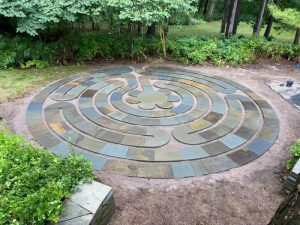
“My property is like my artist canvas,” she says. Whether it’s designing a cloth labyrinth for a portable experience or implementing a laser-cut bluestone labyrinth that is bound to be a cherished treasure for generations, she pours her heart into the projects.
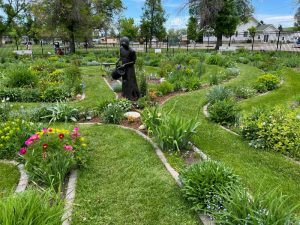
“There are so many different ways and mediums in which to create them,” she says. Some are as simple and temporary as mowing a path in the grass or drawing lines in the sand. Longer-lasting installations involve using brick or concrete to shape the design, as well as field stones, as the Meyers used to create the Redsun Labyrinth. Some enthusiasts plant gardens in or around them as a way of bringing flowers to the experience.
Stone Labyrinth Patterns
Patterns also vary widely. A concentric labyrinth, where there is an entrance with a path that leads to the center and back out the same direction, is one of the most popular designs. The number of circuits involved is the number of times the path crosses the center and the outside edge of the labyrinth, and many larger structures are either seven or eleven circuits, such as the renowned labyrinth at Chartres Cathedral.
Moriarty noted that during and after the pandemic, additional considerations came to the forefront when it comes to labyrinth design. More people sought labyrinths with wider paths — some even 10 feet across — to offer social distancing. Creating wide paths to adapt to people’s physical limitations is also something more people think about when they’re creating a new one.
Stone Labyrinth Frequently Asked Questions
What is a stone labyrinth?
A stone labyrinth is a walking path built using stones arranged in a spiral or circuit pattern that leads to a center and returns outward, often used for meditation, reflection, or contemplation.
How is a stone labyrinth different from a maze?
A labyrinth has a single, non-branching path that leads to the center and back out, while a maze has multiple paths, dead ends, and choices.
Where is the Redsun Labyrinth located?
The Redsun Labyrinth is located in Victor, Montana, on private land and has been open to the public for decades.
How big is the Redsun Labyrinth?
It measures approximately 108 feet in diameter and is designed after the eleven-circuit labyrinth at Chartres Cathedral in France.
How long did it take to build the Redsun Labyrinth?
The project took about five years from planning to completion, including landscaping, stone placement, and planting surrounding vegetation.
Can people walk the Redsun Labyrinth?
Yes, it is open to visitors and designed with wide, accessible paths suitable for wheelchairs and group walking.
Why do people walk labyrinths?
People walk labyrinths for meditation, stress relief, spiritual reflection, and mindfulness, often describing the experience as calming or transformative.
For those who wish to step into their labyrinth journey, Lewis reminds us that World Labyrinth Day is the first Saturday in May. Walks are planned by enthusiasts throughout the world, and offer an excellent opportunity to first-time visitors, along with those who already love them, to step together along this peaceful path.
To find labyrinths in your area, as well as resources and events, visit labyrinthsociety.org.
This story about the stone labyrinth history and design previously appeared in Rock & Gem magazine. Click here to subscribe. Story by Amy Grisak.