
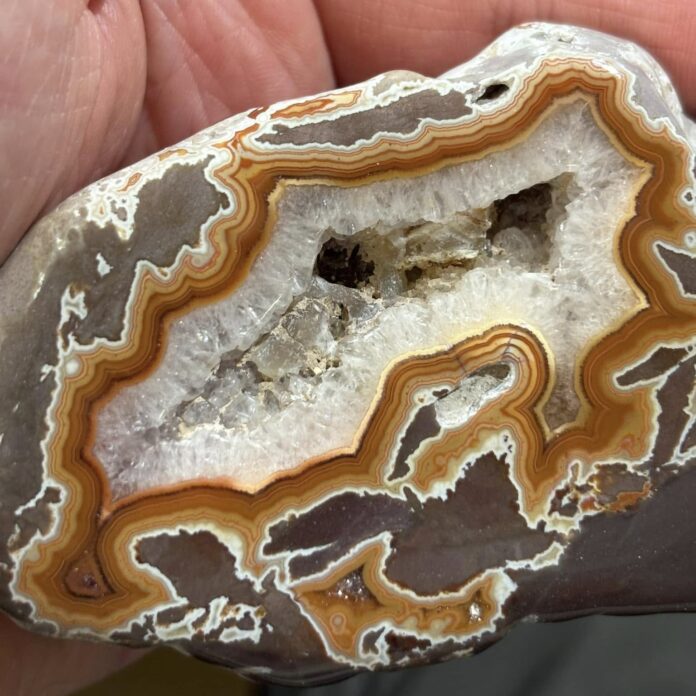
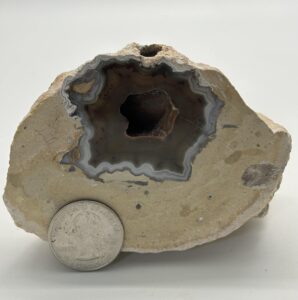
How to open a geode is part science, part surprise, and part pure satisfaction. The cracking and cleaning of these popular “stone eggs” is no yolk. Beneath their unassuming exteriors can lie stunning clusters of crystals or banded layers of agate waiting to be revealed.
From their Latin and Greek origins meaning “earth-like,” geodes have long fascinated collectors and beginners alike. Inside what looks like an ordinary rock, nature may have hidden a hollow cavity. This can be lined with quartz, calcite, or other mineral formations that form over thousands or millions of years.
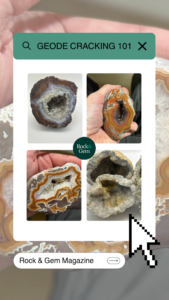
Knowing how to open a geode means you get to reveal its hidden interior. A prize-winning sense of discovery that doubles as a fun, hands-on introduction to geology. It’s also fueled a growing social media following, where the satisfying “Pop!” of a geode breaking open has become a popular form of ASMR (Autonomous Sensory Meridian Response). This is valued for its oddly calming and sensory appeal.
“The first geodes I cracked open were sent by a subscriber to my YouTube channel, which turned into a good friendship, big thanks @GeodeCrackerCollector,” says a Minnesota geode collector (Taylor) who goes by @AgateDad. “I’m late to the cracking game. I was in my late twenties when I cracked those. Geodes are my second favorite mineral. Agates are first.” He has 188,000 subscribers happy to watch him open everything from Oregon thunder eggs to agatized corals.
Geode vs. Agate: What’s the Difference?
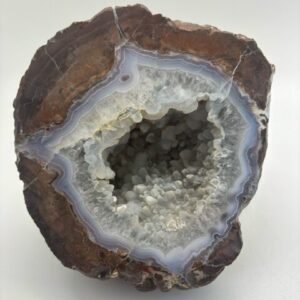
What’s the difference between a geode and an agate? In short, a geode is a hollow rock, with a crystal-lined cavity inside, found mostly in basaltic lavas or limestone. Agates are solid, usually banded, stones formed from accumulated layers of silica inside volcanic or sedimentary rock cavities. Agate (or opal) also composes the solid, often star-shaped core of another popular collectible, geodal thunder eggs.
Why Geodes “Pop” When You Open Them
That geode “pop” is part of the origin story to The Geode Guys. This Colorado father/son team of Leo and Dusty Atkinson shares nearly 60 years of experience. They educate, entertain, and expertly pop stones on their “Geo-tine” (guillotine for geodes).
What makes a geode worth cracking? The answer is more nuanced than how large or small a stone appears.
How to Choose a Geode to Crack Open
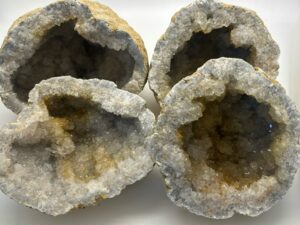
“The most important element to consider when trying to crack a geode of any size is how hollow is it?” Dusty says. “Are the host matrix layers hard or soft minerals? A 12” diameter Moroccan geode that’s almost completely hollow, with a super-thin chalcedony wall holding it together, will be easier to crack than a 3-inch Mexican Choya geode with a 1-inch layer of hard-banded agate on either side of the outer crystal pocket.”
Identifying your most hollow specimens first will increase your chances of opening one successfully and finding a nice pocket inside.
Eric Carlson, of Carlson’s Rock World, a small-town rock shop in Goldfield, Iowa, says that, especially for kids and first-timers, Moroccan geodes are a good choice. “They are very hollow and easy to crack with a hammer or chisel and filled with clear quartz.
“My geode addiction started when I was seven or eight, collecting them from a creek at my grandparents’ farm. I did my first rock show when I was 16 with self-collected geodes from Iowa. My kids know to always put their geode in an old sock. Then they hit it with a hammer, so there’s no worry about flying rocks or chips. I usually saw geodes instead of cracking them and have a fun popper.”
How to Open a Geode: Hammer, Scoring, and Cutting Methods
If you want evenly split specimens, your next steps for how to open a geode may vary.
“There are two tried-and-true methods,” says Southern California rough-cut gems and minerals supplier, John E. Garsow, “and no, a hammer is not your first choice. It’s the tool of last resort. A hammer may open a geode but more than likely is going to shatter it into pieces.”
“If you’re okay with the possibility of getting a few ‘extra pieces,’” Dusty adds, “you can jump right in using a hammer and masonry chisel. But if you’d like to increase your odds of getting even halves, take the extra time to score the geode around the outside, creating a line around its center diameter.”
For how to open a geode, the easiest scoring is with a rotary tool (Dremel) with a diamond wheel. To extend the life of a wheel, spray it with water to keep it cool during use. “Scoring” Dusty explains, “will create an artificial ‘fault line’ where it will (most likely) crack when a hammer and chisel are applied to the weakened surface.”
The two methods John referred to for how to open a geode involve saws or pipe cutters.
“A [diamond-coated] rock saw is a preferred method,” he says, “followed by pipe clamps, which use a chain to apply pressure equally around the entire geode. It’s the quickest way to open them, where you will get two reasonably equal halves.”
Best Tools and Safety Tips for How to Open a Geode
“I used a hammer and 7-inch tile saw to crack and cut my first geodes,” says AgateDad. “A lot of experienced geode crackers use pipe cutters and get great results. I prefer to cut them on lapidary saws to get a clean-cut face. It makes it easier afterward to polish display pieces especially. And always wear eye and ear protection. I choose to wear a respirator when cutting minerals or fossils to avoid lung issues like silicosis.”
“The last method available for the average person without dedicated lapidary saws,” says Dusty, “is a tile saw. Though more dangerous than other methods, and with certain size constraints of usually 3.5-inches and smaller, tile saws get a nice flat finish. This leaves the option – if desired – to polish the geode halves.
“Anyone implementing a tile saw for cutting geodes should exercise extreme caution, as they are now dealing with a power tool and using it for a purpose other than what it was made to do.”
Essential Tools for How Open a Geode
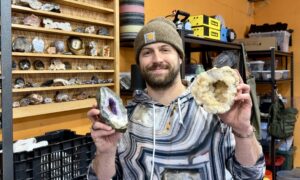
Basic cracking tools for how to open a geode include safety glasses, a hammer, a chisel, and a clamp to hold the geode. The Geode Guys suggest the DASCO Pro G436 Brick Set with TargetGuard 3.5-inch and high carbon steel blade (under $20 on Amazon.com) for a basic chisel and, for clamps, the Dremel Rotary Tool Multi-Vise, 3-in-1-Attachment, 360 Stationary Vise, Stand-Alone Clamp and Tool-Holder, 2500-01 (under $45 on Amazon).
Since The Geode Guys specialize in (primarily) unopened geodes with a diameter of 10 inches or less, what do their “pro workhorses” look like?
For cutting and scoring, it’s trim saws because “They allow you to ‘free hand’ the geodes, as opposed to clamping them into a vice, which is how slab saws operate. We operate 10”, 8” and 6” trim saws in our shop, which may sound redundant but given the number of geodes we cut and score for customers – and our own pleasure – we like to keep a different diameter blade on each saw.
“On the 6-inch saw we run a 6” x .020 blade for cutting or scoring very small geodes, like Tabasco and Oco. The 8-inch is an HP production saw that runs very true and powerfully, so we can work through lots of geodes in a short time. Lastly, the 10-inch trim saw usually has a 10” x .55 blade for cutting and scoring geodes up to 4-inches in diameter.
Professional Geode Cutting Equipment and Saws
“Those saws cover about 90% of the geodes that we sell. People do request cutting open Jumbo (5-inch or more) geodes for them, in which case we utilize a 16-inch drop saw or – in rare cases – 20” Clipper masonry saw. Some shops run up to a 36-inch drop saw, which is the largest non-special order lapidary saw available on the market.
“There is one more saw variety larger than a 36-inch saw and that’s a wire saw. Wire saws operate by running a diamond-encrusted wire around the rock and threading it back through a motor/arbor. Over time it will slowly wear its way through the rock. However, diamond wire saws are prohibitively expensive and usually used only in the mining and construction industries.”
Carlson’s Rock World
How to Clean a Geode After Opening
You’ve opened your geode – now what? Water, a gentle detergent and toothbrush or small hand brush are reliable places to start cleaning your spiffy new specimen without raising concerns about damaging it.
“My philosophy,” says Dusty, “is to start with the gentlest solutions and progress to more aggressive methods if needed.” Dawn® dish soap and a firm toothbrush are usually all it takes to clean out most loose dirt. “A more aggressive, but still mild method is toothpaste. Its baking soda and grit helps on more caked surfaces.
“If you give it a scrub and stains persist, try step two: vinegar. For mild/moderate cleaning of calcium-based stains, vinegar (acetic acid) works wonders.”
Start with a soak in white food-grade (5%) household vinegar but if there’s still residue, “Jump up to pure (or horticultural-level) vinegar at a 35%-40% grade. Let the affected area soak for 12-48 hours depending on how severe the stain. One thing to be careful about with this method is, if you have cal-cites you are trying to preserve, vinegar will dissolve anything calcium-based, including your calcites.”
Advanced Methods for Cleaning Stained Geodes
But even nature may need a little help. For instance, creek geodes found in streams or along rivers might require a pressure washer to remove algae found on, or having seeped into, a stone. Hint: If using a pressure washer, put your geodes in a bucket or container so they don’t hurtle across the lawn! Or try a Textile Spot Cleaning Gun ($50-$100) to aim a concentrated stream of water into crevices inside crystals.
“Occasionally, when a geode is opened you encounter staining of the crystals inside, usually from seepage of an outside element into the pocket while in the ground,” Dusty adds. “When this happens, there are a few methods for cleaning more aggressively.”
Chemical Cleaning and Safety for Geodes
Naturally broken or otherwise ‘found’ geodes may have unattractive calcification along their edges, which can come clean after a few hours of fizzing in a bucket containing a mixture of water and muriatic acid.
“Muriatic acid is the final step in a cleaning/staining arsenal and should only be used after every other method has been exhausted,” Dusty says. “It is very caustic and can dissolve materials – including skin – if exposed.”
Always wear protective eyewear when using this acid, use it only in a well-ventilated area (do not inhale the fumes), use chemical-grade rubber gloves when handling/rinsing geodes afterward. “Keep some baking soda nearby to neutralize the acid in a hurry if needed.”
The effervescence of muriatic acid “eats” the calcification, but check back on your geodes every half an hour, as some crystals may break off in the process and, as an acid, should not be used on more porous or delicate stones.
For stubborn stains, AgateDad found success using the rust and hard water cleaning product Iron Out® to remove yellowing from an Indiana geode. He immersed the geode face down in a bucket of water with a tablespoon of Iron Out and 24 hours later, the water was yellow and the geode a brighter, crystalline white. Similarly, for calcium-based sediments, try Lime-A-Way bathroom stain and rust remover.
Ultrasonic Cleaning for Geodes
For cleaning or polishing, sometimes all it takes is good vibrations.
Ultrasonic chambers for cleaning jewelry can clean geodes, especially those with cavities too deep to reach with a brush. A chamber is filled with water and a gentle cleaning detergent, heated (130°F-180°F), and ultrasonic vibrations force tiny ‘scrubbing bubbles’ to pop to the surface.
To polish your new halves, try a flat-lap vibrating rock polisher like the Covington or Lortone Vibra Lap. Each geode piece will need to be weighted, face down, on the vibrating surface (Dusty goes by a pound of weight for every inch of geode to be polished). The benefit of weighting is that all sides of your geodes will polish evenly and efficiently.
Before you start, run a permanent marker across the surface of your geode – when the ink is gone you’ll know you’ve ground a layer off (but be careful about using permanent marker on porous materials, like calcite). Start your pre-polish with a grit in the 90-120 range, run the Vibra Lap for a couple of hours and clean and spray your geodes before moving to grits of 220 and 600 in the final pre-polish steps. Moving on to a polish pad, Dusty says tin oxide works well. “Cerium (oxide) is popular but, through trial and error, I like tin oxide as my best all-around polisher. I like to go for a mirror-like polish and that’s not always easy to get.”
Frequently Asked Questions – How to Open a Geode
What is the easiest way to open a geode?
A hammer and chisel method is the simplest, but scoring first improves results.
Can you open a geode without breaking it?
Only with saws or pipe cutters designed for clean splits.
Are all geodes hollow?
No, some are solid or partially filled with crystal or agate.
What is inside a geode?
Quartz, calcite, amethyst, or banded agate, depending on origin.
How to Open a Geode – Final Thoughts
What’s the last, best piece of advice about how to open a geode? From one rock hound to another, The Geode Guys might just say it best: “Admire and bask in the incredible beauty that Nature has created. Show them to friends and family and spread the wonder of geodes!”
This story about how to open a geode previously appeared in Rock & Gem magazine. Click here to subscribe. Story by L.A Berry.