
Cripple Creek turquoise has long been recognized for its rarity and distinctive quality, with the Florence Mine in Colorado producing some of the finest examples. Among these, Burtis Blue Turquoise™ stands out for its vibrant colors, low porosity, and exceptional hardness, making it highly prized by gem collectors and jewelry makers alike.
The Florence Mine has consistently revealed rich pockets of turquoise, with mining over the years uncovering significant quantities of high-quality stones. Observations of the mine’s veins suggest that much of the turquoise deposit remains untapped, indicating the potential for continued discoveries of Burtis Blue Turquoise™ in this historic Cripple Creek turquoise site.
The Legacy of Burtis Blue Turquoise
Burtis Blue Turquoise™ is a naturally hard, low-porosity stone prized for its vivid colors and durability that ranks with the finest Cripple Creek turquoise ever mined. First mined more than 75 years ago, Burtis Blue has only recently gained wider recognition for its exceptional quality. Unlike most turquoise on the market, which is often treated or stabilized, Burtis Blue is 100% natural, with laboratory testing confirming its untreated purity.
“The big reason for the success of Burtis Blue Turquoise™ is that it is 100% natural,” said Clint Cross, manager of the Florence mine in Cripple Creek, Colorado. “We have laboratory reports to prove it, and we guarantee it because we maintain complete control over our stones from mining to marketing.”
The Florence mine is one of Colorado’s five turquoise occurrences, all of which were visited by Native Americans who collected bits of turquoise. But unlike certain other Native American cultures in New Mexico and the Southwest, those in Colorado neither venerated turquoise nor mined it as a trading commodity.
History of Cripple Creek Turquoise Mining
Colorado’s early prospectors had a similar lack of interest in turquoise. Most prospectors were unfamiliar with it and, if they found it at all, dismissed their discoveries as minor occurrences of oxidized copper minerals that did not justify mining. Those who did recognize turquoise probably lacked the gemological and marketing background necessary to realize its value.
The Florence mine turquoise deposit came to the attention of miners following the great Cripple Creek gold strike of 1892. By 1900, Cripple Creek, 9,200 feet high on the western shoulder of Pikes Peak, was a bustling city where hundreds of mines collectively turned out one million troy ounces of gold per year. But the attention of the thousands of miners who milled about the booming district was focused only on gold, not turquoise.
Gold prospectors dug thousands of prospect holes, including several on the site of today’s Florence mine. Although some collected bits of turquoise from the surface to sell as novelty items, none attempted to mine the deposit.
The modern story of Burtis Blue Turquoise™ began in 1938 at the end of the Great Depression, when Wallace C. Burtis arrived with his family in Cripple Creek. Burtis worked as a musician and prospected for gold in his spare time. One site that interested him was the Emma Palmer, an inactive, 20-acre placer claim. Although the claim had produced little if any gold, Burtis became intrigued by a small exploration tunnel that yielded bits of turquoise.
Cripple Creek Turquoise Mining and Processing Techniques
Burtis bought the Emma Palmer in 1939, renamed it the Florence Lode, and eventually patented the claim. Over the years, he mined small amounts of turquoise and taught himself gem cutting, silversmithing, and jewelry making—interests and skills that he passed along to his son Wallace F. “Wally” Burtis.
During the 1940s, Wally and his father worked the little tunnel together, manually drilling holes with hammers and hand steels, blasting with dynamite, and hand-tramming the broken rock to the portal in a tiny, half-ton ore car. But because unstable rock made the tunnel dangerous, the father-son turquoise-mining team abandoned it in 1950 and began mechanically excavating an open pit.
When Wallace passed away in 1982, Wally continued mining Cripple Creek turquoise, mainly to fashion into gems and jewelry for gifts or to add to the growing family collection. Wally’s careers as a machinist and later as a teacher left no time for serious mining and marketing, but he occasionally exhibited his Cripple Creek turquoise at gem and mineral shows and sold some to Native American jewelry makers in Arizona and New Mexico.
Wally later marketed his stones under the name “Cripple Creek Natural Turquoise”. But after undergoing back surgery in 2010, the mining and marketing stopped.
Cripple Creek Turquoise
That year, Wally, then 80 years of age and needing help with the mine, teamed up with Clint Cross. Clint, a member of the Sokoki tribe of the Missiquoi Abenaki Nation, a Native American culture of the northeastern United States, had 12 years of experience in mining and marketing turquoise.
Clint began by supervising the manufacture of jewelry from Wally’s stock of previously mined turquoise. His jewelry makers included such accomplished Colorado and New Mexico artists as Ray Lovato, Ken Nord, and Katie Picken. In 2013, Clint resumed mining and began marketing stones under the new name of “Burtis Blue Turquoise.”
Turquoise, a hydrous basic copper aluminum phosphate with the chemical formula CuAl6(PO4)4(OH)8•4H2O, is a rare oxidized mineral that forms under specific mineralogical conditions from the weathering of rocks containing aluminum, copper, and phosphate minerals.
With Cripple Creek turquoise, these conditions came together amid some unusual geology. Cripple Creek rests atop a caldera, or collapsed volcanic system, that formed some 35 million years ago. After eruptions had relieved the underlying magmatic pressure, the entire system subsided. Renewed surges of magma and associated mineral-rich hydrothermal solutions then repetitively penetrated the fractured caldera, emplacing the large amounts of metallic gold and the gold-telluride minerals calaverite and sylvanite that made Cripple Creek the greatest gold camp of its time.
Natural Appearance of Turquoise
Situated at the edge of the Cripple Creek caldera, the Florence mine turquoise deposit is one of the district’s rare occurrences of copper mineralization. While the local gold deposits have been thoroughly studied, the turquoise deposit has received virtually no attention at all. The little that is known about its origin and extent is based upon geological interpretations of the exposed host rock and turquoise vein systems in the mine’s open pit.
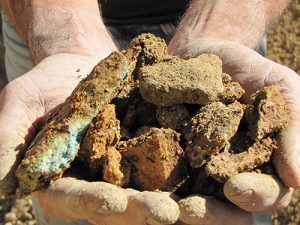
The host rock is diorite, a medium-silica, igneous rock similar to granite. Because this altered rock is soft and crumbly, miners refer to it as “rotten granite.” Turquoise occurs within the yellowish-brown, hematite-stained diorite as erratic veins and pockets that are structurally related to a hydrothermally altered fault.
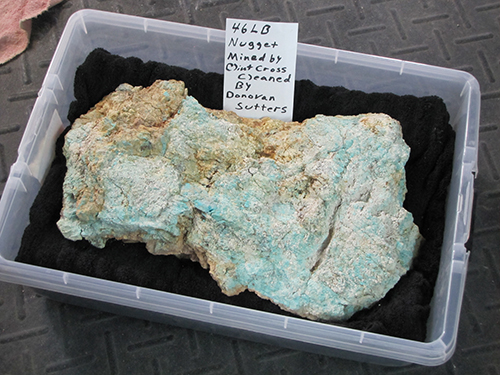
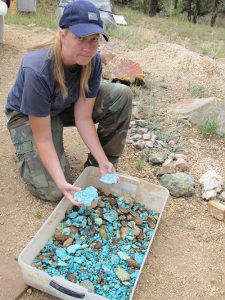
Mining begins with the mechanical removal of overburden material that does not contain turquoise. Mechanical mining stops immediately when turquoise veins are exposed. The turquoise is then mined manually with hammers, chisels, bars, rock picks and shovels.
“This is the only way we can recover all the turquoise,” Clint explains. “We manually excavate along each vein and collect the turquoise as we go. Most veins are thin, but some blossom into big pockets. Not knowing what we’ll find next is part of the excitement of turquoise mining.”
Colors, Matrix, and Natural Silicification
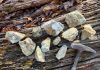
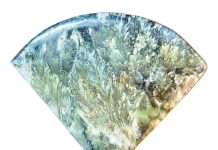
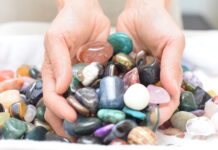
The spectrum of Burtis Blue Turquoise™ colors includes blue, green-blue, and blue-green, green, and even a delicate purple. Nearly pure turquoise has a bright, clean, “robin’s-egg” blue color. But when iron and other metals substitute for copper within the turquoise lattice, the colors shift toward green. The purple stones, called “fluorite turquoise,” are unique to Cripple Creek and are caused by the presence of purple fluorite, a mineral that is abundant throughout the caldera. This wide color range in Burtis Blue Turquoise™ indicates multiple-phase deposition by solutions with varying chemistries.
Burtis Blue Turquoise™ has an attractive matrix of brown and black veining. The brown material is limonite, a variable mixture of iron hydroxides and oxides; the jet-black veining is mostly pyrolusite, or manganese dioxide.
An extraordinary degree of natural silicification sets Burtis Blue Turquoise™ apart from turquoise from all other sources. Silicification occurs when silica-rich solutions deposit microcrystalline quartz within the pores of preexisting turquoise. High levels of silicification fix and intensify color, reduce porosity, decrease friability, and increase hardness to create turquoise of the highest gem quality.
Most turquoise is poorly silicified—the reason that virtually all turquoise on the market today is dyed to improve color, stabilized with epoxy resins, or otherwise treated to make it an attractive, workable gemstone with consumer appeal and commercial value.
Burtis Blue Turquoise™ Hardness and Quality
Turquoise generally varies between Mohs hardness 5.0 and 6.0, but because of its unusually high level of natural silicification, Burtis Blue Turquoise™ has a hardness of Mohs 7.0, approaching that of quartz. Its high structural integrity enables it to be shaped, cut, carved, drilled and polished, while its low porosity resists staining from skin oils even after many years of continuous wear.
After mining, Burtis Blue Turquoise™ is tumbled to remove adhering bits of the yellowish-brown host rock. Clint’s “tumbler” is a rotary cement mixer that he loads with 150 pounds of raw turquoise and water. He runs the mixer for two 12-hour periods, screening the load after each run. In the final step, he tumbles the turquoise for three days. The only tumbling medium used is turquoise bits that are too small for inlay or jewelry use.
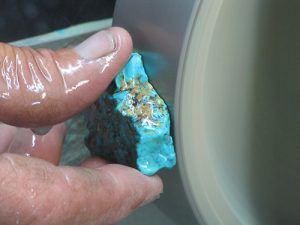
Clint sorts the tumbled turquoise by size, shape, and four general categories of color: powder-blue, sky-blue, tricolor and fluorite. He then sandblasts the turquoise that will be retained in its natural shape with 80-grit garnet at a pressure of 165 pounds per square inch to remove any features that might detract from its appearance. The turquoise is then shaped on a 10-wheel lapidary unit that is incrementally stepped from an 80-grit rough-shaping wheel to a 14,000-grit fine-polishing wheel.
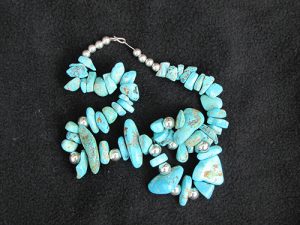
As a Native American, Clint enjoys a special relationship with turquoise. “Turquoise is a beautiful stone that has great personal significance for me,” he explains. “As a healing and giving stone, it is sacred to many Native Americans. And I feel that turquoise talks to me. The size, shape and color of each individual piece of tumbled turquoise tell me exactly how it should be used—whether as a cabochon, naturally shaped gemstone, carving block, beads, inlay, or a natural specimen.”
Burtis Blue in Jewelry and Collecting
Clint offers his own insight into the issue of turquoise treatments. “About 97% of the turquoise sold today is treated in some way,” he says. “And very few people are aware of this because dealers and jewelers don’t mention turquoise treatments unless asked about it, and then their answers are often misleading. The few folks who are aware of turquoise treatments are mostly mineral collectors, gem collectors, or others with mineralogical or gemological backgrounds.”
Education is part of Clint’s rock show presentations, in which he discusses turquoise treatments and provides examples of dyed, stabilized and reconstituted turquoise for comparison with natural Burtis Blue Turquoise.
At big shows, Clint even provides a “hands-on turquoise experience” for visitors to his booth. He invites them to help make their own jewelry by choosing a piece of rough turquoise, shaping and polishing it themselves on lapidary wheels, then watching a silversmith mount the stone in a custom silver setting.
“They then own a piece of fine turquoise jewelry that they helped to make,” Clint says. “They have a personal tie to, and an understanding of, that particular piece of natural turquoise. It’s something they can’t get by buying turquoise out of a jeweler’s showcase.”
At shows, Clint also displays reports from Stone Group Laboratories, a gemological laboratory specializing in detecting gemstone treatments.
Cripple Creek Turquoise Testing and Authenticity
Stone Group Laboratories has tested Burtis Blue Turquoise with X-ray fluorescence analyzers and with Raman, Fourier-transform-infrared, and ultraviolet-visible spectroscopy instruments. Together, these instruments reveal chemical composition, molecular structure, and bonding characteristics. They also reveal the presence of plant dyes, epoxy stabilizers, and potassium, all of which are “fingerprints” left by various turquoise treatments.
These laboratory reports on Burtis Blue Turquoise™ conclude with the statement: “No treatments were detected. Most turquoise in the commercial markets today is heavily treated with stabilizing polymers due to its friability and lack of cohesion in the cutting process. The lack of treatment and naturally attractive color sets [Burtis Blue Turquoise] apart.”
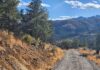
During my recent visit to the Florence mine with Clint, Louisa and Wally, the results of two years of additional mining were evident. Rim to rim, the pit is now 150 feet wide, with its deepest part 50 feet below the original surface contour.
The fault that controlled turquoise emplacement appears as a 6-foot-wide seam of altered feldspar slashing across the pit wall. Adjacent to the fault is a section of pegmatitic diorite, with greenish-blue turquoise visible amid 1-inch crystals of quartz, muscovite and feldspar. The mine has also yielded turquoise, including visible bits of the gold-telluride mineral calaverite.
Particularly interesting is what Clint calls “burnt turquoise”, which occurs in turquoise-like veins but is nearly black in color.
“This is turquoise that was completely altered, or ‘burned’, by contact with extremely hot silica solutions that penetrated the turquoise veins,” Clint explains. “These solutions most often silicified the turquoise, but were sometimes so hot that they completely altered it, leaving black manganese oxides and tenorite, a black copper oxide.”
FAQ: Burtis Blue and Cripple Creek Turquoise
Q: What makes Burtis Blue Turquoise™ unique?
A: Burtis Blue Turquoise™ is naturally hard, low in porosity, and vibrantly colored. Unlike most commercial turquoise, it is 100% untreated and fully natural, making it ideal for cutting, polishing, and jewelry use.
Q: Where is Burtis Blue Turquoise™ mined?
A: Burtis Blue comes exclusively from the Florence Mine in Cripple Creek, Colorado, one of the state’s few turquoise-producing locations.
Q: How is Cripple Creek turquoise different from other turquoise?
A: The unique geology of Cripple Creek, including hydrothermally altered diorite and natural silicification, produces turquoise with exceptional hardness, color stability, and striking veining patterns.
Q: Can Burtis Blue Turquoise™ be used in jewelry?
A: Yes. Its hardness and low porosity allow it to be shaped, polished, and set into rings, necklaces, and other jewelry without additional stabilization or treatment.
Q: Is Burtis Blue Turquoise™ treated like most commercial turquoise?
A: No. Burtis Blue is 100% natural and untreated. Most turquoise on the market is dyed, stabilized, or otherwise treated to improve color or durability.
Cripple Creek Turquoise, particularly the rare Burtis Blue Turquoise™ from the Florence Mine, represents some of the finest natural turquoise available. Its vibrant colors, natural hardness, and untreated purity make it highly valued by collectors and jewelry makers alike. With much of the deposit still untapped, the Florence Mine continues to be a significant source of this unique gemstone, offering a rare glimpse into Colorado’s rich mineral heritage.
This article about Burtis Blue Turquoise™ and Cripple Creek turquoise was written for Rock & Gem magazine. Click here to subscribe. Article by Steve Voynick.