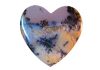

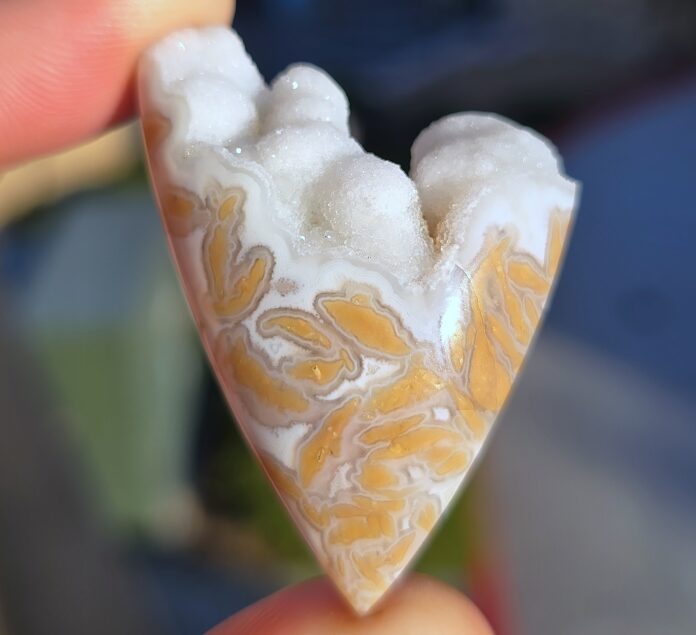
Youngite is a peach-toned agatized breccia found near Guernsey, outside of Hartville in
Platte County, Wyoming. With a hardness of 6 to 7 on the Mohs scale, it takes a high
polish while preserving its natural color contrast.
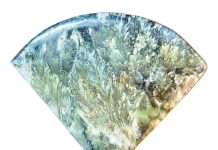
This material formed as an agatized breccia when fragmented jasper and surrounding
silicate material were cemented within white translucent chalcedony. The agate is often
lined with a drusy layer of microcrystalline quartz. This adds visual depth and appeal to
lapidary artists and collectors alike. Iron and manganese elements contribute to the
warm coloration, producing tones of orange, peach, yellow, and occasional pink against
the lighter chalcedony.
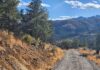
Youngite was discovered in the early 1970s within what became known locally as the “Youngite Caves,” formed in sedimentary rock near the Hartville uplift. These cavities
produced a limited supply of this stellar material before the area was eventually submerged during the construction of a nearby reservoir. This cut off access to the source. That short window of access provided all that is available today.
Key Takeaways
- Youngite is a peach-toned agatized breccia found near Guernsey, Wyoming.
- Its hardness of 6 to 7 on the Mohs scale makes it suitable for cabbing and polishing.
- Study Youngite rough for exposed color, pattern, druzy and quartz-lined areas before cutting.
- Youngite can chip on coarse-grit wheels, so careful grinding and progressively finer grits are important.
- Finishing through 8k or 14k grit, followed by polishing compound if desired, can bring out its contrasting colors.
Where to Find and Identify Youngite
High-quality pieces rarely show up in the marketplace. While it may be difficult, it is still
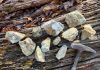
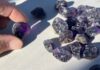
possible to find Youngite at online marketplaces or rock and mineral shows. When buying rough, you can often get a good idea of the interior from the exterior surface. In many cases, the color and pattern continue throughout the stone, so any naturally exposed “windows” along the outer surface serve as strong indicators of quality material. This helps determine value.
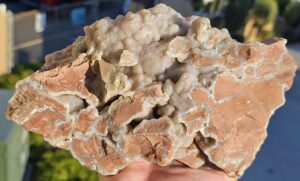
Be careful not to confuse Youngite with Mexican cotton candy agate, which has become increasingly common in the marketplace. True to its name, cotton candy agate typically displays lighter, more consistent pink coloration, appearing cloud-like within white chalcedony. This is different than the brecciated structure associated with Youngite. If possible, using a UV light can also help when identifying true Youngite before purchase. This material is known for its fluorescent response, glowing a subtle to bright green under shortwave UV within the chalcedony. In comparison, Mexican cotton candy agate is not known for fluorescence, making UV light a helpful tool when separating the two.
Cutting & Cabbing Youngite
Cutting Youngite is straightforward, though taking some time to study the rough before
cabbing can be beneficial. I enjoy trying two approaches: keeping the druzy edges as
part of the final design or focusing on the solid inner portions instead. While trimming,
look for exposed windows showing strong color or sections with attractive quartz lining.
Because the color and structure commonly continue throughout the stone, careful slicing
can reveal additional well-formed crystal pockets not immediately visible from the
exterior.
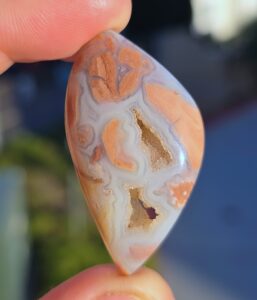
After you’ve made your cuts and preforms, getting started at the wheels is a breeze.
You’ll find that it cuts evenly in its composition. Because of its highly silicated
composition, it tends to chip easily, especially by the bottom edge on coarse-grit wheels.
It’s best to grind away excess material on these wheels, then continue with a smoother
grit steel wheel to avoid chipping. I like starting with an 80-grit steel wheel followed by a
60-grit soft resin wheel. This allows me to clean up for those chipped edges while slowly
shaping my girdle and dome at the same time.
Finishing and Polishing Youngite
It’s always best to have patience with Youngite. Scratches can hide against the
light-colored chalcedony, so be sure to dry occasionally and check your work. Once all
the scratches are gone, you’re good to move on to the 600-grit wheel. At this point, you
should start to see a nice gloss shine starting to develop.
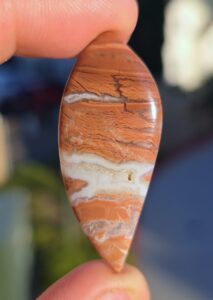
To finish off your cab, work your way up to either 8k or 14k grit and it will take a brilliant
glossy shine. You can also use Zam polishing compound on a felt tip using a rotary
hand tool to make the contrasting colors pop further.
Conclusion
Youngite rewards a careful approach at the cutting wheel. Studying the rough before cutting, watching for areas that may chip and taking the time to remove scratches can help preserve its distinctive color and brecciated structure. With careful shaping and a thorough polish, Youngite makes a striking cab that showcases the contrast between its warm-toned material and lighter chalcedony.
This What to Cut column about youngite appeared in Rock & Gem magazine. Click here to subscribe. Column and photos by Ben Kaniuth.