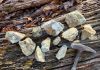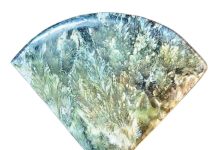


Alien eye fluorite is a rare variety of fluorite from Namibia known for its distinctive green colored, diamond-shaped centers surrounded by dark outer zones. These contrasting bands resemble alien eyes, giving the mineral its unusual name and making it a sought-after specimen among mineral collectors. Under ultraviolet (UV) light, alien eye fluorite can also fluoresce a striking royal blue.
Key Takeaways
- Origin: Alien eye fluorite was discovered in the Erongo Region of Namibia in a pocket found in 2007.
- Appearance: Dark outer zones surround vivid green, diamond-shaped centers that resemble alien eyes.
- Formation: Chemical variations during crystal growth created the mineral’s distinctive color zoning.
- Fluorescence: Under longwave ultraviolet (UV) light, alien eye fluorite can glow royal blue.
- Mineral properties: Like other fluorite, it has a Mohs hardness of 4 and perfect cleavage in four directions.

Where Is Alien Eye Fluorite Found?
Alien eye fluorite comes from the Erongo Region of Namibia. All of this special fluorite was found in what is known as the “Alien” or “Alien Eye” pocket in 2007 and is one of the most sought-after finds in mineral collecting. This small pocket contained fewer than 30 fine specimens.
The largest and most spectacular specimen, known as “Eyes of Africa,” stands about 2 feet tall. Discovered by miner Herold Gariseb, it is on display in the Lyda Hill Gems and Minerals Hall at the Perot Museum of Nature and Science in Dallas, Texas.
How Does Alien Eye Fluorite Form?
Erongo Mountain was an active volcano 140 to 150 million years ago. As the magma-filled chamber and element-rich waters began to slowly cool, alien eye fluorite and other aesthetic minerals such as tourmaline, quartz, and aquamarine grew within the pockets.
Fluorite is composed of calcium fluoride (CaF2 ) and belongs to the halide mineral group. Alien eye fluorite’s rings are formed through zoning. As the crystals grow, variations in chemical composition and environmental conditions result in different layers forming. These layers reflect light differently, giving rise to alien eye fluorite’s distinctive banding patterns.

Color & Fluorescence
One of the most distinctive properties of fluorite is its fluorescence under ultraviolet (UV) light. Alien eye fluorite is no exception and glows an ‘eerie’ royal blue under longwave UV light. This phenomenon is caused by the replacement of calcium by europium ions.

Alien Eye Fluorite Physical Properties
Fluorite is a relatively ‘soft’ mineral, having a Mohs hardness of 4. It also displays perfect cleavage in four directions, which means it can be easily split into octahedral fragments. Fluorite can range from transparent to translucent, with some specimens exhibiting exceptional clarity. Fluorite has many uses, including in industry as a flux for smelting, in the production of glasses and enamels, and is also used as a gemstone.

Alien Eye Fluorite Metaphysical Beliefs
For metaphysical believers, alien eye fluorite is said to possess protective properties; it is often used in crystal healing and energy work. Advocates suggest that alien eye fluorite can aid in spiritual awakening, enhance intuition and promote mental clarity.
FAQs About Alien Eye Fluorite
What is alien eye fluorite?
Alien eye fluorite is a distinctive variety of fluorite from Namibia, recognized by its dark outer zones and green, diamond-shaped centers that resemble eyes.
Where does alien eye fluorite come from?
Alien eye fluorite comes from the Erongo Region of Namibia. The well-known specimens were recovered from a small pocket discovered in 2007.
Does alien eye fluorite glow under UV light?
Yes. Alien eye fluorite can fluoresce royal blue under longwave ultraviolet (UV) light. This response is associated with trace elements, including europium, in the mineral’s crystal structure.
How hard is alien eye fluorite?
Alien eye fluorite has a Mohs hardness of 4, like other fluorite. It also has perfect cleavage in four directions, so specimens should be handled carefully to avoid breaking or chipping them.
Alien eye fluorite stands out for its sharply contrasting green centers and dark outer zones, a distinctive pattern found in specimens from Namibia’s Erongo Region. Its limited discovery, unusual crystal zoning and blue fluorescence under longwave UV light make it a memorable addition to a mineral collection. For collectors, these features are what distinguish alien eye fluorite from more common fluorite specimens.
This article was written for Rock & Gem magazine. Click here to subscribe. Story by Dr. Stuart Mills and Pam Freeman.