

Religious gemstones of early Christianity are surrounded by colorful stories and traditions that add to the richness of the gems we love. Many of the stories are obscure but offer an opportunity to rediscover some nearly forgotten legends.
The significance of these valuable gemstones of the Bible originated in the Old Testament through the history of the Israelites. Many of the gems were indigenous to the region. From the Book of Exodus, there was a specific list of 12 gems in the breastplate of the High Priest, foreshadowing the same symbols in the Book of Revelation.
Religious Gemstones: Key Takeaways
- Religious gemstones played an important role in early Christian symbolism and storytelling.
- Bloodstone, amethyst, emeralds, and pearls each carry unique spiritual meanings.
- Many traditions surrounding religious gemstones come from biblical references and early church history.
- These gemstones were often used in amulets, jewelry, and religious teachings.
- The symbolism of religious gemstones continues to influence faith and culture today.
Bloodstone: A Powerful Religious Gemstone of Christianity
One of the most poignant stories of religious gemstones for the Easter season concerns bloodstone. According to the story, when Jesus hung on the cross, his blood dripped on the deep green jasper below his feet, staining it with telltale deep red spots.

By the late second and early third centuries, scenes of the crucifixion, sometimes with a written inscription, were carved into bloodstone amulets. The practice continued for centuries. While widespread martyrdom wasn’t prevalent during the Middle Ages, bloodstone was often referred to as the “martyr’s stone,” where medieval Christians etched scenes of either the crucifixion or martyrs within the stone.
Amethyst: A Royal Religious Gemstone in Early Christianity
Amethyst found significance in the early church with royal purple symbolizing the kingship of Christ. As a result, it was often found in the rings of the bishops. Amethyst is the symbol of St. Matthias, who replaced Judas as reported in the Book of Acts and is also the patron saint of carpenters, tailors, and people suffering from smallpox. There are often rosaries with amethyst beads made in the name of St. Matthias.
In Hebrew, the word for amethyst, which is “ahlamah,” means “dream stone,” indicating its use to encourage sound sleep. In the Old Testament, amethyst was one of the 12 precious stones in the High Priest’s breastplate, and this symbolism continues to the Book of Revelation, where it is one of the 12 foundational stones of the Holy City.
Emeralds: Legendary Religious Gemstones of Faith and Power
Another stone often associated with royalty, emeralds found their way into a large number of myths and legends related to early Christians. One rather odd story claims that an emerald in the shape of a bowl dislodged from Satan’s crown. In one version, this was the bowl Christ used during the Last Supper, which later became the much sought-after Holy Grail in the legend of King Arthur. Another story claims the bowl was used by Joseph of Arimathea to catch Christ’s blood from the cross.
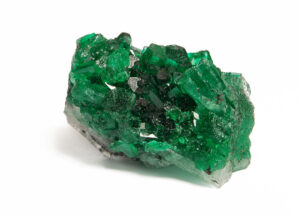
photoworld/Adobe Stock
Around 37 to 68 A.D., legend notes that Nero, the eccentric and frankly, downright mad, emperor of Rome, reportedly watched gladiatorial games, which often involved using Christians for sport, through a concave emerald. Of course, since it is impossible to identify stones during that time, it’s a distinct possibility that it might have been another transparent green stone, such as olivine. But the story is still intriguing.
Pearls: Symbolic Religious Gemstones in Biblical Teachings
In the “Parable of the Pearl of Great Price,” told in the Book of Matthew, the story talks about a merchant who was looking for fine pearls. When he found one of great value, he sold everything to purchase it. This story about religious gemstones correlates with the importance of obtaining the Kingdom of Heaven. Pearls are often used to this day to illustrate the concept.

FAQ: Religious Gemstones
What are religious gemstones?
Religious gemstones are stones associated with spiritual meaning, often tied to biblical stories, saints, or religious traditions.
Which gemstones are important in Christianity?
Some of the most well-known religious gemstones in Christianity include bloodstone, amethyst, emeralds, and pearls.
What does amethyst symbolize in Christianity?
Amethyst symbolizes royalty and spiritual wisdom, often linked to Christ’s kingship and worn by bishops.
Why are pearls important in the Bible?
Pearls represent great spiritual value, especially in the Parable of the Pearl of Great Price.
Religious gemstones continue to captivate us through their blend of history, symbolism, and faith. From bloodstone’s connection to sacrifice to pearls representing spiritual devotion, these stones offer a glimpse into how early Christians expressed belief through the natural beauty of the earth.
This story about religious gemstones previously appeared in Rock & Gem magazine. Click here to subscribe. Story by Amy Grisak.