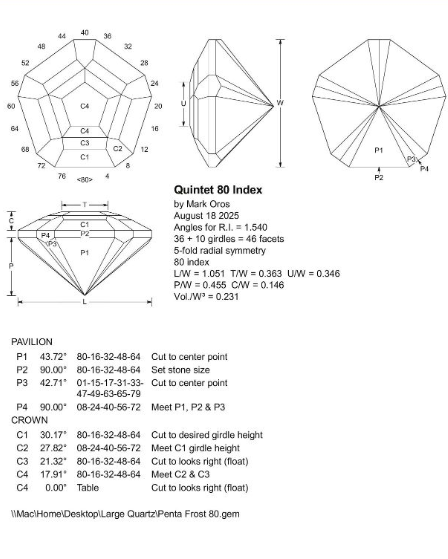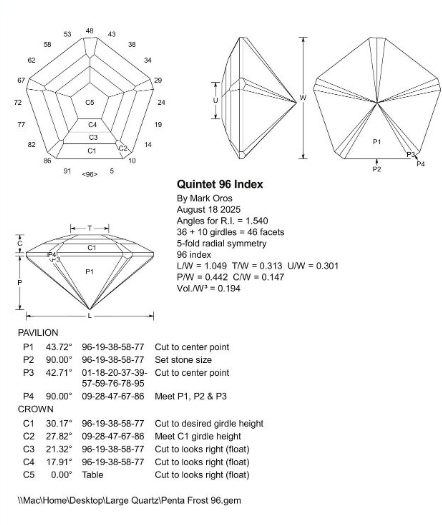

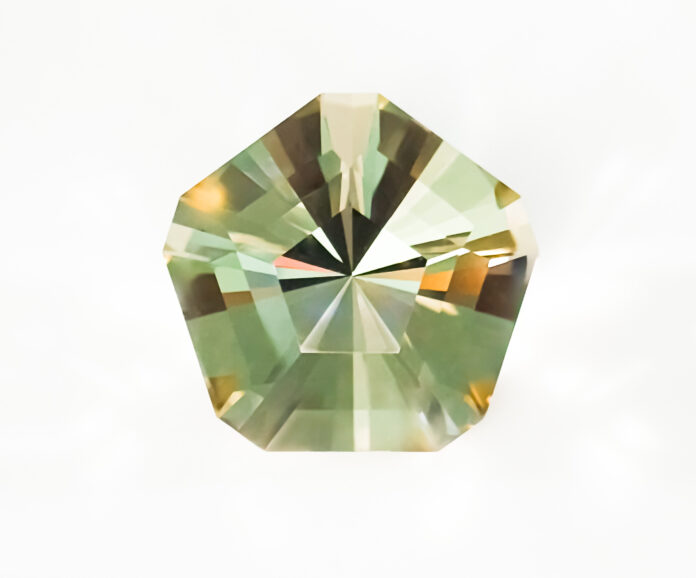
Gem cutting combines precision, geometry and an understanding of how light behaves inside a gemstone. The Quintet design featured here takes those principles to an unusual scale, using an 80-index gear to create five-fold symmetry in a large quartz gemstone. The finished stone is exceptionally bright and large enough to serve as a display gemstone—attributes that make this gem-cutting project particularly challenging and rewarding.
Key Takeaways
- Gem cutting combines precision, geometry and optics. The choice of index gear determines which symmetries can be created in a faceted gemstone.
- An 80-index gear makes five-fold symmetry possible. The Quintet design uses an 80-index gear to create a precise five-fold pattern and pentagram.
- Light return affects a gemstone’s appearance. The Quintet design intentionally produces exceptionally high light return, creating the bright appearance of a “headlight” gemstone.
- Large gemstones require special cutting techniques. Large surfaces can be more difficult to control and may grab the lap, making careful cutting, polishing and secure dopping especially important.
- Quartz is a practical choice for large display gemstones. Large quartz rough can provide faceters with an accessible material for creating an oversized, brilliantly polished gemstone.
- Patience is essential when cutting large gemstones. Working through each grit carefully and achieving a good pre-polish can make the difference between a good cut and a polished finished stone.
Creating Symmetry With an Index Gear
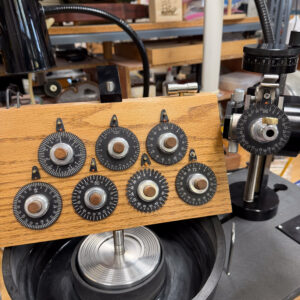
A faceting machine index gear is used to create perfect design symmetries. The 96-index is used in an estimated 95% of all gemstone designs because it has many divisors (1, 2, 3, 4, 6, 8, 12, 16, 24, 32, 48 and 96), supporting many symmetries. Multiple symmetries allow for more complex patterns by creating layers of geometric shapes on top of each other.
In this design, Quintet, a perfect five-fold design is created. The 96-index gear is not divisible by 5. Luckily, my ULTRA TEC faceting machine can interchange index gears and ULTRA TEC makes an 80-index gear. With the 80-index gear being divisible by 5, a perfect pentagram can be created. Not every gemstone faceter has access to an 80-index gear, so a 96-index design has also been provided with slight variations for optimizing light return.
Maximizing Light Return in Gem Cutting
This bright gemstone design produces a high light return. Gemstones are designed to take in light, reflect the light inside, and return it through the crown and table. It is possible to return too much light and make the gemstone overly bright. The nickname for this is a “headlight.” When this happens, the gemstone loses definition and a lack of contrast; too much of a good thing. However, this design was created to be a headlight intentionally and have the special attributes of being very bright and very large.
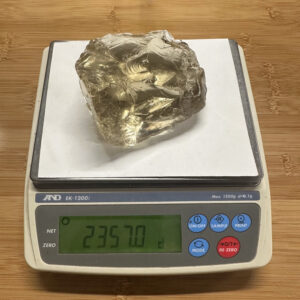
Very large gemstones are used primarily as display or collector gemstones. A gemstone’s value increases based on its size because of the rarity of the large gemstone crystals that can be faceted. Please keep in mind that the author does not promote the faceting of perfect gemstone specimens. These are perfectly formed by a more powerful hand.
Since most faceters do not have access to large precious gemstone pieces for faceting, quartz is recommended. If cut and polished properly, quartz gems can make a beautiful, large display.
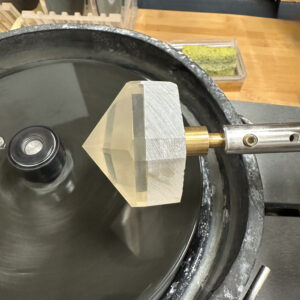
Gem Cutting: Faceting a Large Quartz Gemstone
Faceting large quartz gemstones can present challenges to the hobby faceter. Most faceting machines are not constructed to cut larger gemstones. Here are some tips on cutting and polishing large quartz display gemstones.
- Do not try initially to cut in complete and large facets. Take turns cutting in P1 and P2, alternating between the tiers.
- Once the pavilion is roughly cut in, undercut the girdle, allowing for a smaller girdle for the rest of the cutting and polishing.
- Go over each tier at least three times with each lap/grit, except pre-polish and polish. This will even out the facets for the next lap.
- Do not skip laps/grits.
- Make sure your gemstone is securely attached to your dop and the dop is securely set in the machine. Large gemstone surfaces tend to grab the lap and move the stone.
- The secret to a perfect polish is a great pre-polish.
- Be patient. This large gemstone is going to take a long time to finish. It will be worth your time.
Frequently Asked Questions
What is an index gear in gem cutting?
An index gear is a toothed wheel on a faceting machine that controls the rotational position of the gemstone during cutting. Different gears allow faceters to create different numbers of evenly spaced divisions and, therefore, different symmetries.
Why does the Quintet design use an 80-index gear?
The Quintet design requires five-fold symmetry. Because 80 is divisible by 5, an 80-index gear allows the faceter to create a precise five-fold pattern. A 96-index gear, while commonly used for many faceting designs, isn’t divisible by 5.
What is a “headlight” gemstone?
A “headlight” is a nickname used by some faceters for a gemstone with exceptionally high light return. Although brilliance is generally desirable, too much light return can reduce contrast and make the facet pattern less defined. The Quintet design intentionally embraces this very bright appearance.
Why is quartz a good choice for a large gemstone?
Quartz is available in sufficiently large pieces of rough to make it a practical material for oversized display gemstones. Large quartz crystals can be cut and polished into impressive faceted stones without requiring the cutter to obtain an unusually large piece of precious-gem rough.
Why is cutting a large gemstone difficult?
Large gemstones present challenges because their size and weight can make them harder to control. Large surfaces can also grab the lap, which makes securely attaching the stone to the dop and carefully progressing through the cutting and polishing stages especially important.
What is gem faceting?
Gem faceting is a form of gem cutting in which flat surfaces, or facets, are cut at precise angles and positions into a gemstone. The angles, rotational positions and depths of the facets determine the finished stone’s shape, symmetry and optical performance.
Final Thoughts
Gem cutting is a combination of precision, patience and an understanding of how geometry affects a gemstone’s appearance. The Quintet design demonstrates how changing something as specific as an index gear can create a different symmetry, while the deliberate emphasis on light return produces a gemstone with an unusually bright appearance.
Cutting a large gemstone adds another level of difficulty, but quartz provides an accessible material for faceters interested in creating an oversized display stone. With careful cutting, a thorough pre-polish and plenty of patience, the result can be a remarkable example of what is possible through gem faceting.
Want to explore more of the science behind rocks, minerals and gemstones? Subscribe to Rock & Gem for collecting tips, mineral identification, lapidary techniques, rockhounding destinations and more. Gem cutting article by Mark Oros.
Quintet Gem Cutting Pattern: 80-Index Design |