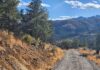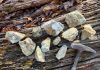

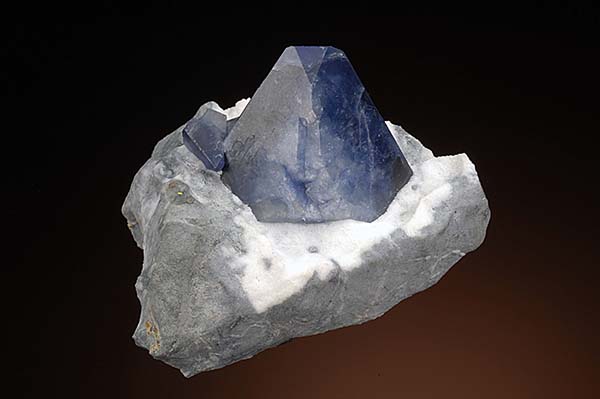
Benitoite seems like something out of a fairytale. Imagine camping in a well-vegetated, high-mountain meadow in a remote area along the headwaters of the San Benito River, near California’s Diablo Mountains. When you awake in the morning, you notice a distinct white area on a nearby hillside glowing in the sun. Intrigued, you walk up the slope to find a white cavity glittering with small, oddly shaped blue crystals. At first glance, they resemble diamonds. The ground is littered with these same blue crystals.
The Discovery of Benitoite
This really happened to prospector Jonathan Mitchell Couch in 1907. Couch had been working in the nearby Coalinga oil fields. He wanted to go prospecting for mercury, which was needed in the nearby gold fields. He was grubstaked by R.W. Dallas.
Couch had chosen his prospecting area because mercury deposits had already been found in several places in California just before John Marshall picked up his nugget in Sutton’s millrace. Mercury was critical to gold recovery in the early days. It would combine with small bits of gold, called “fines”, as an alloy, or amalgam, in a process known as amalgamation. The mercury could be boiled off and recaptured for future use, leaving behind its valuable golden load. Couch’s hope was to add to the dwindling supply of the slippery metal being mined in nearby Idria and New Idria.
Instead of mercury minerals, however, he stumbled upon these odd blue crystals, which he collected and brought back to town. Little did Couch realize that he had discovered what would one day become California’s state gem. Couch staked claims in his patron’s name, and the deposit was exploited as the Dallas Gem mine.
Identifying a New Mineral
The blue crystals Couch had gathered ended up in a rock shop in San Francisco. Professor George Louderback, of the State Mining Bureau, saw the odd crystals and was intrigued by them. He eventually chemically identified the mineral as something new, a barium titanium silicate. When Couch brought Professor Louderback to the deposit, the professor pronounced the mineral “benitoite”, since it was found near the San Benito River and in San Benito County.
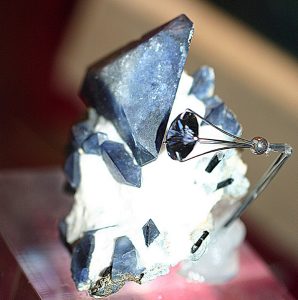
Other California deposits have reported occurrences of benitoite. But nothing found in Fresno, Kern or Mariposa counties comes close to the quality of the crystals found at the San Benito County mine.
Crystal Form and Optical Properties
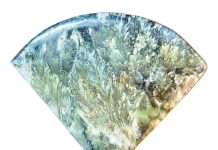
Benitoite is unique in several ways, including its crystal form. Before benitoite, no mineral species had been found that belonged to the ditrigonal dipyramidal subclass of the hexagonal system. No others have been found since. The faces of benitoite crystals are usually triangular, and the overall form of the crystal is flattened, with facial modifications along the edges of the major faces.
Color, Fluorescence and Zoning
Another unusual feature is its fluorescent response to shortwave excitation: a lovely, bright blue. The true color of benitoite is owed to what scientists call “charge transfer.” When light strikes the crystal surface, the energy is picked up by trace atoms of iron and titanium. Their electrons shift back and forth, or transfer, using oxygen as a conduit, or go-between. These outer electrons tend to absorb energy from the red end of the color spectrum, making wavelengths of the complementary color blue to become more dominant in the reflected light.
Associated Minerals: Natrolite, Neptunite, and Joaquinite
Benitoite crystals are often color-zoned, with the richest shades near the crystal edges; the interiors of most benitoite crystals tend to be slightly less blue, sometimes almost gray, thanks to an included amphibole known as crossite. The bright-white material that caught Couch’s eye is natrolite, a fine-grained, crystalline, tectosilicate mineral species.
Geological Setting and Formation
The mineralization of the deposit occurred millennia ago, in what was originally basaltic rock. This rock underwent extreme metamorphism, which turned it into crossite schist. This gray rock was later invaded by hydrothermal solutions, which deposited benitoite, neptunite and joaquinite. Later solutions brought in the natrolite, which engulfed those species. The entire deposit is enclosed by the host rocks, greenstone and serpentine.
Mining Challenges and Safety Concerns
Be aware that crossite is an amphibole altered from serpentine. Serpentine is one of the silicates in the asbestos group of minerals. To the federal government, “asbestos” is a dirty word, to say the least. The asbestiform crystal habit consists of long, fibrous crystals that, when inhaled, can cause mesothelioma and other lung diseases. This has caused the government to step in and regulate mining and recreation in this area. This has seriously restricted the mining and digging for benitoite.
Preparing Benitoite Specimens
Benitoite is almost always found on crossite and enclosed by white natrolite, which has to be etched or dissolved away with acid to expose the benitoite crystals. The problem with using acid is that, if the etching is allowed to go on too long, the benitoite, neptunite and joaquinite crystals will become detached. Care must be taken, but the result is extremely attractive blue and black crystals, contrasting nicely with the snow-white natrolite. The white natrolite ends up looking smooth in the extreme.
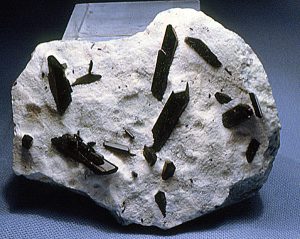
Neptunite is a fairly complex silicate containing potassium, iron, manganese, sodium, lithium and titanium. While blue gem benitoite is unique to the San Benito County deposit, neptunite is more common and is found in other localities. It forms lovely, lustrous, prismatic monoclinic crystals with a square cross-section. The crystals are usually sharp-edged and smooth, and appear black, but on thin edges they show an unusual reddish hue.
Tiny joaquinite crystals are sometimes associated with the benitoite and neptunite at this deposit. Its chemistry is even more complex than that of neptunite. It is a silicate made up of atoms of cerium, barium, sodium, iron, titanium, and the hydroxyl and hydrous radicals. Joaquinite’s problem is that it occurs in extremely small crystals, seldom over a couple of millimeters across, and seems to have formed in the natrolite. Any carelessness in etching the natrolite and the joaquinite crystals is easily lost. These little, orange-brown crystals are usually randomly scattered within the rock, making it difficult to etch away the natrolite while preserving the joaquinite. It is best done by someone who is experienced in specimen preparation.
Ownership and Mining History
Ownership of the property has changed repeatedly. As the financier of Couch’s prospecting expedition, R.W. Dallas took total control of the property and worked it until 1910. After that, it passed through the hands of several owners.
Josie Scripps, a member of one of the most powerful newspaper families in the country and a great devotee of minerals and specimen mining, owned the mine for a time. Josie also sponsored serious gem mining in some of the pegmatite mines in Baja California, Mexico. Other owners in relatively recent years were Bill Forrest and Buzz Gray. Buzz was a very active and exceptionally skilled gem faceter and created many superb pieces of jewelry incorporating faceted benitoite. Another fellow who treasured fine benitoite and is well remembered by California collectors is Bob Gill, whose superbly fashioned benitoite necklace was displayed many times at California Federation shows and in Tucson.
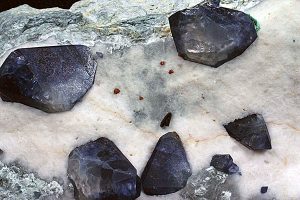
The Kennecott Mining Co. drilled and sampled the property, much as they had with the red beryl mine in Utah, but without success. They were followed by the fellow who was so successful in mining rhodochrosite from the Sweet Home mine, near Alma, Colorado. Bryan Lees, of Collector’s Edge, bought the property and seriously worked it for several years, extracting specimens successfully.
Today, the official name of the deposit is the California State Gem Mine, an appropriate name for the site of California’s official state gem.
Declaring Benitoite California’s State Gem
It was the California Federation of Mineralogical Societies (CFMS), a large group of dedicated amateur collectors—aided by the parent American Federation of Mineralogical Societies (AFMS)—that developed the act submitted to the California Legislature to declare benitoite the state gem. The initial bill was acted on by the State Legislature in 1984, but failed to get enough votes. A year later, the bill was introduced again and passed.
Unfortunately, the state gem is mined in an area that is full of serpentine and related fibrous amphiboles. This fact gained the attention of environmentalists and the federal government because of fibrous minerals’ reputation for being a carcinogen when inhaled over time. A two-year study was initiated by the federal government to study the potential hazards of stirring up asbestos dust across the entire area. Mining, blasting, the use of heavy equipment, and heavy travel to the area were prohibited, as well as any serious mining for benitoite. These measures are still in place, but fortunately, the mine is open to the general public as a fee-collecting site. Go to www.calstategemmine.com to get the necessary information for a field trip.
Benitoite FAQ
Q: What is benitoite?
A: Benitoite is California’s official state gem, a rare barium titanium silicate prized for its vivid blue color, unique triangular crystals, and brilliant fluorescence under shortwave light.
Q: Where is benitoite found?
A: High-quality benitoite is found only in San Benito County, California, at the California State Gem Mine, near the headwaters of the San Benito River.
Q: How did benitoite get its name?
A: The mineral was named for San Benito County after its discovery there in 1907 by prospector Jonathan Mitchell Couch.
Q: What minerals are associated with benitoite?
A: Benitoite commonly occurs with natrolite, neptunite, and joaquinite, all of which form strikingly contrasting crystals in the host rock.
Q: Why is benitoite so rare?
A: Its rarity comes from its limited geographic occurrence, unique crystal formation, and strict federal safety regulations due to asbestos-containing serpentine in the area.
Q: Can the public see or collect benitoite?
A: Yes. The California State Gem Mine allows fee-based public access for rockhounding, but full-scale mining is prohibited to protect both the environment and visitors’ health.
This story about benitoite was written for Rock & Gem magazine. Story and photos by Bob Jones. Click here to subscribe.