
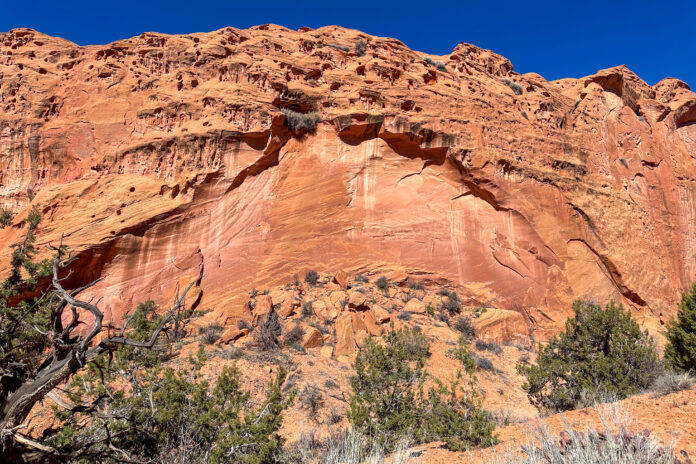
Desert varnish is an iconic feature of the Southwest’s canyon-and-mesa country, where colorful sandstone cliffs and canyon walls are often adorned with dark vertical streaks somewhat reminiscent of an artist’s brush strokes. Indeed, these streaks once did serve an artistic purpose. They were the “canvas” upon which Indigenous cultures etched countless thousands of petroglyphs as a permanent record of their presence.
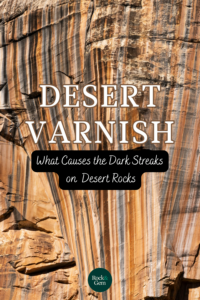
In recent decades, these streaks, known familiarly as “desert varnish,” have drawn much interest. Scientists have learned that the deceptively simple appearance of desert varnish belies a complex biogeochemical origin. Researchers are developing high-tech methods to determine the growth rate of desert varnish. This will help geologists and archaeologists accurately date various landforms and cultural features.
Key Takeaways
- Desert varnish is a thin, dark coating that forms on exposed rock surfaces, particularly in arid environments.
- The coating consists primarily of wind-blown clay minerals along with manganese and iron oxides and hydroxides.
- Microbes play an important role in concentrating and oxidizing manganese, contributing to desert varnish’s dark coloration.
- Most desert varnish is only about 20 to 40 microns thick, yet it is extremely durable.
- Indigenous peoples used desert varnish-covered rock surfaces as a “canvas” for creating petroglyphs.
- Because desert varnish develops extremely slowly, researchers can use its layers and chemical composition to help date geological and archaeological features.
What Is Desert Varnish?
Desert varnish first attracted scientific attention in 1799. German geographer and explorer Alexander von Humboldt, traveling in South America, described boulders that appeared “smooth, black, and as if coated with plumbago.” The latter is a period term for graphite, a black, crystalline form of carbon. In 1871, British naturalist Charles Darwin, the father of evolutionary biology, unsuccessfully attempted to chemically analyze desert varnish. After studying these mysterious streaks in 1898, geologists from the United States Geological Survey coined the term “rock varnish.”
Because this distinctive surface coloration is most common and apparent on the barren rock of desert regions, the term “desert varnish” became popular in general usage. Scientists, however, continue to use the term “rock varnish” to reflect its occurrence in environments other than deserts.
Desert varnish was once assumed to consist of minerals that had leached directly from its host rock. In the 1970s, advanced analytical methods showed the streaks contained hundreds of times more manganese than the surrounding rocks and soil. Scanning electron microscopy also revealed a sharp morphological boundary between the varnish and the host rock. This indicates that the varnish is unrelated to the host rock and is an accretion of materials from extraneous sources.
What Is Desert Varnish Made Of?
Desert varnish consists primarily of tiny particles of aeolian (wind-blown) clay minerals. These adhered to moist rock surfaces during the early stages of varnish development. The remainder, also of aeolian origin, consists mostly of oxides and hydroxides of manganese and iron minerals. Desert varnish’s extraordinarily high manganese concentrations are because of bacterial microbes that accumulate, oxidize and retain dark-colored manganese compounds on their surfaces as protection against direct sunlight.
The colors of desert varnish range from black to brownish. Higher proportions of manganese create black. Greater proportions of iron produce browns. Thick, high-silica coatings sometimes exhibit bluish colors and even a subtle iridescence.
The thickness of desert varnish is measured in microns or millionths of a meter. Most streaks are only 20 to 40 microns thick, or about that of a human hair. Yet their opacity enables even thin streaks to greatly darken the color of the host rock.
A Study in Patience
Growing at an estimated rate of only one micron every few hundred years, desert varnish is a study in patience. At least 10,000 years are needed to develop a dark, “mature” varnish layer. While very thin layers have been observed in quarries where exposed rock surfaces are only 50 years old, the oldest-known layers are several hundred thousand years old. Despite desert varnish’s extreme thinness, its hardness, nearly that of quartz, imparts great durability.
Under electron microscopes, desert varnish shows distinct growth layers that are loosely comparable to those of tree rings. Current research suggests that the darker and thicker of these layers formed during periods of higher available moisture and may in the future contribute to our knowledge of paleoclimatology.
A “Canvas” for Rock Art
Archaeologists define “rock art” as human-made markings most often found on vertical surfaces of natural stone and categorize them as pictographs or petroglyphs. Pictographs, which consist of applied pigmentation materials, are vulnerable to fading and wind abrasion and can survive only on protected surfaces such as cave walls or sheltered cliffs.
Petroglyphs, on the other hand, are made by etching or “pecking” rock surfaces. Found on all continents except Antarctica, petroglyphs comprise 99 percent of all rock art, with most being pecked through layers of desert varnish. Because of its thinness, relatively little effort is needed to expose the underlying, lighter-colored host rock and thus create high-contrast images. Unlike pictographs, petroglyphs can survive many thousands of years of wind abrasion and direct sunlight. The oldest known petroglyphs are more than 40,000 years old.
Dating Desert Varnish
Researchers have developed three methods to date desert varnish. Short-term dating of up to 12,000 years relies on the atomic decay rate of the carbon-14 isotope present in pollen and other organic materials that were trapped in the varnish when it formed.
For longer-term dating, geophysicists measure the iron-manganese ratios in different varnish layers. Because manganese levels are directly related to the duration of microbiological activity, manganese-to-iron ratios are a measurable function of time. Very long-term dating relies on determining the radiometric ratios of uranium’s atomic decay-chain isotopes present in the varnish’s clay particles.
FAQs About Desert Varnish
What is desert varnish?
Desert varnish is a thin, dark coating that develops on exposed rock surfaces, particularly in arid environments. It consists primarily of wind-blown clay minerals along with manganese and iron compounds.
How does desert varnish form?
Desert varnish forms extremely slowly as wind-blown materials accumulate on rock surfaces. Microbial activity contributes to the accumulation and oxidation of manganese, helping produce the coating’s characteristic dark color.
Why is desert varnish dark?
The dark coloration comes largely from manganese compounds concentrated within the varnish. Higher proportions of manganese tend to produce black coatings, while greater amounts of iron contribute brown coloration.
How thick is desert varnish?
Most desert varnish is only about 20 to 40 microns thick. Despite its extreme thinness, it is hard and durable enough to persist on exposed rock surfaces for thousands of years.
Why are petroglyphs often found on desert varnish?
The dark coating provides a natural canvas for rock art. When people peck through the thin layer of desert varnish, the lighter-colored rock underneath is exposed, creating a high-contrast image.
Can desert varnish be used to date rocks?
Researchers can use the chemical composition and growth layers of desert varnish, along with radiometric techniques, to help determine the age of rock surfaces and geological and archaeological features.
Desert Varnish Reveals the Past
Knowing the age of desert varnish is helping archaeologists determine the age of petroglyphs and helping geologists establish when events such as glacial scouring and landslides occurred. Because the varnish develops so slowly, its layers preserve a record of environmental conditions extending far beyond the span of human observation.
The next time we admire the dark streaks decorating the colorful sandstone cliffs of the Southwest, they may look like simple brush strokes across the rock. But beneath that deceptively simple surface is a complex record of microbes, minerals, climate and time—and, in many places, the marks left by people who used that same dark coating as their canvas thousands of years ago.
This story about desert varnish previously appeared in Rock & Gem magazine. Click here to subscribe. Story by Steve Voynick.