
Oregon agates can turn up in some unexpected places, including the remote canyon of the Grande Ronde River in northeastern Oregon. About 20 years ago, during an annual family rafting trip, I discovered an outcrop of green moss agate along a small creek flowing into the river. That discovery eventually became a favorite rockhounding destination for my family and the starting point for many of their first agate-collecting experiences.
Key Takeaways
- Oregon agates occur in a variety of geological settings, including basalt outcrops along the Grande Ronde River.
- The green moss agate found at Grandpa’s Agate Diggings gets its color from iron.
- Agate-filled gas pockets in basalt create distinctive specimens, including moss agate, botryoidal formations and hollow pieces.
- Weathered agate can collect in hillside scree and creek gravels. This makes it possible to find specimens without digging into the basalt.
- Family rockhounding trips can introduce a new generation of collectors to Oregon agates.
A Luxury Float
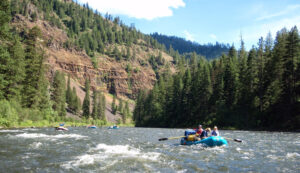
This rafting trip is quite the luxury float. We usually take 15 to 25 people for the four-day trip down the river. We set up tarp roofs at camp to provide shelter from the sun or the rain. There are enough tables and chairs under the tarps to seat up to 30 people.
In our covered kitchen area, we set up a gas stove with six burners, a barbecue, a large griddle and three Dutch ovens. We have a shower tent with hot running water plus a bathroom tent.
Everyone takes part in all the cooking and chores and some call it the “Float and Bloat” trip because of all the great meals with excessive food.
Rafting the Grande Ronde River
The beginning of the trip is at the confluence of the glacially fed Minam and Wallowa Rivers shortly before they join the Grande Ronde. Boaters put in at the boat ramp in Minam, Oregon, a town with one hotel and a state park.
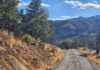
The hills above the river are heavily forested with Ponderosa Pines and Douglas Fir, with lush green grass growing under their branches. The river rumbles down toward the Snake River, twisting and turning as it cuts deeper into the canyon. Sometimes the boat is heading north, then east, then south, then west, while the river heads mostly north.
As the river runs deeper into the canyon, the walls get steeper, the trees thin out, and basalt outcrops with irregular spires poking towards the summer sky dominate the view. The Grande Ronde passes the little town of Troy, then crosses the Oregon/Washington border, eventually joining the Snake River on its way to the ocean.
Bruce McKay
A Favorite Stop Along the Grande Ronde River
About a day’s float down the river, a creek flows into the Grande Ronde near our favorite campsite. The creek canyon opens into a tree-studded, wide gravel bar delta as it reaches the river. A fun area to wander around and take dips in the creek, the delta is a common habitat for the numerous rattlesnakes that make the canyon their home.
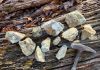
As I poke around the delta, I keep my eyes down, doing the rockhounder’s search for rocks and hoping to spot the rattlers before I get too close. One year, I spotted a small dark green rock that looked very different from all the other river gravels. Lacking any rock hammer, I smashed it with another rock, and the interior turned out to be agate. I began to look for the source.
Bruce McKay
Finding the Source of the Green Moss Agate
I used standard prospecting habits of working my way upstream, finding more agates in the creek gravels until I stopped finding them. At that point, I started hiking up the hills, traversing back and forth in my search for the source of the green-skinned agates. I finally found a hillside covered with Oregon agates.
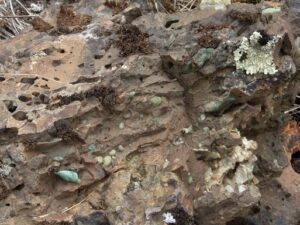
I climbed this steep hillside scree pile until reaching a basalt outcropping. That is where I found the motherlode of the agate. Pockmarked across the twelve-foot-tall face of a basalt wall are former gas pockets now filled with agate.
Down the hill for one hundred yards toward the creek, the surface is peppered with agate that has weathered out of the basalt. There is so much loose agate to pick up that I have not bothered to mine agates out of the basalt or to dig down into the scree pil
It was clear that this agate outcrop had never been dug by rockhounds before. I had found my own private agate diggings! I first named this agate after the creek that it comes from, but using the actual creek name would give up the location, so let’s just call it Grandpa’s Agate Diggings.
Nearly every year, I have taken my family and friends up to my agates, and we collect some. We then hike the mile back to camp to lay out our day’s treasures. I go through everybody’s pile and choose the best ones for me to cut back home and return to the finder.
What Grandpa’s Oregon Moss Agate Looks Like
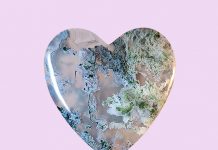
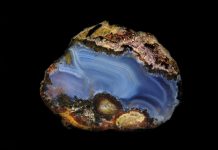
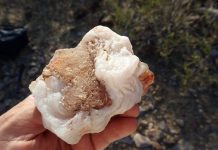
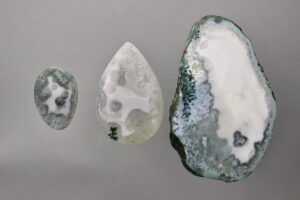
None of the agate from this outcrop is large. The largest is four inches across. Some are hollow. Others have white common opal or agate banding. Some have botryoidal growth, and others have agate stalactites and stalagmites hanging into or growing up into cavities. Most have a base of clear agate; however, some are white. Much of it is moss agate with a deep green moss color.
What Gives the Moss Agate Its Green Color?
As a gemologist, I was curious about which metallic oxide gave the stones the green color, tinting the moss and coating the outside. I used X-Radiograph Fluorescence (X-REF) to analyze multiple pieces of the agate. I found the source is iron. Green areas of the agate showed iron, and clear areas showed no iron. The iron content distinguishes the green areas from the clear portions of the agate, giving the specimens their characteristic green mossy appearance.
Some of the material has a layer of olive drab common opal filling part or all of a cavity. That material is not stable and is just plain ugly, so it all stays on the hillside. I have come to recognize the shape and color of the good moss agate, so I am always pleased when one of my fellow agate hunters comes up with one of those.
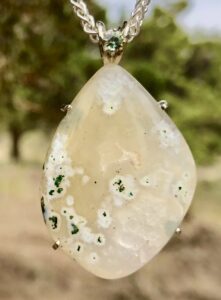
Often, the hollow pieces will never produce a cabochon-cut gemstone, but they are so pretty that I take them home to polish part of the exterior, making them into specimens. The agates that are cut into good gems usually go to friends and family. I have not sold any of the agates from my diggings. A few I set into jewelry for the person who found it.
Bruce McKay
An Agate Stash
My entire stash of material, good enough to load on the raft and haul home, fills only a five-gallon bucket.
I am sure the scree pile contains much more material that has weathered out over the millennia, but it will get left to the snakes and scorpions that call it home. I have no desire to dig it all up. The only way to easily find Grandpa’s agate is to come on the yearly rafting trip; hence, I expect it to remain my secret stash.
Family Floating
A recent trip was a special float for me because I was able to bring along my grandson, Tyler, and his mom, Kristin. Tyler’s dad, Evan, wasn’t able to come, but he has gone on these trips since he was young. Now I was able to treat the next generation to our tradition. Tyler and Kristin had never been on an expedition like this, and they both looked forward to it with a bit of nervousness.
We drove to the river in my motorhome and camped near the launch. In the morning, we geared up the boats and shoved off with six rafts and 17 rafters. Tyler was quiet and clearly concerned about this folly until we started to bounce up and down over the waves, and the folly turned into great fun.
Fun turned to dismay when we landed at our riverside camp and he began to look for the motorhome. He had no idea that he was going to be sleeping in a tent for the next few days.
Bruce McKay
A Rock-Collecting Side Trip
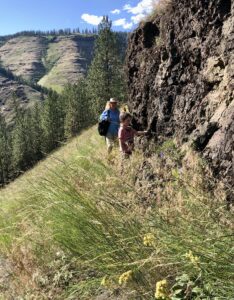
By the next morning, camp had become fun for him, but Tyler wanted to go rockhounding. He loves rocks and crystals, and he was ready to find some of his own. We took off, marching up the hill. Before long, Tyler began to get tired. He rode on Grandpa’s shoulders for a while until that became tiring for my old knees. I set him down to hold my hand as he walked beside me. We soon came across a decent-sized rattlesnake. I had Tyler listen carefully to the sound of the rattlesnake’s alarm so he could recognize that sound in the future.
The snake encounter energized him as we were starting to go downhill, following deer trails and cutting through the trees and brush. Tyler was having fun well into the next big uphill. His steps slowed, anguish and tears set in, and he was sure he couldn’t make it another foot forward.
Finding the Agate-Bearing Area
That is when we began to enter the agate-bearing area, and Tyler found his first agate. There was no more complaining as he put one agate after another into his collecting bag. He scrambled up the steep hillside ahead of the rest of us, calling out at every new find and filling his bag with treasures.
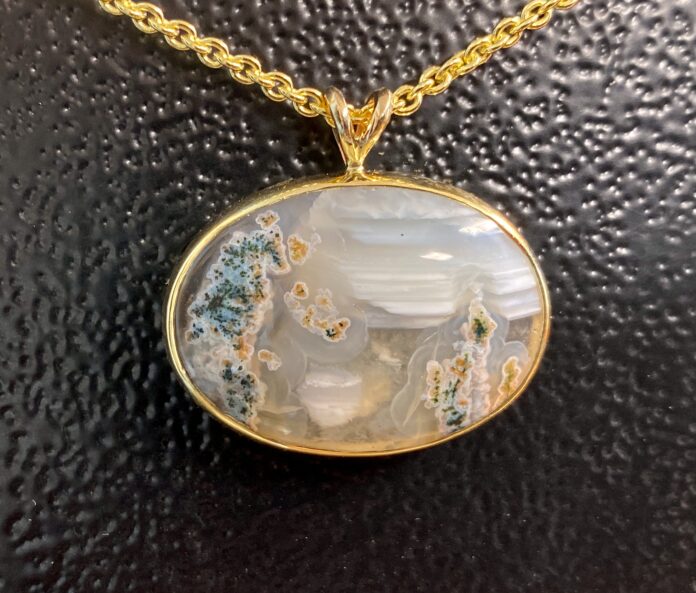
I found a chunky piece of mossy, spotted agate that I knew would cut a good gem, so I showed it to Tyler, then quietly slipped it into his bag. That stone turned out to be the best one I cut from that year’s digging. Tyler is proud to be the one who found it for his mom. The mile hike back to camp was no problem for a six-year-old rockhound with a bag full of agates to show off at camp. Every adult was shown his treasures as Tyler proudly laid out the agates from Grandpa’s agate hill.
I cut Tyler’s best agate and made it into a gold pendant for Kristin as soon as we got to my home, so they could fly home with Mom wearing Tyler’s agate. There could be no better way for me to enjoy a Father’s Day weekend.
This story previously appeared in Rock & Gem magazine. Story & Photos By Bruce McKay. Click here to subscribe.