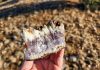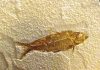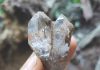

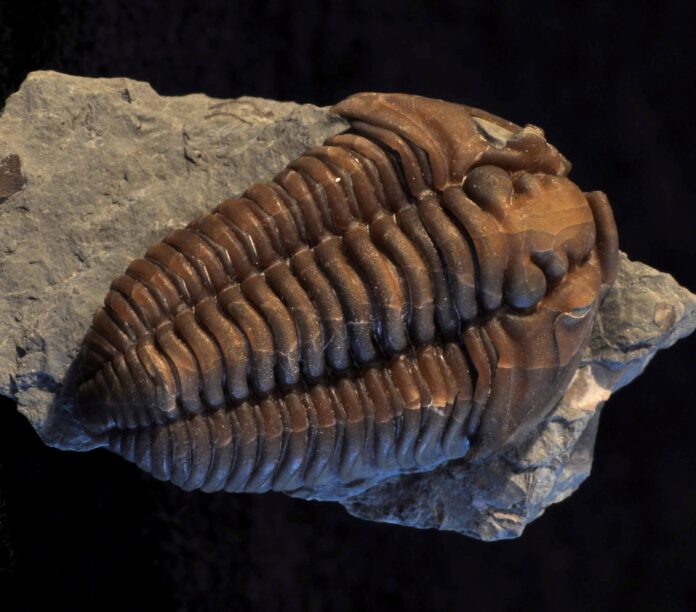
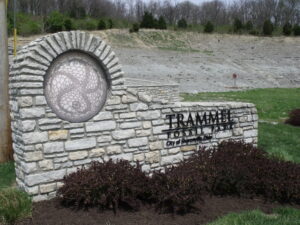
Trammel Fossil Park is one of the premier spots for fossil collecting in Ohio, situated in the heart of the Cincinnati Arch. This area, formed during the Ordovician Period, preserves an extraordinary variety of ancient sea life. Collectors visiting Trammel Fossil Park can find trilobites, crinoids, bryozoans, and other fossils that tell the story of a warm, shallow sea that covered the region over 450 million years ago. Whether you’re a beginner or an experienced collector, Trammel Fossil Park and the Cincinnati Arch offer accessible and rich fossil layers to explore.
 The Cincinnati Arch Explained
What is known as the Cincinnati Arch is a large and broad area of structural uplift between several major basins. The Illinois Basin to the west, the Michigan Basin to the north and the Appalachian Basin to the east.
This area was formed during the Ordovician Period when it was a warm, shallow saltwater sea. Ocean sediments that were deposited during the period often contained large amounts of fauna that were common in those ancient seas. Much of the sediment today is comprised of layers of shale mixed with layers of fossiliferous limestone. The shale was formed from sediments deposited by large-scale storms such as hurricanes that are thought to have been as common as they are today. These hurricanes destroyed ecosystems and buried them in the sediment. These storms also hit land masses, supplying an outwash of sediment, aiding in the burial of the creatures. The shale it produced preserved the creatures in outstanding detail. This is also the case when limestone is formed from the remains of millions of calcium carbonate-rich fauna that settled to the bottom.
 Life in the Ordovician Sea
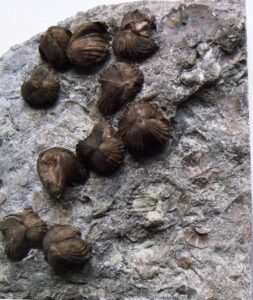
Creatures of the Ordovician period comprised a wide variety of life. Trilobites, brachiopods and crinoids all enjoyed a bountiful sea as well as gastropods and cephalopods. Some of the largest straight-shelled cephalopods lived during this period. These creatures sported tentacles that extended from the opening of the hard-shelled body and were formidable predators. Trilobites scurried across the ocean floor, some as large as 20 inches long. Bryozoan colonies and coral outcroppings created places for other fauna to eat and hide. When one thinks of the Ordovician Sea one can imagine modern reefs of today such as the Great Barrier Reef.
 Collecting Fossils at Trammel Fossil Park & Other Area Locations
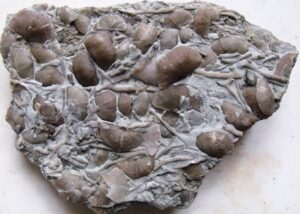
Some of the best fossil-collecting localities can be found along road cuts in southern Ohio, southern Indiana, and northern Kentucky. Localities such as the large roadcut north of St. Leon, Indiana and the Maysville Roadcut near Maysville, Kentucky, are quite famous.
As long as the roadcuts are not along interstate highways, collecting is generally allowed. It is best to consult local laws before one ventures out. The roadcuts are some of the best examples as they are laid down over hundreds, if not thousands, and millions of years. Here, one can see and study how various creatures lived, thrived, and changed throughout the passage of time.
There are other areas that are open to collecting, such as Trammel Park in Sharonville, Ohio, and the famous Caesar Creek spillway near Waynesville, Ohio. Southern Ohio is rich in fossil fauna.
Nearby Fossil Collecting Sites
Southeastern Indiana also offers some exceptional fossil collecting. One favorite spot of collectors is the roadcut just north of St. Leon on Route 1. This road cut is quite large and is also quite steep. As with all roadcuts, footing may be hazardous, so wear good boots or hiking shoes. There are several layers that produce many fossils here, but in general, all one must do is look down to find hundreds, if not thousands, of fossils. In this particular location, no tools or digging are allowed, but that is not a problem. You can surface-collect a carload of fossils, including corals, bryozoans and the occasional trilobite. This location also has pieces of the Isotelus maximus trilobite scattered in the sediment. Sadly, I have never found a complete one there. There is even a large concrete shoulder to park on so you can stay safely off the road. This is in all roadside locations, so park your car in a safe manner and be watchful for traffic.
There is also a large roadcut just northwest of Lawrenceburg, Indiana, on Route 1 that has some very large bryozoan colonies that can be found there.
As with all fossil collecting, check for local laws for collecting, be mindful and respectful and please, above all, leave the area better than you found it so these areas may remain open to the public for future collecting.
FAQ: Trammel Fossil Park & Cincinnati Arch Fossils
Q: Where is Trammel Fossil Park located?
A: Trammel Fossil Park is in Sharonville, Ohio, just north of Cincinnati, in the heart of the fossil-rich Cincinnati Arch region.
Q: What types of fossils can I find at Trammel Fossil Park?
A: Collectors commonly find trilobites, crinoids, bryozoans, corals, gastropods, and other Ordovician sea creatures.
Q: Do I need special tools to collect fossils?
A: No tools are required for surface collecting. Sturdy shoes and careful observation are sufficient for finding fossils safely.
Q: Can beginners collect fossils at Trammel Fossil Park?
A: Absolutely! The park is beginner-friendly, and its rich fossil layers make it easy to find specimens without digging.
Q: Are there rules or permits for collecting fossils in the Cincinnati Arch?
A: Yes. While many roadside sites in the Cincinnati Arch allow surface collecting, it’s important to follow local laws, stay off highways, and respect private property.
Q: What makes the Cincinnati Arch special for fossil collecting?
A: The Cincinnati Arch is a geologic uplift with Ordovician limestone and shale layers. These deposits preserve an exceptional diversity of marine life from over 450 million years ago.
Q: Are there other notable fossil sites near Trammel Fossil Park?
A: Yes! Nearby collecting spots include the Caesar Creek spillway near Waynesville, Ohio, and roadcuts north of St. Leon, Indiana, all rich in Ordovician fossils.
This story about fossil collecting in Cincinnati and at Trammel Fossil Park previously appeared in Rock & Gem magazine. Click here to subscribe. Story and photos by Joseph J. “PaleoJoe” Kchodl.