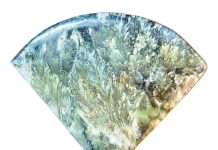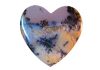

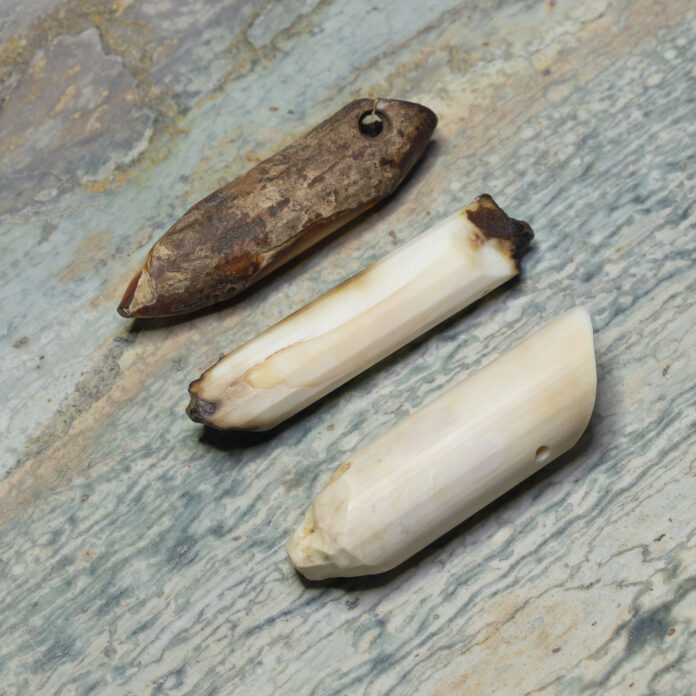
Free-hand faceting opens the door to working with materials beyond traditional transparent gemstones. In this project, you’ll learn how to apply free-hand faceting techniques to an opaque fossilized walrus tooth using cold wax dopping, creative facet placement and careful polishing. The result is a one-of-a-kind lapidary creation that demonstrates how faceting can be combined with other lapidary techniques to transform unconventional materials into beautiful works of art.
Note: The fossilized walrus tooth used in this project is ancient, legally collected surface material from Alaska. No animals were harmed, and no laws were broken in its harvesting.
Key Takeaways
- Free-hand faceting allows lapidaries to work with opaque and irregular materials beyond traditional transparent gemstones.
- Cold wax dopping provides a secure way to hold irregularly shaped materials during cutting.
- Starting with pavilion facets creates a solid foundation for free-hand designs.
- Preserving portions of the original material can enhance the finished appearance.
- Fossilized walrus teeth are legal to use when obtained from approved, legally collected ancient material.
- Experimenting with alternative materials helps expand both faceting skills and artistic creativity.
Why Free-Hand Faceting Works with Opaque Materials
I consider faceting as one of many lapidary techniques in the spectrum of creating beautiful gemstones. Although it is mainly used for clear gemstone fabrication, it can be used and combined with other lapidary techniques. Faceting can be enticing when combining sculpturing with cabbing, knapping, carving and even fantasy faceting. A good example of combined lapidary techniques would be a faceted buff top gemstone where the pavilion is faceted and the crown is cabbed.
Cold Wax Dopping for Free-Hand Faceting
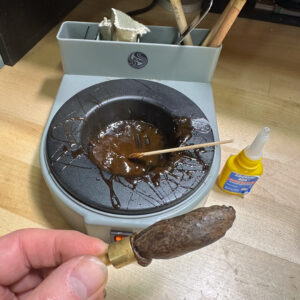
Fossilized walrus teeth are irregular in shape and need a special method for dopping. Here are the seven steps for the cold wax method.
- Decide which direction you want to dop.
- Select a cone dop that is at least three-quarters the diameter of the tooth. You want the dop to be smaller than the tooth’s diameter so you can facet the tooth without faceting the dop.
- You want the tooth to be as straight as possible in the dop. I highly recommend that you practice aligning the tooth in the dop before using the wax.
- Heat the wax and then place a ball of wax in the dop to fill it. It is better to have a little too much wax than not enough.
- While the wax is still hot, press the tooth into the wax as straight as possible. Hold the tooth in place for about two minutes until the wax cools. The dopping does not have to be perfect. Remember, you will be free-hand faceting the design.
- Pull the tooth out of the wax and add one drop of glue to the wax mold and reinsert the tooth into the wax mold. I like to use Loctite 404 glue or a two-part epoxy.
- Once the glue has hardened, place a bead of glue around where the wax and dop meet.

Keeping track of facet angles and indexes
Tips for Placing Free-Hand Facets
The tooth is now dopped and it is time to decide where to place the facets. You can either make up your faceting pattern/design or use one from your design books. I like to use a briolette design for the basis of my free-hand faceting. The briolette design gives me a reference for where to add my facets. Here are six tips on free-hand faceting.
- Only facet the pavilion to start. This is what I did in my examples. Adding a crown can be done in subsequent endeavors.
- Keep your dop from hanging over the lap. You do not want to facet the dop.
- I usually start with 90-degree angles, creating girdle facets.
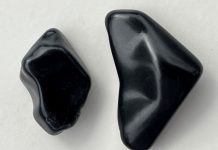
- I like to keep some of the original surfaces of the tooth. This is done by finding the low spot on your angle, raising your mast height and leaving several facet indexes unfaceted.
- Once you have your 90-degree girdle facets in, you can start to cut additional facets using different angles, indexes and symmetries. Remember you cannot put in the wrong facets when free-hand faceting. Go slowly and be creative.
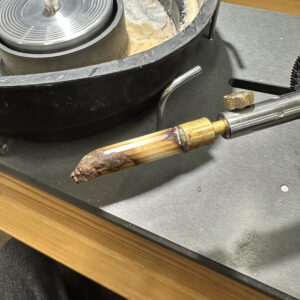
Girdle complete at 90-degree angle
Polishing and Cleaning a Faceted Fossil Tooth
A tooth is relatively soft when compared to other gemstone materials. I usually start with 250 grit and finish at 8,000 grit. You will not be able to get the same high-quality polish that you would normally get on a transparent gemstone.
Once the tooth is faceted and polished, I place the tooth and dop into a capped jar of acetone to dissolve the wax. The acetone will have some effect on the tooth, so only keep it in the acetone until the wax is removable.
I sometimes like to embellish my faceted fossilized walrus teeth with a little pyrography, using a wood-burning tool. The wood-burning tool can add some designs or just give it a more primitive look.
Once finished, you can decide how you want to display or set the tooth. I like to drill a hole in the tooth and have my favorite Etsy macramé artist, Elena, from September’s Child Art, create a beautiful necklace. For drilling, I use the Deluxe Rock Drilling System, by Minnesota Lapidary. I use a traditional wood bit for the hole-drilling process.
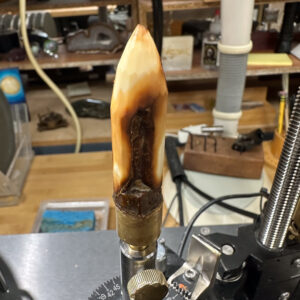
Understanding Fossilized Walrus Teeth
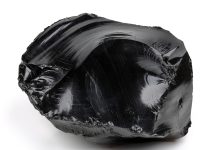
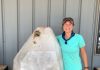
The walrus teeth used in the example photos were collected by my friend, Mathew McCrum of Aurora Faceting. He collected the teeth near Gambell, Alaska, on St. Lawrence Island in the Bering Sea. These fossilized walrus teeth are approximately 1,000 to 3,000 years old but can be up to 10,000 years old. The Siberian Yupik people have been carving walrus ivory for 5,000 years, making utensils, tools and art pieces. The teeth used in the examples showed tooling from these Eskimo people. Please keep in mind that this walrus ivory is ancient and legal.
Frequently Asked Questions
What is free-hand faceting?
Free-hand faceting is a lapidary technique that allows cutters to create facet patterns without following a fixed faceting design. It is especially useful for irregular or opaque materials.
Can opaque materials be faceted?
Yes. While transparent gemstones are the most common faceting materials, opaque materials such as fossilized walrus teeth, agates and jaspers can also be faceted to create distinctive decorative pieces.
Why use cold wax dopping?
Cold wax dopping helps secure irregularly shaped materials that are difficult to mount with traditional dops, allowing greater flexibility during free-hand faceting.
Does a fossilized walrus tooth polish like a gemstone?
No. Fossilized walrus teeth are softer than most faceting materials, so they generally produce a softer polish than transparent gemstones.
Is fossilized walrus ivory legal?
Ancient fossilized walrus ivory may be legal to own and work with when it has been legally collected and complies with applicable federal, state and local regulations. Always verify the laws where you live before purchasing, selling or working with fossil ivory.
Final Thoughts on Free-Hand Faceting
Free-hand faceting demonstrates that lapidary artistry isn’t limited to transparent gemstones or traditional faceting designs. By combining faceting with techniques such as cold wax dopping and creative shaping, lapidaries can transform fossilized walrus teeth and other opaque materials into unique finished pieces.
As you explore free-hand faceting, experiment with different materials such as agates, jaspers and other suitable fossils while always researching their properties before cutting. Every unconventional material presents its own opportunities and challenges, making each finished piece a one-of-a-kind expression of craftsmanship. Work safely, take your time and enjoy discovering where your creativity leads next.
Discover more expert faceting techniques, lapidary projects and gemstone-cutting tips in every issue of Rock & Gem magazine. Subscribe today and keep expanding your lapidary skills. Story and photos by Mark Oros.