
Fantasy cut gemstones push the boundaries of traditional faceting, combining precision engineering with artistic vision. Instead of standard cuts designed primarily for jewelry, these pieces explore light, geometry, and optical effects in entirely new ways.
In this video, lapidary artist Mark Oros walks through a collection of his latest work in fantasy cut gemstones, including intricate quartz designs, collector-scale pieces, and a one-of-a-kind gemstone kaleidoscope. Along the way, he shares insights into his process, the tools he uses—including ULTRA TEC machines—and the inspiration behind his fantasy cut gemstones and designs like the Vogel wand and Cleopatra’s Eye.
Whether you’re a beginning faceter or an experienced cutter, this behind-the-scenes look offers a practical perspective on what goes into creating fantasy cut gemstones—from concept and geometry to final polish.
Key Takeaways: Fantasy Cut Gemstones
- Fantasy cut gemstones focus on light, geometry, and optical effects rather than traditional jewelry cuts.
- Advanced faceting often combines multiple machines, including ULTRA TEC and fantasy cutting equipment.
- Designs like the Vogel wand and Cleopatra’s Eye show how structure can create visual depth without relying on color.
- Large “viewing stones” are created for display and interaction, not just set in jewelry.
- Strong foundations in geometry, gemology, and material science are essential for successful faceting.
- Unique pieces, such as gemstone kaleidoscopes, highlight the intersection of art and engineering in lapidary work.
What Are Fantasy Cut Gemstones?
David: Morning, Mark.
Mark: Good morning, Dave. How are you?
David: Good. It’s been a year.
Mark: Yes, it has.
David: Yes, it has. And it’s been quite a year.
Mark: It’s been a fast one, and I’m glad we’re back.
David: And you’ve been incredibly productive.
Mark: I’ve been busy. Yes.
David: You’ve cut a lot of stones over the last 30 to 60 days I’ve been talking to you. You’ve been really counting down, getting everything ready for the show that we’re going to talk about in the case. I don’t think there’s one stone here I could have cut in the whole year.
Mark: Well, thank you. It was a bit of a last-minute rush to get everything ready, but we’re here now and good.
Vogel Crystal Designs and Inspiration
David: Let’s get right into it and show you what’s up top, and then we’ll circle back and tell you about that. So, I want to start with the Vogel wand. And that’s a wand design that was invented by a scientist named Vogel. Is that right?
Mark: Yeah. An IBM fellow named Vogle, who looked into the metaphysics of crystals. He designed a crystal that he thought he could actually charge with intentions. Whether that’s true or not is still being debated, but I really like the design that he did, and I used the angles that he used in his crystals to create this one. Now this one’s a lot more complicated, a lot more fun, and is more interesting to look through, but the inspiration came from his original crystals.
Faceting Designs and Viewing Stones
David: So, whatever you charged it with, it seems to be working. And then we’re going to come back to this kaleidoscope at the end and really talk about it. So, let’s head down to the bottom of the case, and we’re going to work our way up. So, let’s start down here with the Muse. And first of all, why that name?
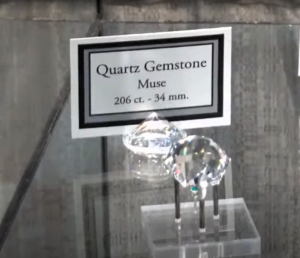
Mark: Well, the Muse is the name that Jeff Graham gave the design. I got the design from Jeff Graham. Underneath that, we have a synthetic emerald that is showing through it. I am in the process of creating what I call viewing stones. Large stones that people can pick up, look at, put in cabinets, play with, and this is phase two of the process. So, the stone is actually sitting under there and adding a very beautiful effect to it. By this time next year, we will have the stone attached, and it will be a single piece.
Fantasy Cut Gemstones: Cuts and Materials
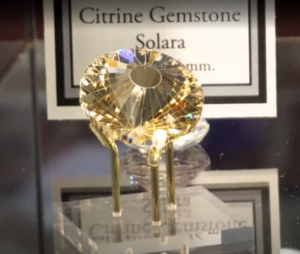
David: So then, let’s see, this one is citrine. So, give me the name of that one.
Mark: That one is what we call Solara. That gemstone was designed by Marco Voltolini, one of my favorite designers of quartz, and that is Bolivian citrine. Very beautiful. That citrine has been heated a little to bring up that color, but it is my favorite color. We’re using that gemstone as the logo gemstone for our new company, Solara Gemstones.
David: You’re kind of a collector gemstone cutter. I’m sure you cut some for jewelry, but it looks to me like your main jam is collector stones.
Mark: Well, I enjoy the larger gemstone, and the ULTRA TEC allows me to cut that larger gemstone because it gives me a larger canvas in which to do more intricate designs. But we also cut very small ones down to a quarter, a fifth of a carat, for many of our clients, but we can go up to 5,000 carats a kilo.
Using Light and Structure in Fantasy Cuts
David: Now, this looks like you’ve got a piece. Oh, no. Same thing. You have it below it. I love the structure of this separate piece. Oh wow, and then when you look into it, you see dozens of… what’s the red stone underneath?
Mark: So, the red stone is ruby, the blue stone is sapphire, and the theme here at the Tucson show this year is red, white and blue. So, I thought it appropriate to do a gemstone that was red, white and blue. The design was a fan trunk design, and what it does is allow you to put one or several stones underneath and then break it into a bouquet.
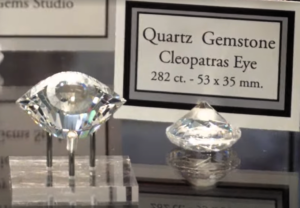
David: Yeah, that’s exactly what it looks like. A bouquet of gemstone flowers. But, you know, what I’m seeing is the accuracy of the machine fulfills the dream of the artist, that you’re able to use this incredibly engineered machine. I just heard about a fantasy cutting competition in Germany where the number one and number two winners both were using the ULTRA TEC Fantasy machine, and that’s high praise for a German. Loving that American machine. So, then the Cleopatra’s Eye. I’ve seen quite a few of these. I don’t think I’ve ever seen one this big. Uh, and just the polish, the symmetry, the cutting is superb.
Cleopatra’s Eye and Optical Effects
Mark: Thank you, David. It is a large Cleopatra’s Eye. I find the design a lot of fun to cut, and I’ve cut many of them. This is not the largest one I’ve cut. I’ve cut an amethyst that was about twice this size. And this one has some frosting also in it. It also has some mats that go around the pupil to kind of give a dramatic look to it. And this one is just a lot of fun. It’s clear quartz, but it’s amazing what you can do with clear quartz to just make it entrancing and full of wonder.
David: Especially the triangular rim of facets that create the…is that the iris, the outside part of the eyeball, you know?
Mark: And then this one also has mats on the back to do the delineation. It’s a lot of fun just to take something without color and then add design and depth and scintillation, extinction, dispersion, and let light actually be your medium instead of the stone.
The Role of Geometry in Gemstone Faceting
David: And you know something that we were talking about the other day during the interview, you said before doing gemstones, you went, and you bought “Geometry for Dummies.” Was that right? And when I look at this, it’s super geometry. So, to be able to take a basic for adults’ book and really study geometry and then have that kind of an end result, and of course, having it be sold is the full chain from research to operations to sales. You know, that’s kind of the food chain. That’s fantastic. I love it.
Mark: Yeah. So I did get “Geometry for Dummies.” Geometry in high school, let’s say, I just didn’t pay as much attention as I should. So, I needed to refresh because what’s wonderful about cutting gemstones is that you have geometry. You have geology, gemology and chemistry. You have all these different disciplines that you have to learn and integrate into your art and craft. And again, this one was also done with the V5 by ULTRA TEC.
Quartz Kaleidoscope
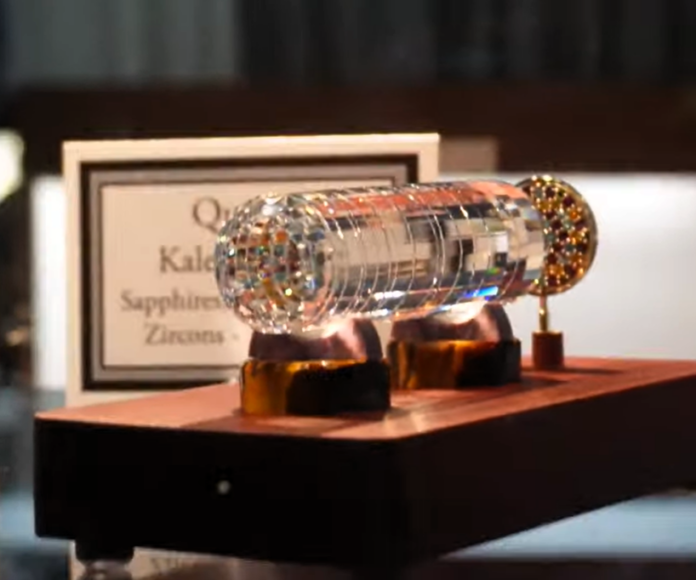
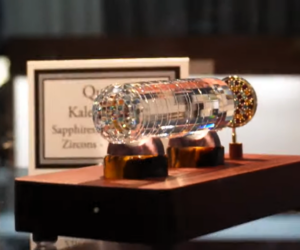
David: Very nice. Very nice. And, I know you have every piece of equipment ULTRA TEC ever made, and so you have kind of a quiver that you can go from machine to machine and accomplish these things, but let’s move up to this. It might be my current favorite. It’s a hard, hard call, but the quartz kaleidoscope. You know that you’ve cut it kind of similar to the Vogel, but with flatter ends. And then you have this beautiful little wand. I didn’t see this coming that it would be a separate piece. A little gold, almost like a magnifying glass with gemstones set in it, so that when you look through it, you see. Hats off on this piece of work. Really fantastic. So, take us from how this idea started, and then through the process, and how we got here.
Creating a Gemstone Kaleidoscope
Mark: So, it started with the fact that my father collected kaleidoscopes. He had a small collection of kaleidoscopes, and I have one or two in my study. I got the idea of maybe creating a crystal that was a kaleidoscope, that the crystal itself was the kaleidoscope, and that you could take it, hold it, and look at different things through it. And this was about three years ago, I came up with this idea, and it perked for a while. I mentioned it here to Mark, who does the lecture series, and he said he would love to see me present that. So, we got the idea to do it. We had a very large piece of quartz that we had to take this out of to get a very clear piece. And what’s fun about this piece is that it is just a single crystal. And I would say I have somewhere between 60 to 80 hours in carving this piece
David: With all the polish and everything?
Mark: With polish and everything.
David: That’s not much. I mean, in my estimation, when I look at it.
Tools and Equipment for Fantasy Cut Gemstones
Mark: And then, as you were saying about having multiple machines that ULTRA TEC provides, this was cut a little bit on a Glass Tech, a little bit on a B5, and the rings were put in on a Fantasy machine. But it was all done on 8-inch laps, so you could do a stone this size on the V5 or VL with no problem. And then we brought it over to the Fantasy. We were able to put in those rings. The rings go from being far away to closer, in order to give the piece some movement, and the taper allows it to give some movement. The base is made of bingo wood, tiger’s eye and purple jade. And my good friend, Matt the jeweler, did what I call the wand. Now the wand is 14 karat gold, and it has yellow Montana sapphires, blue zircon, grape garnets, and green garnets in it. And what’s fun about this is you can pick up the scope, pick up the wand, move it back and forth, twist it, and just have a lot of fun with it, and then just put it back onto the stamp.
David: Yeah, it’s truly so many things at once. It’s science and art; it’s a museum piece in my eyes. But I don’t think it’s going to end up in a museum. I have a feeling this is going to end up with somebody who has the means to afford something amazing like this.
Mark: I agree. It’ll probably go to a private collector, but I hope that private collector has it out where people can use it, play with it and share it.
Bringing Art and Intention into Gemstone Design
David: So, then let’s wrap up. We’ll go back to the Vogel Wand. I believe he was an IBM engineer who came up with this, and it was something about transmitting images. Some people say that his work has been buried and not really allowed to go to the public very much. So, what I’ve seen has been like photocopies and kind of underground publishing. But I do think you know, did you put an intention in it?
Mark: I would have to say my intention was wonder and beauty.
David: Well, mission accomplished.
Mark: Thank you very much.
David: And Mark also has a book for beginning faceters that you can download.
Mark: You can find the book on Amazon under Andrew Brown or Mark Oros. Andrew did the designs. I did the articles leading up to it. And what’s nice about it is that the designs go from very simple to more complex, introducing new materials, and it’s perfect for the beginner.
David: Fantastic display! As a Tucsonan, I really appreciate you coming from Ithaca, New York. I think you kind of like the weather here.
Mark: It’s been wonderful.
David: So, just fantastic work.
Mark: Thank you, David. I appreciate all the nice things you’ve said.
Fantasy Cut Gemstones FAQ
What are fantasy cut gemstones?
Fantasy cut gemstones are faceted stones designed to emphasize light, geometry, and artistic form rather than traditional jewelry cuts. They often include complex angles, carvings, and optical effects.
How are fantasy cut gemstones different from traditional cuts?
Traditional gemstone cuts are optimized for brilliance and standard settings, while fantasy cuts focus on creativity, depth, and unique visual effects, often resulting in one-of-a-kind collector pieces.
What tools are used to create fantasy cut gemstones?
Lapidaries use specialized equipment such as faceting machines, including ULTRA TEC systems and fantasy cutting machines, to achieve precise angles and intricate designs.
Are fantasy cut gemstones used in jewelry?
Some are, but many are created as display or “viewing stones” for collectors, especially larger or more complex designs.
Why Fantasy Cut Gemstones Stand Out
Fantasy cut gemstones highlight what’s possible when technical skill and creativity come together. As this collection shows, faceting isn’t limited to traditional cuts or jewelry applications—it can also produce interactive, display-worthy pieces that emphasize light, structure, and design.
For lapidaries interested in exploring fantasy cut gemstones, studying geometry, experimenting with different machines, and learning from established designers are all part of the process. Pieces like these demonstrate how far the craft can go with the right combination of tools, patience, and vision.
Be sure to watch the full video above for a closer look at these remarkable creations and the techniques behind them.
This article about fantasy cut gemstones was made by ULTRA TEC for Rock & Gem magazine. Click here to subscribe.