
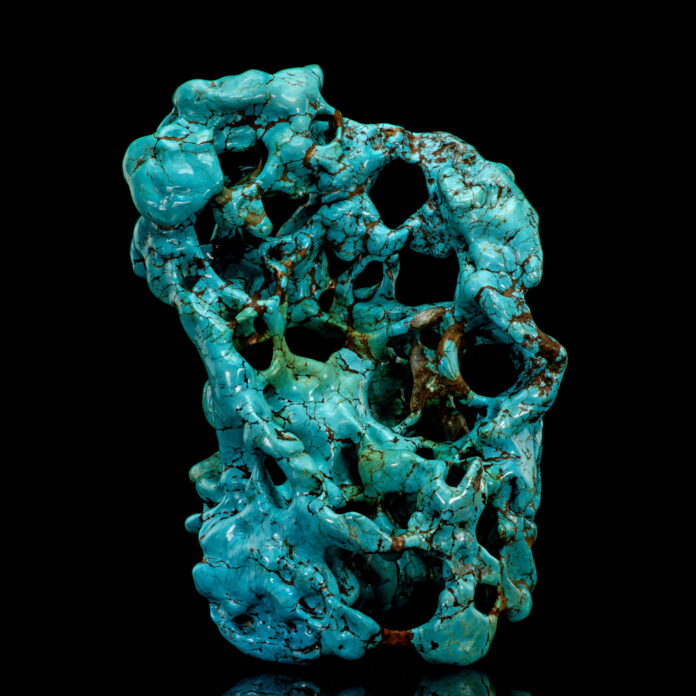
What is turquoise? With its vivid sky-blue to greenish hues, turquoise is a favorite with everyone from collectors to casual jewelry wearers. This mineral’s color is a fashion must-have. It is considered a universal color that looks good on everyone, from those with warm and those with cool undertones in their skin. Known as one of the world’s oldest gemstones, turquoise has been mined and treasured across the globe and cultures from Ancient Egypt to the American Southwest, such as Chaco Canyon, New Mexico. Holding steady value through the years, turquoise is used in fine jewelry, inlay work, and as a symbol of protection and good fortune.
Arkenstone, iRocks.com
What is Turquoise? Formation and Geology
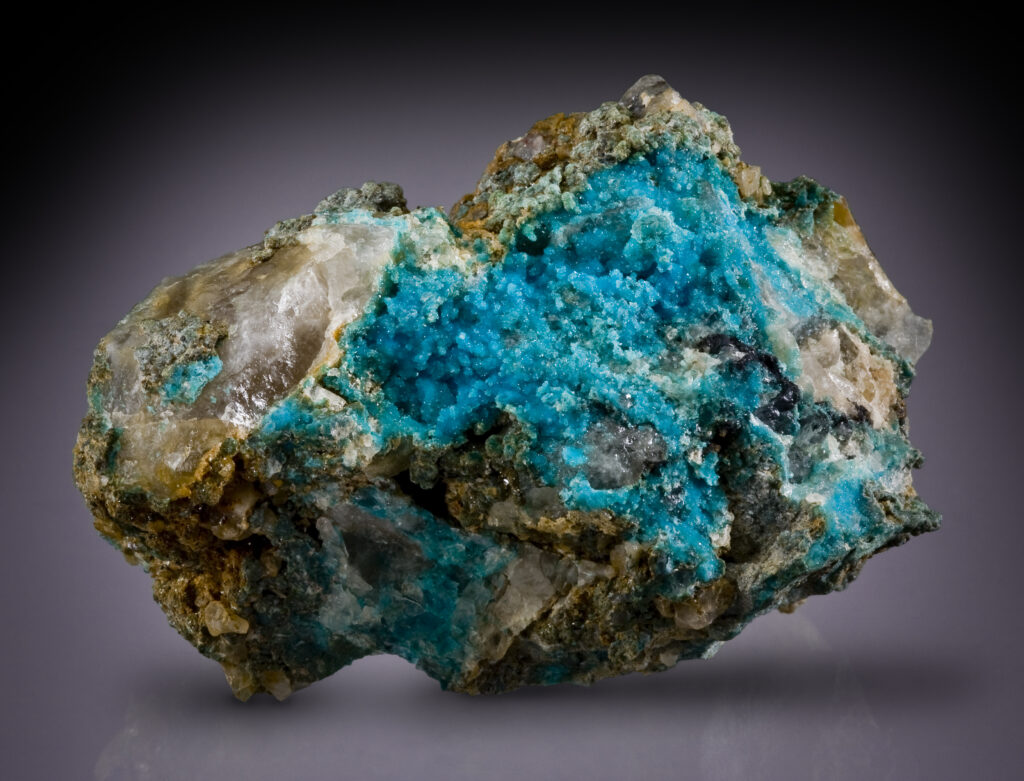
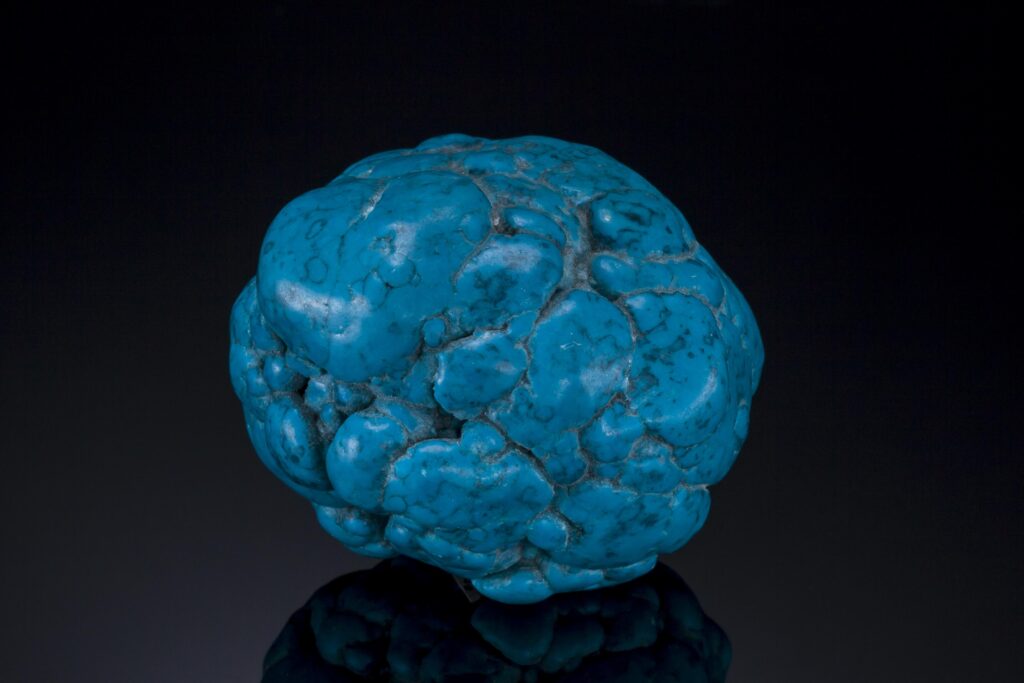
Turquoise is a hydrous phosphate of copper and aluminum with the chemical formula CuAl6(PO4)4(OH)8·4H2O. Its color comes from copper, which produces shades ranging from robin’s egg blue to bluish green, while traces of iron add greener tones. Turquoise forms through the slow percolation of acidic, copper-rich groundwater into aluminum-bearing rocks, typically in arid climates. Over time, these chemical reactions precipitate turquoise in veins, nodules and cavity fillings.
The gem often occurs intergrown with host rock— commonly sandstone, limonite or shale—creating the familiar dark “matrix” patterns seen in many specimens. These spiderweb-like inclusions are prized by collectors for their contrast and natural artistry.
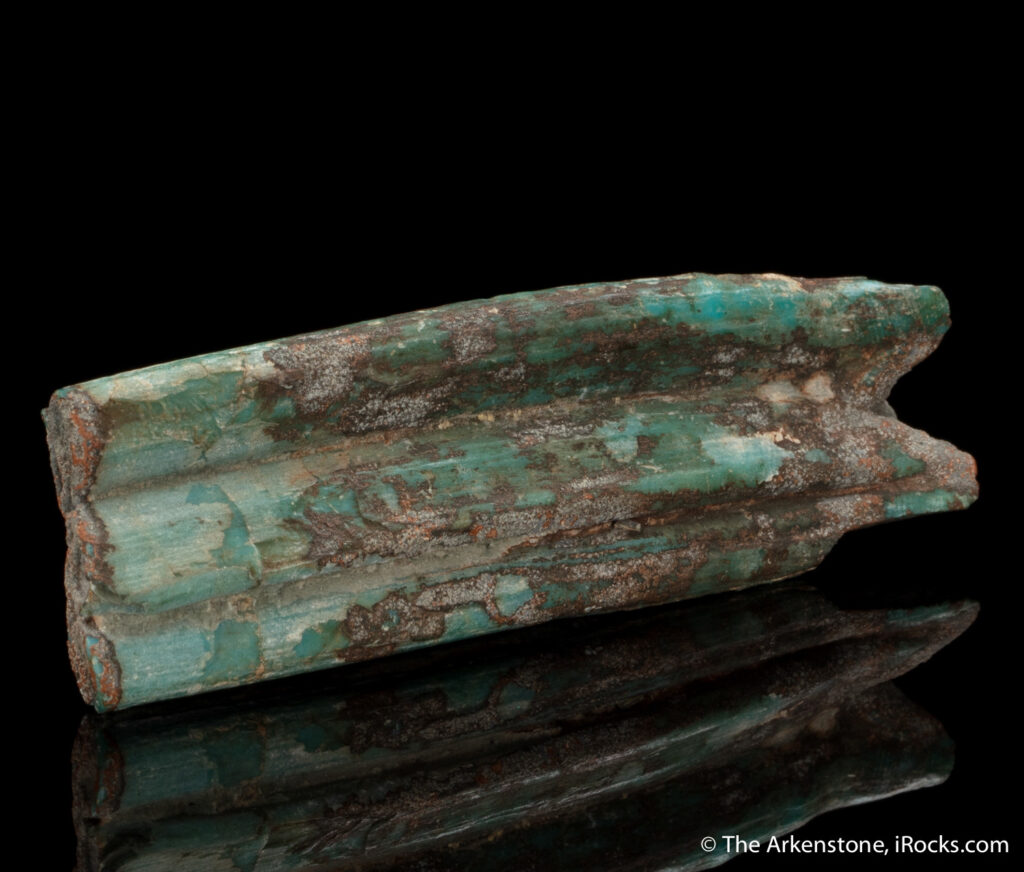
Turquoise can also form by replacing bone, a material known as “odontolite.” In this process, turquoise takes the place of apatite in fossilized bone under supergene conditions. Turquoise is famously found replacing mastodon teeth but has also been documented replacing the teeth of other mammals, including horses and even zebras.
Arkenstone, iRocks.com
Turquoise Sources
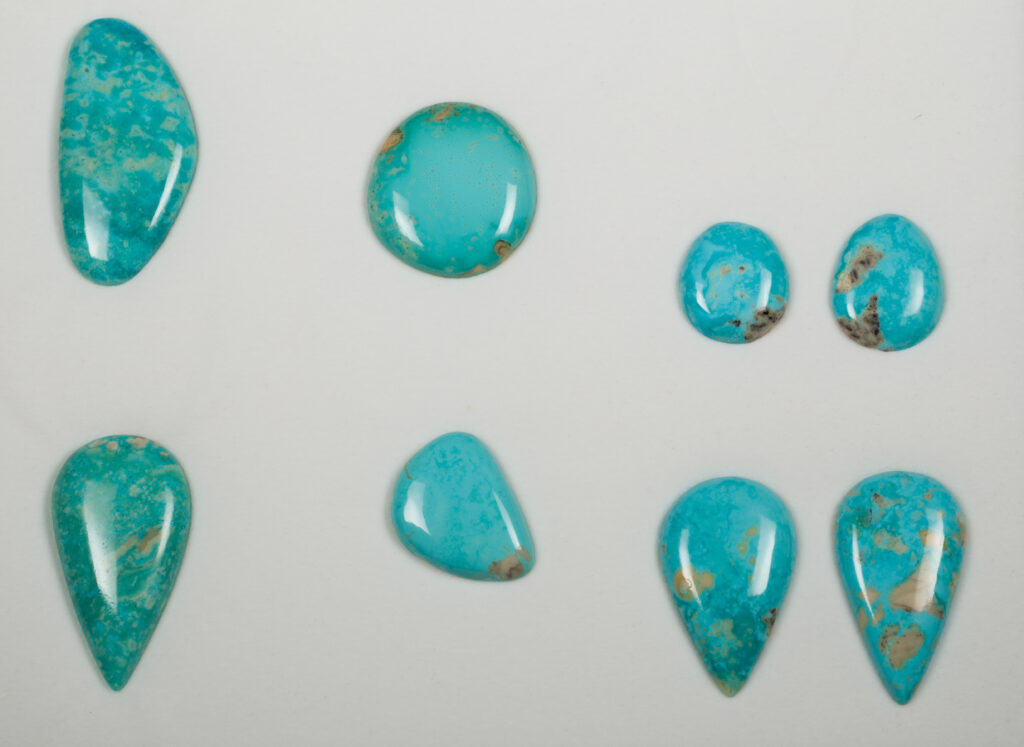
Mined since at least 3000 B.C., turquoise from Serabit el-Khadim and Wadi Maghara in Egypt’s Sinai Peninsula can be found in the jewelry of Egypt’s pharaohs, including in Tutankhamen’s tomb. Persia (modern-day Iran) has been renowned for its vivid sky-blue turquoise, prized for its purity and minimal matrix. The mines of the Nishapur district, active since at least 2000 B.C., supplied gems that became central to trade along the Silk Road and set the standard for turquoise quality worldwide. In the United States, Arizona, Nevada, Virginia, Arkansas, and New Mexico are celebrated for their mines, many of which yield richly patterned stones. Today, deposits are also found in China, Mexico and Chile.
Uses and Cultural Significance
Across civilizations, turquoise has been regarded as a sacred stone. Native American tribes of the Southwest used it in amulets, ceremonial objects and jewelry, believing it connected the sky and the earth. In Persian culture, turquoise was considered a protective talisman. In medieval Europe, turquoise was thought to guard travelers.
Fake Turquoise
Most “turquoise” on the market isn’t the real thing at all. White stones like howlite and magnesite are often dyed bright blue to mimic it (but are softer than real turquoise), while chips and powder from low-grade turquoise get mixed with resin and pressed into blocks. Some pieces are simply plastic, glass or ceramic, colored turquoise blue, sometimes with fake black lines painted on them to look natural. Even genuine turquoise is often “stabilized” with resin to make it harder and more vibrant. So, buyer beware!
What is Turquoise? December’s Birthstone
Turquoise is associated with communication, healing and protection. Many believe it promotes emotional balance and spiritual clarity. As December’s birthstone, turquoise is thought to bring good fortune, peace, and prosperity to those born under winter skies. It is the state gem of Arizona and New Mexico. It is also the state semi-precious gem of Nevada.
What Is Turquoise? FAQ
What gives turquoise its blue color?
Turquoise gets its blue color from copper. Variations toward green occur when iron is present, while zinc can add lighter or slightly yellowish tones.
Is turquoise a mineral or a gemstone?
Turquoise is a mineral (a hydrous phosphate of copper and aluminum) that is cut and polished for use as a gemstone in jewelry and decorative objects.
Where does turquoise form naturally?
Turquoise forms in arid regions where copper-rich groundwater reacts with aluminum-bearing rocks, typically filling veins, fractures, and cavities over long periods of time.
How can you tell real turquoise from fake turquoise?
Real turquoise is relatively soft and often shows natural matrix patterns. Many imitations are dyed howlite or magnesite, plastic, glass, or reconstituted turquoise made from powder and resin.
Is turquoise always untreated?
No. Much turquoise on the market is stabilized with resin to improve durability and color. While stabilized turquoise is genuine, untreated natural turquoise is rarer and more valuable.
This Field Guide about what is turquoise appeared in Rock & Gem magazine. Click here to subscribe. Story by Dr. Stuart Mills and Pam Freeman