
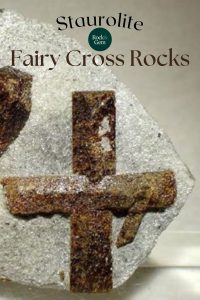
Staurolite has escaped mineralogical obscurity because of a single trait. It has a tendency to form twinned, prismatic crystals that sometimes intersect in the universally recognized configuration of the Christian cross. For this reason alone, this is a favorite at rock shops and gem and mineral shows. It is widely collected, steeped in gemstone legend and lore, worn as a good-luck charm. It is honored as an official state mineral and celebrated as the namesake of Fairy Stone State Park.
Staurolite: Mineral Properties & Formation
Staurolite, a basic iron-aluminum oxysilicate, crystallizes in the monoclinic system. With its Mohs Scale of Hardness of 7.0 to 7.5 and relatively high specific gravity of 3.7 to 3.8, it is somewhat harder and denser than quartz. Its colors range from yellowish-brown and reddish-brown to brownish-black.
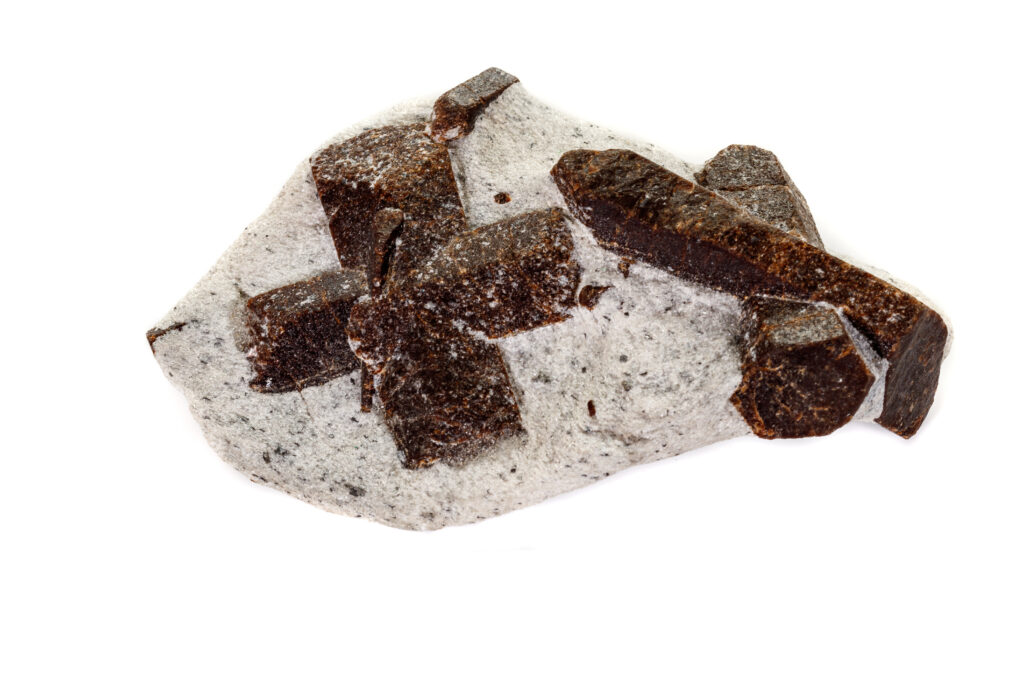
Staurolite has a metamorphic origin and forms from the high-grade alteration of shale. It is primarily hosted by schist, a medium-to-coarse-grained, silvery-gray, foliated, metamorphic rock. Staurolite is closely associated with kyanite, sillimanite, and andalusite, the three polymorphic forms of aluminum silicate.
Twinning and Cross-Shaped Crystals
About one-third of all staurolite crystals are twinned. This unusually high rate is because of its complex chemistry, along with widely varying amounts of accessory elements and frequent impurities. All contribute to disruptions in the normal sequence of crystal growth.
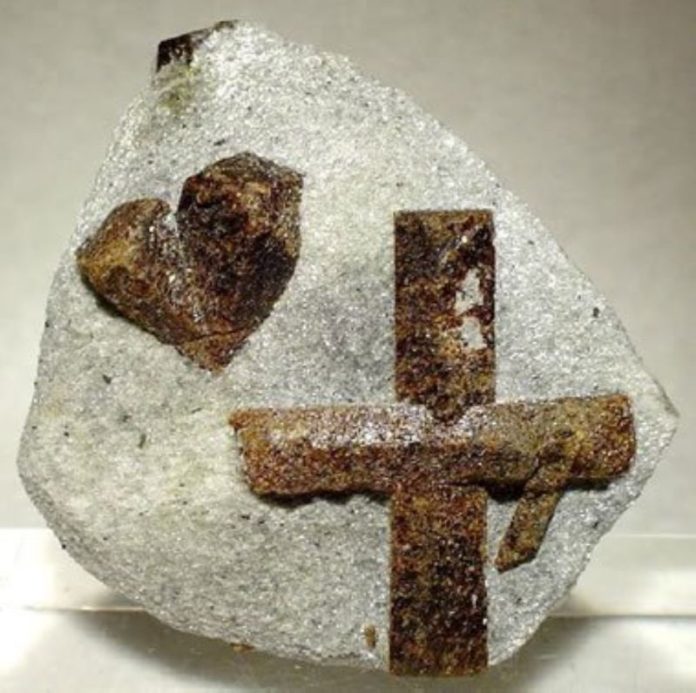
Staurolite forms penetration twins in which one prism appears to penetrate the other. The three basic types of staurolite twins are the St. Andrew’s cross, the Maltese cross and the Roman cross. The common, X-shaped St. Andrew’s cross consists of two similarly sized and shaped prisms that penetrate each other at their midpoints to form opposing 60-degree angles. In Maltese crosses, two stubby prisms penetrate each other at their midpoints at right angles. In the similar Roman cross, longer prisms are crossed in a configuration reminiscent of the cross of the Crucifixion.
The name staurolite, pronounced “STORE-uh-lite,” stems from the Greek words stauros, “cross,” and lithos, “stone,” and literally means “crossed stone.” Twinned crystals are also known as “croisettes,” “angel crosses,” “faith crosses,” “stone crosses,” “fairy crosses,” and “fairy stones,” all alluding to their shapes or alleged mythical or religious origins.
Legends, Lore & Belief
Twinned staurolite crystals, both loose and in matrix, were collected for talismanic and jewelry uses before the time of Christ. But after the cross emerged as a symbol of Christianity in the fourth century C.E., these crystals gained great popularity as natural crucifixes, which, free of matrix, were worn as pendants or strung on rosaries. One legend tells of angels who, upon hearing of the Crucifixion, shed teardrops that fell to Earth as twinned staurolite crystals.
By medieval times, twinned staurolite crystals had gained secular acceptance throughout Europe as good-luck charms. Medieval physicians prescribed wearing the crystals to alleviate the pain of aching joints and aid the healing of wounds.
Even after mineralogists had correctly described this as a type of iron silicate and a distinct mineral species in 1792, legends of its origin endured. Many remained convinced that its twinned crystals consisted not of a common mineral, but of a mystical material related to the cross of the Crucifixion.
Modern metaphysical practitioners believe that staurolite twins enhance overall physical health and well-being, invigorate the body and counteract the effects of aging.
Fairy Stone State Park in Virginia
In the United States, occurrences are concentrated in the highly metamorphosed rock of the Appalachian Mountains that stretch from Georgia to Maine. Georgia’s most productive collecting sites are found in the northern counties of Cherokee, Fannin, Pickens and Gilmer at such sites as Sharp Top Mountain and Turkey Hill. Recognizing its great popularity among collectors, the Georgia Legislature designated staurolite as the state’s official mineral in 1976.
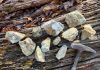
Staurolite has also achieved elevated status in south-central Virginia, where twinned crystals are an attraction at Fairy Stone State Park in the foothills of the Blue Ridge Mountains. Founded in 1936, this 4,700-square-acre park is known for its abundance of twinned staurolite crystals that have weathered free from the local schist country rock. Fairy Stone, one of the few state parks anywhere that encourages mineral collecting, organizes regularly scheduled “fairy stone hunts.”
In a colorful mix of pagan mythology and Christian tradition, a Virginia legend tells of fairies who once lived nearby in peace and harmony. But after an elfin messenger brought them news of Christ’s crucifixion, their tears fell to the ground to crystallize as the tiny stone crosses that are today’s “fairy stones.”
Specimens, Jewelry & Fakes
The most valuable staurolite specimens are dark, reddish-brown, twinned crystals an inch or two in length that are partially exposed in a contrasting matrix of light-colored, fine-grained schist. Most desirable are those with Roman-cross configurations. Specimen appearance is often enhanced by scraping or sand-blasting parts of the schist matrix to better expose the staurolite.
Most jewelry utilizes stubby Maltese crosses free of matrix. Drilled or silver-wire-wrapped, these popular good-luck charms are often mounted in key chains, bracelets, pendants and earrings.
Unfortunately, these crosses are often cleverly faked. All three staurolite-cross forms are easily replicated in sandstone and soapstone, then dyed a rich, reddish-brown color. “Perfect” staurolite crosses with smooth, glassy surfaces are almost certainly fakes.
Thanks to its tendency to form cross-like, twinned crystals, staurolite has not only escaped mineralogical obscurity but acquired a rich lore along the way.
Staurolite FAQ
Why does staurolite form cross-shaped crystals?
Cross shapes form when two prismatic crystals grow together as penetration twins during metamorphism. Disruptions in crystal growth—caused by complex chemistry and impurities—make this twinning unusually common.
Is staurolite rare?
The mineral itself is not rare, but well-formed, naturally twinned cross crystals are far less common. Specimens with clean Roman or Maltese cross shapes are especially prized by collectors.
Where is staurolite found in the United States?
In the U.S., it is most commonly found in the metamorphic rocks of the Appalachian Mountains, particularly in Georgia and Virginia. Fairy Stone State Park in Virginia is one of the best-known public collecting areas.
How can you tell if a staurolite cross is real?
Natural crosses typically show rough crystal faces, uneven surfaces, and slight asymmetry. Perfectly smooth, glassy, or uniformly shaped crosses are often carved imitations made from softer stone.
From its striking cross-shaped crystals to its rich history of legends, staurolite is more than just a mineral—it’s a bridge between geology, culture, and human imagination. Whether admired as a collector’s specimen, worn as a talisman, or hunted in the fields of Fairy Stone State Park, its enduring charm continues to capture the fascination of rock enthusiasts and casual observers alike. The story of staurolite reminds us that even ordinary minerals can hold extraordinary meaning.
This story was written for Rock & Gem magazine. Click here to subscribe. Story by Steve Voynick.