

Cursed gemstones have long been linked to royal deaths, broken romances, and unexplained misfortune. From the Black Prince’s Ruby to the Hope Diamond, these infamous cursed gemstones have inspired stories of tragedy and bad luck while continuing to captivate collectors and gem enthusiasts.
The Black Prince and Pedro the Cruel
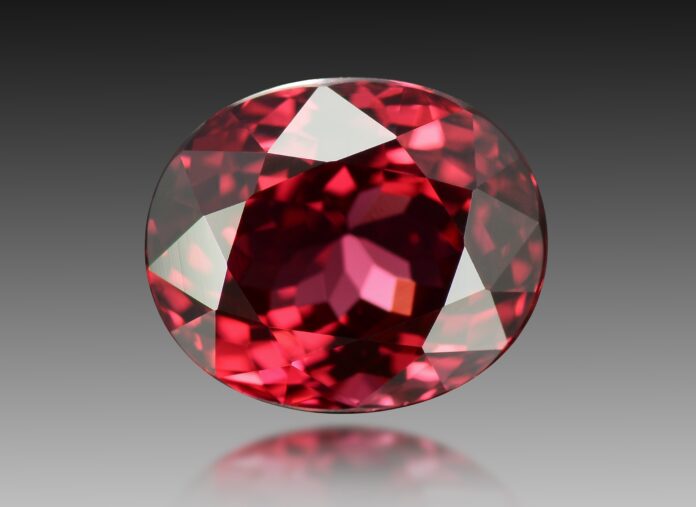
Deposed Spanish king, Don Pedro the Cruel, of Castile, and the man ready to help him keep that crown, Edward of Woodstock, the Black Prince of Wales, were bound by royal politics and a ruby as red as bloodlust. In truth, the gem awarded to Prince Edward for helping King Pedro hold his throne was a spinel gemstone. A 170-carat imposter, gifted in deceit and cloaked in a curse after the murder of its owner, Abu Said, the last Sultan of Grenada. He was wearing it when he died after accepting an invitation, under the pretext of a peace accord, to meet with King Pedro.
As life left the Sultan’s body, the Sultan’s Curse began. Soon after, the king’s brother, Henry of Trastamara, launched a war to claim the Spanish throne.
“To aid in battle, King Pedro enlisted the help of Edward the Black Prince of England. After a series of battles, Henry was kept at bay, successfully preserving the throne of King Pedro. For his service, the ruby was given to Edward the Black Prince,” Natalie Woodward wrote in her November 30 blog for Vulcan’s Forge Custom Fine Jewelers.
Funny thing about curses: They’re hard to outrun. Edward defeated Pedro’s challenger but did not kill him. The war for the throne raged on for three more years, until Pedro the Cruel was stabbed to death by Henry.
The Cursed Gem in England
That was 1367, and Edward and his gift were headed back to England, benignly indifferent to the chaos behind him. But the Sultan’s Curse would not let The Black Prince elude its grasp. En route home, Edward received the news that his eldest son had died. Nor would he live to rule England. He succumbed to dysentery by 1376, leaving his surviving son, Richard II, as heir apparent.
The big red stone rested in the hands of King Richard II until his murder at age 21 by Henry of Bolinbroke. Henry then seized the throne as Henry IV. He lived as king with a disfiguring skin disease. He ultimately suffered a fatal stroke in the Jerusalem Chamber of Westminster Abbey.
Saving the Life of Henry V
Ironically, the gem’s talismanic powers are credited with saving the life of his successor, Henry V. He wore the stone in his helmet at the Battle of Agincourt, but lost a shard in the fierce exchange. A French prisoner named Gaucourt begged to find the fragment on the battlefield in exchange for his freedom. He found that needle in its haystack, but (like any good curse) the king reneged on freeing the doomed man.
Overall, the demise of at least nine royal figures could be linked to the Black Prince’s Ruby before its 1783 appraisal by French mineralogist Jean-Baptiste Louise Romé de l’Isle.
In his assessment, a significant difference became clear: spinels have magnesium, which rubies lack.
Four hundred years after the murder of a sultan, the true sting of the curse was how the coveted cabochon was never a ruby. It was always 170 carats of spinel and remains so to this day, still in the Imperial State Crown of the United Kingdom.
Since its correct identification, there have been few royal incidents.
Diamon jewelry/Adobe Stock
Cursed Gemstones: La Peregrina
Unlike that French prisoner, the slave who found one of the largest pearls of his day in 1513 on a beach in the Gulf of Panama was instantly freed as a reward. The pearl-shaped jewel, before drilling, weighed 55.95 carats and measured more than an inch. Over the centuries, this uniquely organic gemstone of nacre earned the moniker La Peregrina, or ‘the Wanderer.’
It became a pearl dipped in blood and heartache with its gifting by King Philip II of Spain to Queen Mary I of England. When ‘Bloody Mary,’ who had ordered hundreds of executions during her reign, died in 1558, her sister, Elizabeth, returned it to Spain as a gesture of diplomacy.
For the next 250 years, the pearl was said to curse the love life of all who wore it. Queen Isabel saw the death of her poet lover, Peralta. Queen Mariana, beset with health issues, died on a lunar eclipse. With her passing, all paperwork related to the pearl or mention of its existence disappeared until 1813, when the uncle to the future Emperor of France, John Bonaparte, fled Spain with some of the royal jewels. After John’s death, the pearl went to Napoleon III, until his exile forced its sale back to England to the Duke of Abercorn, where it stayed in the family for a century.
La Peregrina’s Later History
“It was during this time when the pearl was given the name La Peregrina,” cites the blog Diamond Buzz®. “It is said during the next few years, the pearl fell out of its setting at least twice because of its incredible size. The first time, the pearl got lost in a sofa in Windsor Castle. The second time, it was during a ball at Buckingham Palace. On both occasions, the jewel was recovered.”
Its curse was not misplaced. In 1969, the pearl sold at Sotheby’s for $37,000 to Welsh actor Richard Burton. It was a Valentine’s Day gift for his wife, Elizabeth Taylor, during the first of two marriages. The pearl outlasted both their unions. Taylor died in 2011, and it took just 4.5 minutes for La Peregrina to set a Christie’s record ($11,842,500) while raising funds for the Elizabeth Taylor AIDS Foundation.
At long last, The Wanderer found a new role in healing others.
More Cursed Gemstones
Hope Diamond
This 45.42-carat, blue-violet cushion antique brilliant, with a faceted girdle and extra facets on the pavilion, is under lock and key at the Smithsonian Institution’s National Museum of Natural History in Washington, D.C. Perhaps this is more for our safety as much as for our delight?
Mere proximity, much less ownership, has been purported to claim or ruin lives. This included the unfortunate mailman tasked with bringing Harry Winston’s sparkling donation to the museum in 1958. In a coup de grâce before the curse lost its freedom, the mailman was in a truck accident. Then in a separate accident, he suffered a head injury, and to add insult to injury, his house burned down.
The Black Orlov and the Eye of Brahma
It was a 195-carat rough diamond. But plucking an eye from a Hindu god is a pretty surefire path to a curse. According to legend, the stone called the Black Orlov/Eye of Brahma was stolen by a monk from the Brahma statue’s head in Pondicherry, India, and cursed by holy men.
Three 20th-century owners – unproven Russian princess Nadia Vygin-Orlov, possibly nefarious diamond dealer J.W. Paris, and mysterious Russian aristocrat Leonila Galitsine-Bariatinsky – are all said to have jumped to their deaths. Diamond dealer Charles F. Winston took the divide-and-conquer approach to the diamond and its curse. He bought the deep gun-metal gray stone and cut it into three separate pieces. The most infamous, the 67.49-carat Black Orlov, was set into a 108-diamond brooch suspended from a 124-diamond necklace.
By the time that diamond dealer Dennis Petimezas owned the Black Orlov, from 2004 until 2006, he said he was “pretty confident that the curse is broken.”
Delhi Purple Sapphire
Like the Black Prince’s Ruby, this gem is not what it seems.
“It is not a beautiful or valuable stone, but a plain and ordinary one. It is not a source of evil but a stone of haunted misfortune and sorrow,” said fine jeweler Timothy Roe in a prior 31 October website blog.
This was not a sapphire but an amethyst, said to have been stolen in Kanpur (not Delhi) by a British soldier, who attributed his misfortunes to its bad karma and passed the purple stone to a friend, English polymath and scientist Edward Heron-Allen.
For the next decade, Heron-Allen swore the stone sapped him of rationale and initiative, and inflicted negativism on all who borrowed it. He hurled the stone, now set as a ring, into Regent’s Canal. It was found when the canal was dredged a few months later. A local jeweler recognized it and returned it.
So, with a warning that the Delhi Sapphire was “accursed and stained in the blood and the dishonor of everyone who has ever owned it,” this time Heron-Allen packed the cursed gemstone inside seven boxes filled with charms and insisted it should not be opened until 33 years after his death. When he died in 1944, his daughter donated the stone to the Natural History Museum in London, where it sat until a curator opened the box in 1972 and found its strange note and tale of woe:
‘Whoever opens this box, do whatever you want with it. My advice, however, is to throw it into the sea.”
The Delhi Sapphire is on permanent display in London in the Natural History Museum… in the Vault Collection.
Cursed Gemstones: Bad Curses, Good Stones
Sir Arthur Conan Doyle understood how cursed gemstones offer a fatal attraction.
“Of course, it is a nucleus and focus of crime. Every good stone is,” said Sherlock Holmes in Doyle’s 1892 story, The Adventure of the Blue Carbuncle, where a near-priceless gem (“The Blue Carbuncle”) is found inside a cooked Christmas goose. “They are the devil’s pet baits. In the larger and older jewels, every facet may stand for a bloody deed.”
This article about cursed gemstones previously appeared in Rock & Gem magazine. Click here to subscribe. Story by L.A. Berry.