
In 19th-century America, few things inspired more fear than rabies, then commonly called hydrophobia. Once symptoms appeared, the disease was almost invariably fatal. Even a bite from a family dog could leave people fearing for their lives.
With no effective treatment available, desperate families turned to folk remedies. One was the madstone, an unusual object believed to draw the poison from an animal bite and prevent rabies. Even Abraham Lincoln reportedly sought this remedy after his son Robert was bitten by a dog.
What exactly was a madstone, and why did people believe it could save lives?
What is a Madstone?
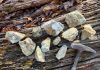
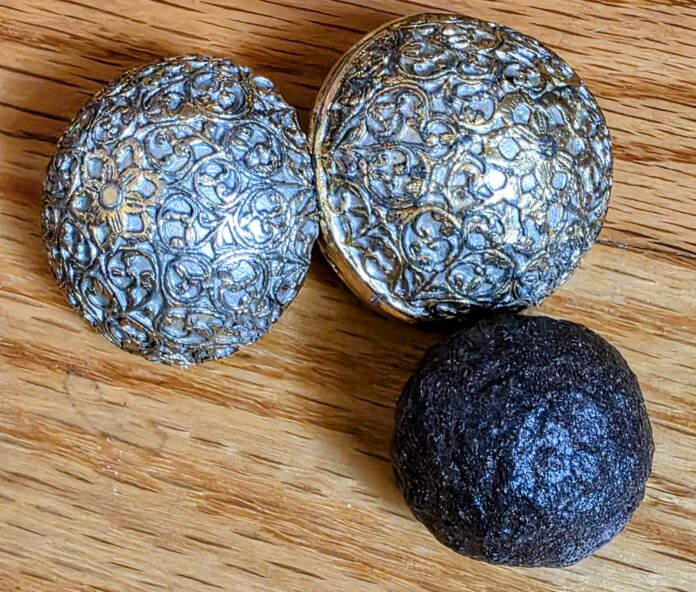
A madstone was an object believed to draw poison from an animal bite and prevent rabies. Despite the name, madstones were not necessarily geological stones. Some were believed to be bezoars or other concretions formed in animals’ digestive tracts. Historical accounts describe objects of varying origins.
Bezoars form when material accumulates and hardens in the digestive tract. Enteroliths are a distinct type of concretion that forms in the intestines. Both were sometimes prized for supposed medicinal and magical properties, particularly their ability to counteract poison.
How could one of these objects not be chock-full of charming, magical properties?
Madstones had no demonstrated ability to prevent or cure rabies. Still, before effective vaccination, the hope of drawing poison from a bite offered frightened families a reason to believe a remedy might work.
In fact, during the 17th-century Mughal Period in India, ornate containers euphemistically described as pill boxes were fashioned of precious metals specifically to hold bezoars (mad stones) derived from the alimentary organs of goats and gazelles. The mad stones were believed to have medicinal as well as magical powers, especially as an antidote to poison.
Madstones as a Folk Remedy
In 1885, the public and medical community desperately sought ways to combat rabies. Just two months before Pasteur was to announce his new rabies vaccine, the New York Times ran a May 3, 1885 account supporting the credibility of mad stones as “formations found in the bladders of deer [that] only exist in animals that live in a high, dry climate where there is not a full supply of water and the water drank is impregnated with limestone.”
Mad stones, the Times continued, formed by a “freak of nature in the small or second stomach of a Hermaphrodite Deer and so constructed with its innumerable cells that, when applied to lacerated flesh, adheres at once and every cell exercises a suction power but does not absorb any substance except Virus; because the cells are too diminutive in size to take in even blood, which is too coarse and tough to gain entrance.”
Other anecdotal reports of cures only deepened belief in the folkloric remedy. This remedy said that a mad stone boiled in milk could attach itself to a bite or wound. It would draw out the poison. Once absorbed, it would drop off like a sated tick.
According to a Winter 1960 Journal of the Illinois State Historical Society, “The stone would then be soaked in warm milk to remove the poison. The milk would acquire a greenish yellow scum, which was supposed to contain the poison, and the purified stone was ready for use again.”
Madstone Rules and Rituals
But if it were that simple, wouldn’t everyone have had mad stones? Therein lies the magic. The rules of the mad stone were temperamental in ways that only magical things (or Fight Club) can be.
A mad stone could only be used on a human. If applied to an animal, it lost its power to heal people. The most powerful mad stones were harvested from the guts of albino buck deer. Most importantly, one must go to the mad stone – it could not be brought to the patient.
The Lincoln Connection to Madstones
Robert Todd Lincoln was the firstborn son of Abraham and Mary Todd Lincoln. He was born on a summer’s day in Illinois on August 1, 1843. What none could have predicted was how Bob would be the only one of their four sons to survive to adulthood.
“He believed in the mad stone,” Lincoln biographer Edgar Lee Masters claimed in his 1931 book, Lincoln the Man. “Sometime in the 1850s, Lincoln, then still a lawyer in Springfield, brought Bob to Terre Haute, Indiana, for a mad stone cure.”
Robert Todd Lincoln biographer Jason Emerson said the boy had been bitten as a teenager by a rabid small dog. Abraham immediately took him to a Terre Haute, Indiana. This is where a folk medicine practitioner was said to have already cured three cases of hydrophobia with a mad stone.
“Great apprehension was felt for the young hopeful’s escape from hydrophobia. Mr. Lincoln, more than anyone else, feared for the life of his firstborn. The aftermath of the incident is unknown, so either the dog was not rabid or Robert‘s immune system was able to fight off the infection.”
Madstone Seekers Flocked to Terre Haute
It was 175 miles from Springfield to Terre Haute. By horseback or carriage, it would have taken father and son nearly a week to get help and they weren’t the only ones making mad stone treks to Terre Haute. In 1858, Isaac M. Brown, editor of the Terre Haute Daily Union, suggested without a hint of sarcasm that the city council should purchase a mad stone for public use, citing an account in the Mount Pleasant Journal of Iowa settler Seth Stanton’s treatment after a rabid cat bite:
“I drank no water for eight days. The stone was promptly applied to the wounds. It stuck fast as a leech until gorged with poison, when it fell off volunteerly [sic]. It was then cleaned with sweet milk, salt and water, and was applied again, and so on, for seven rounds, drawing hard each time, when it refused to take hold any more. The bad symptoms then all left me, and the cure was complete, and I returned to my family and friends with a heart overflowing with thanksgiving for thus snatching me from the very jaws of death.”
Going by the timeline of Lincoln family biographers, Bob was about 15 years old when he was treated for that dog bite with a mad stone. He lived to be 82.
The Value of Madstones
“Mad stones,” noted the Tuckahoe Veterinary Hospital in Virginia, “were highly prized as more valuable than rubies and passed down through generations as ‘family jewels.’ In 1805, a mad stone in Essex County, Virginia, sold for $2,000.”
By today’s bank accounts, that’s just under $55,000.
“Terre Haute mad stones show up over several decades in American and Canadian newspapers,” said medical history blogger Stephen Jesse Taylor, whose family has been in Terre Haute since the mid-1800s. “At one time, journalists made Terre Haute out to be a mad stone mecca. These masses were mistaken for actual stones, sometimes polished to look like hen’s eggs, and often thought to have nearly miraculous properties.”
Final Thoughts
Madstones became part of American folklore because people desperately wanted to believe they could protect loved ones from a disease that was almost always fatal once symptoms appeared. Their supposed healing powers were never established, but their reputation endured for generations.
As Taylor observed, the people who sought madstones weren’t tourists. They came looking for a cure.
This article about mad stones previously appeared in Rock & Gem magazine. Click here to subscribe. Story by L.A. Berry.