
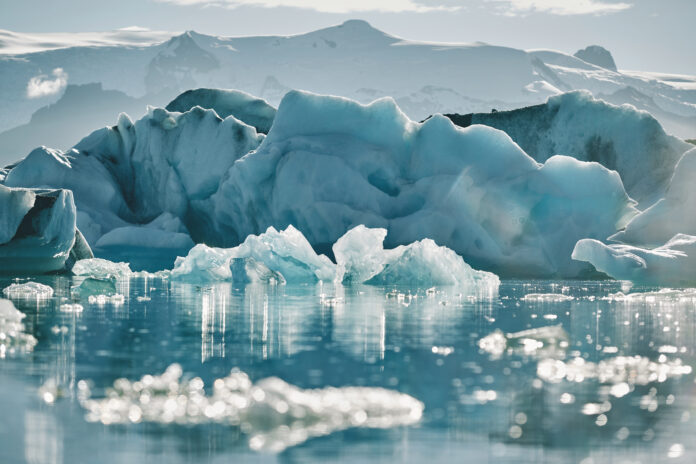
Is ice a mineral? It’s transparent to translucent, usually colorless or white, but sometimes slightly bluish. It has a vitreous luster, a widely variable hardness, and low specific gravity of less than 1.0. It occurs in both massive and crystalline forms and is unstable at moderately elevated temperatures.
So, is ice a mineral? Yes. Ice is a mineral — not the first thing that comes to mind when discussing minerals.
Ice is something we either love or hate. We love it for figure skating, iced tea and bourbon. It’s not great for water pipes, windshields and highways. Ice is thought of as “frozen water” rather than a mineral. It’s not thought of as a collectible mineral. But those who do collect ice travel thousands of miles, endure difficult conditions and spend millions of dollars to do it.
Why Is Ice a Mineral According to Geologists?
Minerals are defined as natural, inorganic, solid materials with definite chemical compositions and orderly atomic structures. Ice is a natural, solid dihydrogen oxide (H2O) that crystallizes in the hexagonal system. To further its mineral credentials, it is assigned the Dana mineral classification number 04.01.02.01 and rates four pages of mineralogical description in the 7th edition of Dana’s System of Mineralogy.
Is ice a mineral? This can be confusing because water, which makes up ice, is not a mineral, being liquid at ambient temperatures and lacking both solidity and a crystalline structure. (Mercury is a grandfathered exception to this rule.) Like opal and obsidian, water is a mineraloid—a mineral-like material that fails to meet all mineral qualifications. The transformation of liquid water to solid ice and vice versa is explained by molecular structure and hydrogen bonding.
(Steve Voynick)
Color and Crystal Structure of Ice
How do minerals, like ice, get their color? Hydrogen bonds absorb more of the red light wavelengths than of the blue. Although small bits of ice appear colorless, large masses of ice, such as icebergs and glaciers, have a bluish cast. Ice has many diverse habits. Massive ice forms when water freezes quickly or when ice crystals are compressed. It is seen in frozen lakes, glaciers, icebergs, stalactites (icicles) and concentrically banded concretions (hailstones).
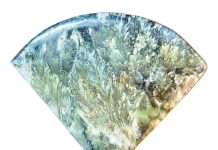
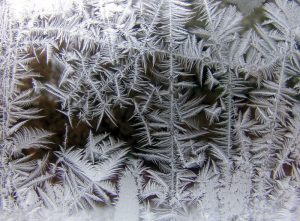
Crystalline ice forms when water freezes slowly or when water vapor deposits directly as a solid. Ice crystals have delicate, complex dihexagonal-dipyramidal shapes and occur in 80 morphological types. Examples of crystalline ice are dendritic growths on windows; flat, lathlike crystals of pond skim ice; skeletal or hopper-shaped frost prisms; and the hexagonal stellar dendrites and sectored plates of snowflakes.
Snowflakes develop when water freezes onto airborne pollen or dust particles, to create seed crystals where water vapor crystallizes in an orderly deposition governed by ice’s hexagonal structure.
Snowflake shape is determined by atmospheric temperature and humidity, time aloft and wind. Warm-air formation produces simple shapes, while cold air creates intricate, complex shapes. Because of radically varying formation conditions, no two snowflakes are exactly alike.
Is Ice a Mineral or a Rock?
While many wonder if ice is a mineral, the United States Geological Survey mineralogists also classify ice as a rock. The ice in frozen ponds is a solidified melt, just as basalt and rhyolite solidify from magma. Just as in rocks, the cooling rate of water determines the grain size of ice.
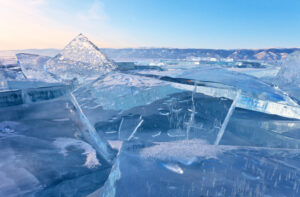
Slowly cooled water becomes coarsely textured massive ice. But when frozen quickly, the ice has a much finer texture. Extremely rapid freezing produces “ice glass” with no texture at all, just as the rapid solidification of granitic magma produces obsidian, a natural glass.
Snow is comparable to a sedimentary deposit with a texture similar to that of sand dunes. As the snow thaws and refreezes, it compacts and consolidates much like sedimentary rock. Ice can also cement sand or soil particles together into hard masses, just as silica binds many sedimentary rocks. This cementing action is seasonal in temperate regions but creates permanently frozen permafrost in arctic climes.
When deeply buried in glaciers or ice caps, pressure can recrystallize ice into a metamorphic form. The texture of glacial ice resembles that of such fine-grained metamorphic rocks as marble and quartzite. Glacial weight and movement can contort and convolute ice into the same forms seen in metamorphic gneiss and schist.
Like many rocks, ice is also quarried. The Inuit of the Arctic construct dome-shaped igloos from ice. In northern Europe and North America, ice palaces are built for winter festivals. Huge tonnages of ice were once cut from northern lakes and shipped to warmer climes as a refrigerant. And ice is also a sculpting medium for seasonal ice-carving events in many northern regions.
Glaciology: The Study of Ice and Glaciers
Glaciology, from the Latin glacies meaning “frost” or “ice,” is the study of glaciers and other ice-related phenomena.
Glaciers are perennial accumulations of ice, snow, rock and sediments that originate on land and move downslope by their weight and gravity. They range from huge continental ice sheets to isolated alpine glaciers. Fast glaciers can travel as far as 100 feet per day, the slowest only a few inches. Glaciologists estimate the average daily travel at 12 inches per day, a rate that is increasing rapidly with global warming.
Some Alaskan glacier ice is only 30,000 years old, while parts of Greenland’s ice cap are 200,000 years old. The oldest ice, found in Antarctica, contains trapped air bubbles from Earth’s atmosphere 2.7 million years ago.
Ice Cores and Earth’s Climate Record
In the 1960s, scientists began sampling glacial ice by core drilling. Ice layers consist of sequential layers, each representing a year of snowfall. Similar to tree rings, these layers can be accurately dated. Each layer is a chemical and physical record of the atmospheric conditions that existed when the ice was created.
Reading Ice: What Frozen Layers Reveal
By measuring oxygen-isotope levels in the air within ice-core bubbles, scientists have compiled a continuous record of global temperatures for the past 250,000 years. During this time, the Earth’s climate has been mostly unsettled. The exception is the unusual climatic stability of the past 10,000 years.
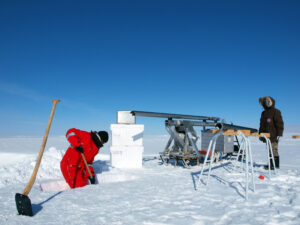
Ice layers rich in volcanic ash and sulfur indicate major volcanic eruptions, while those rich in carbon and biological matter are evidence of large forest fires. Sequences of sulfur- and lead-rich ice layers dating to the second century C.E. represent the atmospheric record of the extensive silver and lead smelting conducted during Roman times.
The ice-core record shows that the cataclysmic eruption of Alaska’s Okmok volcano in 43 B.C. spawned decades of global cooling, agricultural failure, famine, political instability and social unrest. Historians say this contributed to the collapse of the Roman Republic in 31 B.C.
FAQ: Is Ice a Mineral?
Is ice a mineral?
Yes. Natural ice meets all the criteria of a mineral: it is naturally occurring, inorganic, solid, has a definite chemical composition (H₂O), and forms an orderly crystalline structure.
Why is ice a mineral but water is not?
Liquid water is not a mineral because it lacks solidity and a crystalline structure. When water freezes, its molecules arrange into a hexagonal lattice, allowing ice to qualify as a mineral.
Is ice considered a mineral everywhere on Earth?
Ice is considered a mineral only when it forms naturally. Glacier ice, snow, hail, and lake ice qualify, while ice made in a freezer does not.
Is ice also classified as a rock?
Yes. Geologists classify ice as a rock when it behaves like one, such as in glaciers, where it forms through melting, deposition, compaction, and recrystallization—processes similar to igneous, sedimentary, and metamorphic rocks.
Is ice found as a mineral beyond Earth?
Yes. Ice occurs naturally on other planets, moons, and comets and is classified as a mineral in planetary geology.
Why do large masses of ice appear blue?
Thick ice absorbs more red wavelengths of light than blue. As a result, glaciers and icebergs often display a blue color even though individual ice crystals are colorless.
There is much more to ice than meets the eye. So, is ice a mineral? Natural ice is a mineral, a rock, an object of great beauty and an invaluable record of the Earth’s past atmospheric conditions.
This story about is ice a mineral appeared in Rock & Gem magazine. Click here to subscribe Story by Steve Voynick.