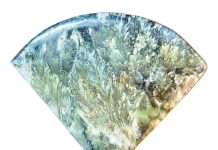

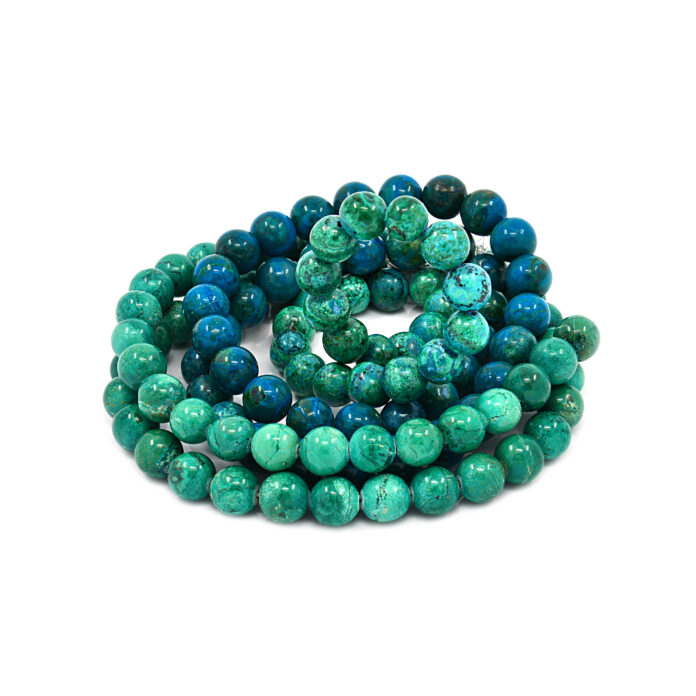
Eilat stone is known as “King Solomon’s stone.” It owes its popularity to its color and historical, geological and cultural significance. Eilat is Israel’s southernmost city. It is known for jewelry shops that specialize in rings, earrings and pendants set with this mottled, blue-green stone.
Eilat stone is sourced from the world’s first systematically mined copper deposit in the Timna Valley, north of Eilat. Eilat stone was first mined 6,500 years ago at the dawn of the Copper Age. Some believe Eilat stone provided the legendary wealth of Solomon, the biblical king of ancient Israel and Judah. And many consider Eilat stone to be the national stone of modern Israel.
Key Takeaways
- Eilat stone is a rare, blue-green gemstone mined primarily in Israel’s Timna Valley.
- Historically linked to King Solomon, it may have contributed to his legendary wealth.
- Formed from copper minerals like malachite, azurite, chrysocolla, and turquoise.
- Modern Eilat stone jewelry became popular in the mid-20th century and is considered an Israeli cultural symbol.
- Supply is limited today, and fakes exist outside Israel, making authenticity important.
Geological Origin of Eilat Stone
The Timna Valley is part of the Great Rift Valley. The Valley is a succession of long, linear surface depressions in the Earth’s crust. It formed when the Asian and African tectonic plates separated and pulled the crust apart. It is Earth’s longest rift, extending for 4,200 miles from Israel, south through the Gulf of Aqaba and the Red Sea, and into eastern Africa.
Because rifts are heavily faulted, they typically host high levels of volcanic, magmatic, and hydrothermal activity. In the Timna Valley, mineral-rich, hydrothermal solutions emplaced large amounts of copper sulfides.
Continued hydrothermal activity, along with subsequent oxidation, concentrated and redeposited this copper within a porous sandstone.
The copper mineralization occurs as disseminated particles and massive veins of intermixed blue azurite and green malachite (both basic copper carbonates) along with chrysocolla (basic copper aluminum silicate) and turquoise (basic copper aluminum phosphate). These four minerals, in variable proportions, are the main components of Eilat stone.
The Ancient Copper Miners
Mining in the Timna Valley began about 4600 B.C. when pre-dynastic Egyptians gathered rich copper ore from the surface.
After this surface ore was depleted, they dug shallow underground workings to follow concentrations of the copper mineralization.
The Timna Valley saw two periods of unusually intensive mining. New Kingdom Egyptians controlled the valley from the 15th to the 11th century B.C.; Israelites worked the mines from the 11th to the 9th century B.C. Using stone tools to work the soft sandstone, these ancient miners created thousands of surface pits and underground tunnels. They smelted the crushed ore with a limestone flux and charcoal. Much later, Arabs arrived to mine Timna Valley about 700 C.E.
King Solomon and Eilat Stone Archaeology
Biblical scholars are uncertain exactly how Solomon, who ruled from 970 to 930 B.C, amassed his fortune. Seeking clues to this biblical mystery, archaeologists continue to excavate and study the Timna Valley mining ruins.
In the late 1930s, American archaeologist Nelson Glueck attracted international attention by suggesting that the legendary “King Solomon’s Mines” were actually the Timna Valley copper mines. Glueck’s peers discredited his theory, citing his inability to precisely date the ruins.
In 2013, Israeli archaeologists accurately carbon-dated organic remains from a period of Israelite mining to 930 B.C. This coincides precisely with the end of Solomon’s reign. Many scholars now agree that the Timna Valley was indeed a major source of Solomon’s wealth.
The Rise and Popularity of Eilat Stone
In the early 1950s, the newly founded nation of Israel opened several small copper mines near the Timna Valley. Local lapidaries began cutting and polishing pieces of the richest and most colorful pieces of ore into attractive cabochons, which, mounted in jewelry, quickly gained popularity among both Israelis and visiting tourists.
This new gemstone took its name—Eilat stone—from the Timna Valley’s nearest city. An alternative name—King Solomon’s stone—was based on regional history and culture. By the 1970s, Eilat stone had become an iconic souvenir of Israel and had even gained recognition, although without formal designation, as Israel’s national stone. Eilat stone also acquired metaphysical significance as a healing stone that promotes emotional freedom, furthers wisdom, and enables confident decision-making.
The supply of Eilat stone declined when the Israeli copper mines closed in the 1980s, leaving only small amounts available today. Unfortunately, some “Eilat stone” now sold outside of Israel is fake and really comes from the copper mines of Arizona and the Democratic Republic of the Congo.
The Timna Valley Today
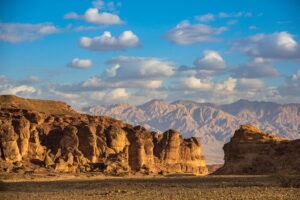
The Timna Valley is located in the southern Negev Desert. This is a rocky, barren desert of low ranges and wadis with very hot summers, pleasant winters, and eight inches of annual rainfall. Many mine ruins can be seen at Timna Valley Park, a private, 23-square-mile park that encompasses a horseshoe-shaped valley surrounded by steep cliffs, natural arches, and monoliths. Operated by the Jewish National Fund, the park provides miles of hiking trails, access to ancient underground workings, and a visitor center and museum.
Seventeen miles to the south, Eilat is a bustling resort and tourism center at the head of the Gulf of Aqaba. It has two archaeological museums that showcase the Timna Valley’s mining heritage. Numerous jewelry shops offer extensive collections of Eilat stone jewelry.
Archaeologists continue to search for solid evidence to positively link King Solomon with the Timna Valley mines and its Eilat stone ore. Meanwhile, Eilat stone is truly a stone with a story, a beautiful, material reminder of the region’s remarkable history, geology and culture.
FAQ
Q: What is Eilat stone?
A: Eilat stone is a blue-green gemstone from Israel, composed of copper minerals such as malachite, azurite, chrysocolla, and turquoise. It is also called King Solomon’s stone.
Q: Where is Eilat stone mined?
A: The primary source is the Timna Valley, in Israel’s southern Negev Desert near the city of Eilat.
Q: Why is Eilat stone called King Solomon’s stone?
A: Its association with the Timna Valley mines and biblical accounts of Solomon’s wealth led to the nickname.
Q: How is Eilat stone used today?
A: It is cut and polished into cabochons for rings, earrings, pendants, and other jewelry, often as a cultural or spiritual symbol of Israel.
Q: How can I tell if Eilat stone is authentic?
A: Authentic Eilat stone comes from Israel; beware of stones labeled as Eilat that originate from Arizona or the Democratic Republic of the Congo. Genuine pieces display a natural mottled mix of blue and green copper minerals.
This story about Eilat stone previously appeared in Rock & Gem magazine. Click here to subscribe. Story by Steve Voynick.