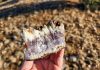

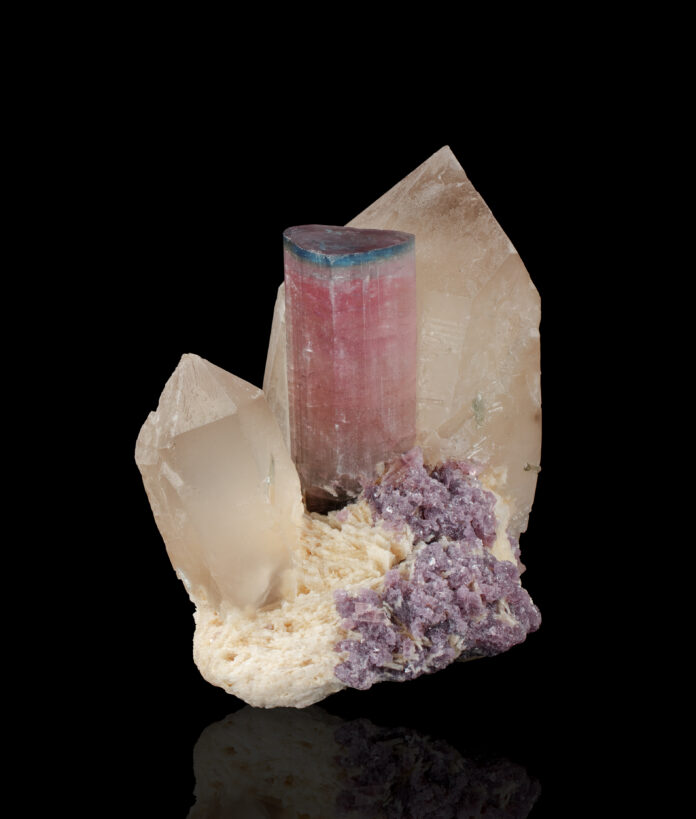
Blue cap tourmaline refers to elbaite tourmaline crystals that display a vivid blue termination atop a contrasting body that is most often pink, red or colorless. Blue caps from California are considered among the true crown jewels of American mineral collecting.
How Blue Cap Tourmaline Gets Its Color
Blue cap crystals grow in lithium-rich pegmatites. The blue cap forms when the fluid chemistry changes during late-stage crystal growth. The body color can be pink, red, watermelon, green, or colorless and is caused by trace inclusions in the crystal. For instance, a pink body color is due to manganese (Mn³⁺), created when natural radiation slowly oxidizes Mn²⁺ ions over geologic time. The very tip is sky blue to deep electric blue. This is caused when the chemistry shifts, and iron becomes more important. The balance between different forms of iron changes how the crystal absorbs light, blocking out other colors and letting rich blues shine through.
Blue caps are associated with other minerals such as quartz, lepidolite, albite, cleavelandite and other tourmalines. They are famously found in California, along with Brazil and less commonly in Afghanistan and Namibia.
Blue Cap Tourmaline in California
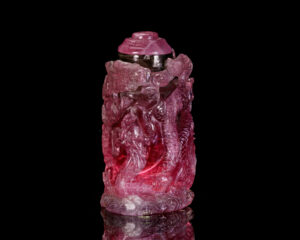
In the hills of San Diego County, tourmaline once caused a mineral rush that captured imaginations. Local Native Americans valued the stones long before miners arrived, but by the late 1800s, San Diego was swept up in a “tourmaline rush.” Tiffany & Co. bought gems by the wagonload, and Chinese agents shipped vivid pinks and greens to Beijing for Empress Cixi, who adored them and had fine crystals carved into snuff bottles, jewelry and luxury wares. Even today, you can still see reminders of that era in San Diego’s street names: Garnet, Beryl and Feldspar.
Legendary Discoveries at the Tourmaline Queen
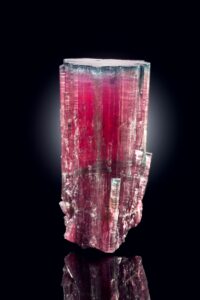
A few blue caps surfaced more than a century ago, between around 1898 and 1902, and only a few important specimens have been preserved. The most famous strike came when jeweler Edward Swoboda and miner Bill Larson uncovered legendary pockets at the historic Tourmaline Queen Mine.
In 1972, Larson worked late into the evening at the mine. With only a flashlight for light, he carefully chipped away at clay and rock until a remarkable formation emerged: a branching mass of pink-and-blue elbaite anchored by quartz. Lifting it free, he realized he had uncovered what would become known as the “Candelabra.” Today, this masterpiece resides in the Smithsonian and is one of the finest mineral specimens ever recovered.
Tips for Collecting Authentic Crystals
True blue caps are rare, prized and from the classic localities. Premium pieces have sharp blue caps, intact terminations and provenance. Smaller, less-perfect specimens are more accessible, but always check authenticity, conditions and shipping terms before purchase.
This story about Blue Cap Tourmaline appeared in Rock & Gem magazine. Click here to subscribe. Story by Dr. Stuart Mills & Pam Freeman.