
White gemstones and minerals are top of mind with Cloud Dancer being named the 2026 Pantone Color of the Year. Cloud Dancer (Pantone #11-4201) is a lofty white color called “a symbol of calming influence in a society rediscovering the value of quiet reflection.”
This soothing, neutral color may be the perfect starting point for lapidaries and jewelry artists; a blank canvas where white gem materials awaken and counterbalance other color choices, creating both harmony and contrast. The billowy white Cloud Dancer may be paired with pastel and neutral tones for serenity, with dark materials to create chiaroscuro (light and shadow), or anchor bright color choices. Cloud Dancer throws a spotlight on lesser-known white gemstones rocks, and minerals.
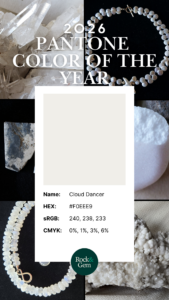
Critics argue that white is not a color at all and should not have been chosen. In a statement, Pantone vice president Laurie Pressman said the “airy white hue…exemplifies our search for balance between our digital future and our primal need for human connection.”
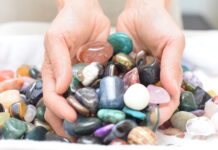
The white spectrum includes materials that are colorless, alabaster, eggshell, oyster, linen, or dove white. White gemstones and minerals that match these colors are numerous and include marble, rock crystal quartz, white drusy quartz, agate, moonstone, calcite, magnesite, white buffalo, white variscite, wild horse variscite, alabaster onyx, white topaz, howlite, aragonite, white precious opal and white common opal, white coral, pearls, and mother-of-pearl.
Marble
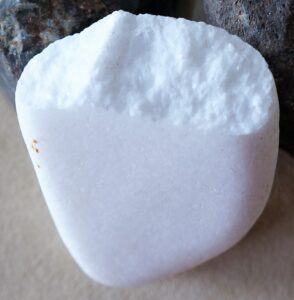
Marble is a metamorphic rock composed of recrystallized carbonate minerals, primarily calcite or dolomite, and usually also contains clay minerals, micas, quartz, pyrite, iron oxides, and graphite. Marble’s hardness is only 3 to 4 Mohs and is considered a “soft” material compared to hard gemstones. It can be shaped and chiseled with metal tools rather than diamond tools.
©Helen Serras-Herman
The bright white marble from the Greek island of Naxos was a very significant ancient deposit and is still quarried today. The Naxian marble is over 98% calcite with traces of dolomite and pyrite, and is one of the largest-grained marbles on Earth. The crystals are usually transparent, a quality that gives the stone an appearance of depth and shimmer. It was used for many statues in antiquity.
©Helen Serras-Herman
White Gemstones in the Quartz Family
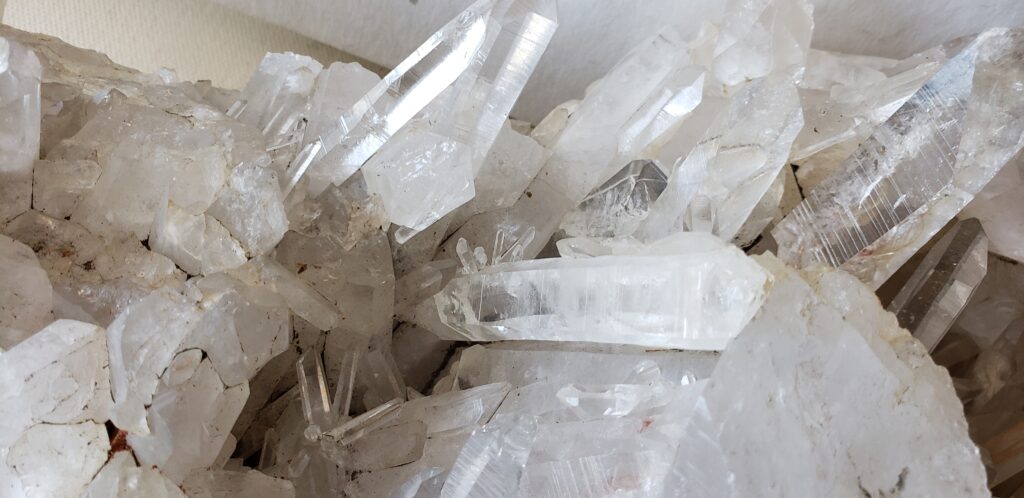
The quartz family includes several crystalline and cryptocrystalline varieties that fit the white gemstones and minerals list. The most prominent crystalline quartz is rock crystal, a clear form of quartz, composed of silica (SiO2 ). It’s usually found with good crystal terminations, often in crystal clusters. Double-terminated rock quartz crystals from Herkimer County, New York, are known as Herkimer “diamonds” because they are so clear and free of inclusions. Quartz is the benchmark for hard gemstones at 7.0 Mohs.
Rock crystal quartz is one of April’s birthstones, used since antiquity for carved objects and gem engravings. Today, rock crystal is a favorite material for carved skulls, crystal towers, spheres, and beads.
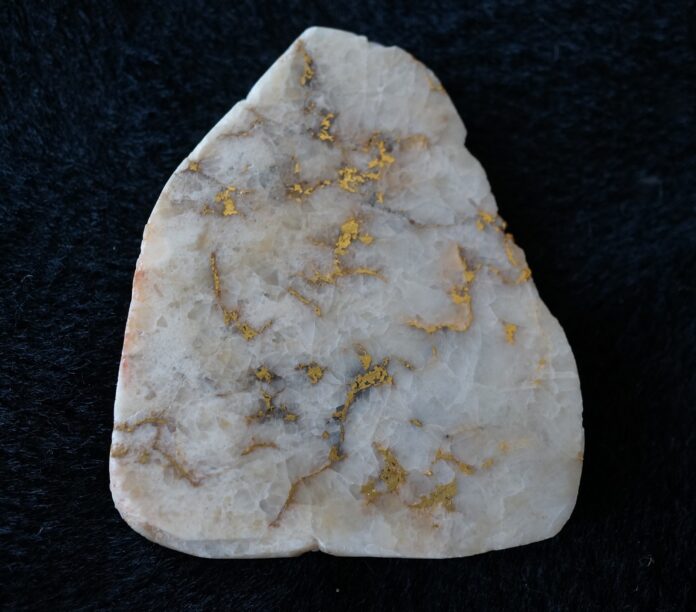
White quartz also occurs as fine drusy formations, often as small pockets within agates and jaspers. Drusy quartz is found at Round Mountain in eastern Arizona, a remote BLM land and a favorite rock-hounding location to collect fire agates and chalcedonies. Gold-in-quartz is a crypto-crystalline white chalcedony with natural gold tendrils. Agates may exhibit bands of cream and white colors.
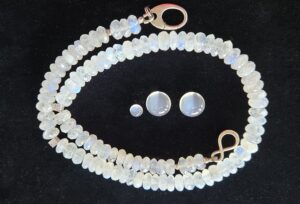
©Helen Serras-Herman
Moonstone (A Popular White Gemstone)
Moonstone is the trade name for a sodium potassium aluminum silicate white feldspar with a blue schiller [(Na,K)AlSi3 O8 ]. The name moonstone reflects the stone’s characteristic visual phenomenon called adularescence or schiller. This is caused by light diffracting through alternating layers of orthoclase and albite feldspar, resulting in a soft, bluish sheen. Cut gemstones often display the cat’s eye effect (chatoyancy) rolling over the stones. Moonstone’s hardness is about 6 to 6.5 Mohs. A favorite variety among lapidaries and jewelry artists is the rainbow moonstone — a translucent feldspar with iridescent rainbow colors.
Opal
Precious white opal is a white gemstone mostly mined in Coober Pedy, South Australia, in Wollo Province, Ethiopia, and Spencer, Idaho. White opal, also known as milky opal, has an opaque or translucent white body color and may display strong spectral colors, depending on the quality. The play of color in white opal is usually more subdued than that in black opals.
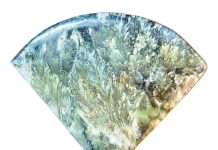
White exotic common opal, with some found in Anatolia, Turkey, and also known as cachalong opal from Russia, occurs as clear, stark white, yellowish or tan, sometimes with swirly patterns. Dendritic or moss opals exhibit black fern-like manganese or brown moss-like inclusions. Dendritic opals come from many localities, including Oregon, Montana, Peru, India, Spain, Russia, and Australia.
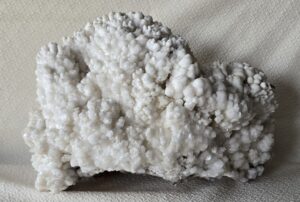
©Ankit
Aragonite
Aragonite (CaCO3) is the most common form of calcium carbonate. White aragonite is mined in Chihuahua, Mexico. It is also known as cave calcite. Some may exhibit long spiky crystals or needle-like stalactites, others large botryoidal patterns resembling cloud formations, or white bubbles. Specimens of these white gemstones are sought by mineral collectors and also for home décor and metaphysical properties.
Howlite
Howlite is a calcium borosilicate hydroxide [Ca2 B5 SiO9 (OH)5 ]. It commonly occurs in irregular massive nodular forms resembling cauliflower. Hardness is 3 to 3.5 Mohs. Howlite is usually opaque, white or whitish in color, often with grey veins running through the material in a spiderweb-like pattern. Crystals of howlite are extremely rare.
Howlite owes its name to Henry How (1828-1879), a Canadian chemist, geologist and mineralogist, who first identified the mineral in Black’s Quarry, a gypsum quarry near Windsor, in Hants County, Nova Scotia, in 1868. Howlite is also found in Germany, Mexico, Serbia, Turkey, England, and in Nevada and California.
Magnesite and howlite are two different minerals, but because of their porosity, they are often colored blue to imitate turquoise, red to imitate coral, or even lime green to simulate the rare gaspeite. Today, there is a reverse trend to feature all-natural, untreated howlite as designer white gemstones.
Lesser-Known White Gemstones for Lapidary Use
Magnesite
A magnesium carbonate (MgCO3), with a hardness of 3.5 to 4.5 Mohs, magnesite rarely forms as hexagonal scalenohedral crystals. It commonly occurs in a massive habit as veins. Colors range from colorless, white, pale yellow, pale brown, faintly pink to lime green. Some natural, untreated magnesite is highly silicified, containing silica in the form of opal or chert. Magnesite is found in many other places around the world. White magnesite is found in seams in Widgemooltha, Western Australia.
Prystene (or pristine) is a dense, fine-grained pure-white magnesite from Elko, Nevada, near the Utah border. Prystene is famous among lapidaries for being used in inlays and intarsia due to its stark white color, hardness, and compactness.
Ivoryite is the trade name for a magnesite from northern Arizona, near Prescott. Its name reflects a creamy-to-white color similar to ivory. Ivoryite is a precipitated sedimentary rock composed of magnesium, calcium, silica, and oxygen, with a hardness of around 5 to 5.5 Mohs. It has a smooth texture and shows a satin finish when polished. It is also found in California and Colorado.
White Variscite
White variscite is mined at the White Angel Mine, near Cerrillos, New Mexico. Variscite is a hydrated aluminium phosphate mineral with chemical composition AlPO4·2H2 O. It differs from turquoise, which is a hydrated phosphate of copper and aluminium. Variscite has a hardness of 3.5 to 4.5 Mohs.
Alabaster Onyx
Alabaster onyx is a calcite variety, also known as Egyptian alabaster or Oriental alabaster. The term alabaster is used by archaeologists to refer to the ancient material used to make vases and other objects. Geologically, these white gemstones are described either as a compact banded travertine or a stalagmitic limestone marked with patterns of swirling bands of cream and brown. Alabaster onyx from Stockton Hill, near Kingman, Arizona, is a lightly-colored banded variety, with some small pockets of drusy material.
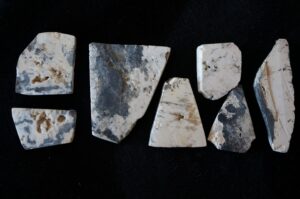
©Helen Serras-Herman
White Buffalo
The “White Buffalo” material is mined and sold by the Otteson family of Broken Arrow Mining Company of Sanford, Colorado. While some other companies mistakenly call it “White Buffalo turquoise,” they call it “White Buffalo.” These white gemstones are mined on the same claims where they mine turquoise near Tonopah, Nevada. Geochemistry X-ray analysis from the Nevada Bureau of Mines and Geology in 1998 shows that the “white buffalo” sample submitted contained major amounts of quartz, calcite, and alunite. Today, its composition is best identified as dolomite (magnesite and alunite) with black veins of chert. There is no copper, iron or zinc, the characteristic minerals in turquoise.
“White buffalo” is frequently encountered in Native American jewelry. Dillon Hartman of Durango Silver Company shared that, “the white buffalo material is actually opalized calcite, and the best quality displays black spider-web matrix against a stark white background.” Hardness is about 4 Mohs, hard enough to take a good shine.
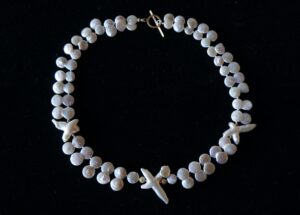
©Helen Serras-Herman
Organic and Biogenic White Gemstones
Pearls are produced in certain salt and freshwater mollusks when a tiny intruder, like a grain of sand, enters the shell. In response to the irritation, the shell covers the intruder with layers of calcium carbonate, known as nacre. In nature, this happens only in about one in 10,000 shells.
Most pearls today are cultured. This means that man implants the mollusks with seeds, which may be round beads or any other shape, and waits for nature to cover them and create pearls. At best, shells are left in the water for two to three years, but common practice today is to retrieve the shells within a few months. That results in very thin nacre layers over the implanted bead, and pearls may not survive long-term wear. Pearls are judged for their luster, surface quality (free of blemishes), color, orient (underlying iridescent play of color), shape, and size.
Shells can be re-implanted several times to make more pearls. Pearls come out perfectly round, off-round, or baroque-shaped – a style very much in vogue today.
Mother-of-Pearl White Gemstones
The mollusks’ inside surfaces are usually covered with shiny mother-of-pearl. When pearls are attached to them, they are cut out and made into half-pearls known as mabé or blister pearls. The shells also often produce a by-product known as keshi pearls, which are non-nucleated and totally composed of nacre. These white gemstones come in unusual baroque and twisted shapes and are most desirable.
Saltwater cultured pearls include Akoya from Japan, South Sea, and Tahitian. Freshwater cultured pearls are grown in rivers and lakes, mostly in China, but also in Japan and the United States. Most stark white pearls are bleached, and bright colors are dyed. Natural-color pearls occur in golden, cream, or peach colors and are fashionable white gemstones today.
Whether you’ll use the Cloud Dancer as a calming influence, a blank stimulating canvas, or an inspiration spark, the available options and combinations of natural white gemstones and rocks are almost endless. When these white gemstones are grouped, they will definitely shine under Pantone’s spotlight this year.
This story about white gemstones appeared in Rock & Gem magazine. Click here to subscribe. Story by Helen Serras-Herman.