
If you’re going to the Tucson Gem & Mineral Show, get ready to resonate with the area’s geologic and human history plus its spiritual resonance.
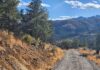
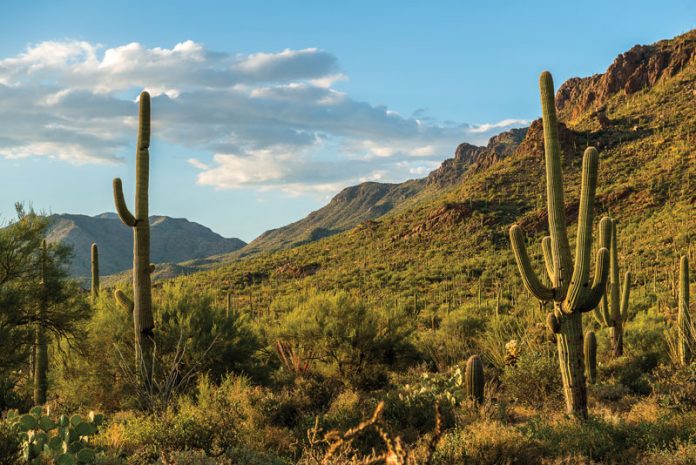
The first evidence of civilization in this corner of the Sonoran Desert dates back to 8,000 B.C., when the Tohono O’odham, the “people of the desert,” called the area Cuk Son, or “at the black base,” referring to the dark look to the basalt-covered mountain rising from the west known today as Sentinel Peak.
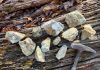
Composed of layers of igneous rock built up over periods of volcanic activity, Sentinel Peak and the Tucson Mountains are remnants of a caldera and 20 to 30-million-year-old lava flows created by composite, or stratovolcanoes, more powerful than Mount St. Helens.1At the top of Sentinel Peak is a basaltic andesite dating more than 20 million years old, capping a 35-meter thick layer of compacted volcanic ash (tuff ) atop older basaltic andesite. Breccia and ancient lava beds, known as lahars, can also be found.
Basalt, metaphysically, is seen as a stone of strength, courage and stability. It provides the power to endure, and enduring is what this ancient ground — where nations and people still come together — does best.
A Lasting Impression
“Anthropologists refer to our ancestors as the ‘Hohokam,’” the Tohono O’odham Student Association wrote in a 2017 land acknowledgment draft for University of Arizona Tribal Relations, after the discovery of 2,500-year-old footprints during a bridge construction project in the city.
“[Our] presence is visible in the landscape. Archaeological evidence of the Hohokam continues to be unearthed as the City of Tucson and surrounding towns expand.”
The footprints, frozen in mud and time, appear to chronicle a day in the life of a group of adults and children, joined by a dog and cat, as they crisscross fields and dig holes to plant crops.
Doug Gann, a preservation archaeologist for Archaeology Southwest with 30 years of experience, said the footprints and intimacy of their story brought him to tears.
“They are not merely footprints, they are the markers of what used to be there.”
Spiritual Resonance
“Native religion in the American Southwest is rooted in a sense of place,” wrote Todd W. Bostwick (Pueblo Grande Museum), Douglas R. Mitchell (PaleoWest Archaeology), and Stephanie M. Whittlesey (Harris Environmental Group) in Reconstructing the Sacred in Hohokam Archaeology for the Journal of Arizona Archaeology 2010, Vol.1.
“The natural world is intimately related to concepts of supernatural power and how ritual is used to support and sustain human life.”
The researchers observed how reverence for the desert was celebrated in full mineralogical color: “White marine-shell ornaments represented the most common color. Red was manifested in distinctive pottery, red hematite used on the body, and red argillite bead and pendant offerings.
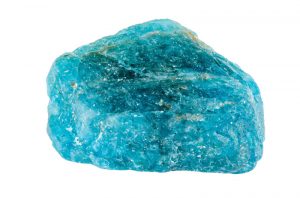
“Other highly visible colors were blue and blue-green derived from turquoise, malachite, azurite, and copper ores. Blue is associated with the sky and is a sacred color to many native peoples. It is the color of Tlaloc, the rain-storm-earth god.”
Blues Harmony
Humans continue to feel a special draw to blue gemstones, making them the best-selling color for jewelry in the world.
In fact, four of the seven rarest precious stones at Tucson in 2022 were blue, according to dealers at two of the city’s most respected fairs – the AGTA GemFair at the Tucson Convention Center and GJX show (“the Tent”) across the street.
That included an Omi Privé 2.21carat grandidierite found only in Madagascar ($90,000), 6.48 carat Himalayan Kashmir sapphire ($1.2 million), 10.62 carat Brazilian (Hematita) alexandrite ($2 million) and 80.26 carat Burma sapphire ($10 million) described by AGTA GemFair vendor Sam Ijadi as, “The finest stone I’ve seen in my whole career.”
Another red-hot blue stone among an “unusually high” number of dealers at last year’s showcase, said Parlè president, Jonathan Farnsworth, was loose Montana sapphires.
“General demand was hot. It was our best-selling gemstone on the first day of the show.”
AGTA exhibitor and president of Boston Gems, Inc., Paul Dragone, told Emily Frontiere of the International Gem Society that he too had seen high demand for Montana sapphires, surmising it “may be partly attributed to the fact that they are a domestic product. In short, Americans like to buy American.”
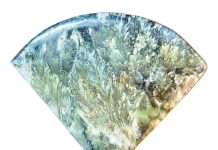
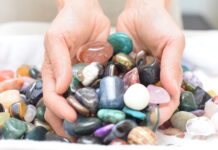
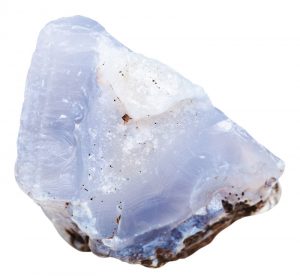
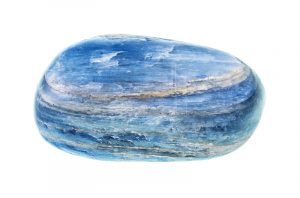
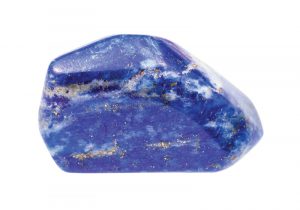
Ten spiritually powerful blue stones that you can afford to have fun hunting for in Tucson are apatite (manifestation), aquamarine, (protection) chalcedony (balance), kyanite (guidance), lapis lazuli (manifestation), sapphire (wisdom), sodalite (creativity), tanzanite (protection), topaz (communication), and zircon (relationships).
Adobe Stock / imfotograf; Adobe Stock / vvoe; Adobe Stock / Ekaterina
Senses of Place
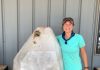
University of Arizona graduate and geologist Linus Keating, DSc, understands the natural attraction of rock and desert. His Arizona Lapidary & Gem Rough, Inc., dubbed “Tucson’s year-round gem show,” was among a handful of local shops that stayed open when the gem show was postponed in 2021.
His boyhood memories include panning for gold with his father in the Mojave Desert and by age 10, he says, “I knew I wanted to be a geologist.”
“For a city with internationally known gem shows, there were not many mineral shops,” he told Natural Tucson’s Marcia Scupin in 2016, when he and his wife, Lesli, moved from Pima Street to a larger shop on Broadway where they could expand on their “homage to the natural world – the stones and the crystals.”
“We wanted to build on that and meet the needs people have for stones,” he said, estimating small jewelry-makers and hobbyists compose a quarter of Arizona Lapidary sales.
The shop also emphasizes handcrafted work by locals like John Poole.“We encourage local artists, and they love that they can discuss methods and ideas, and share with us their experiences with the stones.”
“The beauty that comes out of the Earth is astounding,” says Lesli, a Tucson native. “We get people who come in here and don’t know about rocks, and they’re like, ‘Wow, this comes out of the Earth? This is natural?”
“I think it’s difficult to live and create here, and not somehow be influenced by the desert,” says Tawney Weir, whose Little Toro Designs was also among the nine local businesses that filled the void when the gem show was postponed.
“But I also find the cultural fabric of our community to be equally inspiring.”
Adobe Stock / vvoe ; Adobe Stock / imfotograf ; Adobe Stock / Agnieszka
Coming Together
“This is our annual gift to Tucson,” 2022 co-chair, Peter Megaw, said about last year’s showcase, which drew dealers from 25 countries, including multiple dealers from Africa, Asia, Europe, South America. “It really is all over the world.”
It’s a gift that keeps on giving for those who call Tucson home: In May, organizers with the 22nd Street Show announced, “after nine years in the making,” it had signed an agreement with the City of Tucson to expand its show site, with a bigger tent ready to hold 108 new dealers plus more parking.
“For the 2023 Showcase,” adds Jane Roxbury, director of gem show and convention services for Visit Tucson, “we’ll be launching a new microsite and digital marketing campaign highlighting show destinations as well as ‘must see’ Tucson destinations.
“Visit Tucson has been serving its community since 1982, which is also when the number of gem, mineral and fossil shows really started increasing in Tucson and southern Arizona. We consider our gem show owners and promoters as clients.”
Tucson brings people together.
“We measure the impact of the event every five years, most recently in 2019,” Roxbury says. “We measured 65,000 total visitors to the shows, with 42 countries and 42 states represented among the show owner, vendor and buyer populations.”
“Tucson,” observes longtime gem show dealer, Ian Bruce of Crystal Classics Fine Minerals, “is the center of the world for the gem and jewelry industry.”
Maybe it’s the enduring power of that ancient basalt. See you at the black base.
This story about Tucson’s metaphysical community appeared in Rock & Gem magazine. Click here to subscribe. Story by L.A. Sokolowski.