
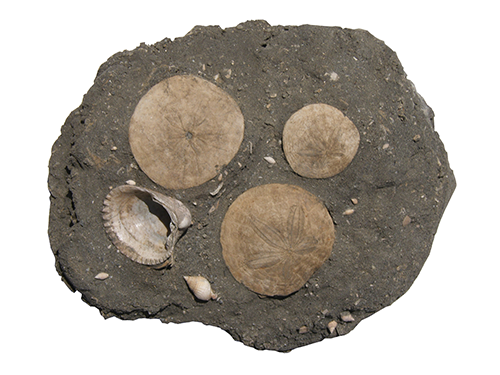
Fossil sand dollars are fascinating finds for beachcombers, fossil hunters and rock collectors alike. These ancient relatives of today’s sand dollars belong to the phylum Echinodermata, a group of marine animals that also includes sea stars, sea cucumbers, crinoids and sea urchins. Like all echinoderms, sand dollars have five-fold symmetry, which is revealed by the five-rayed star pattern on their tests.
Key Takeaways
- Fossil sand dollars are the preserved tests, or skeletons, of ancient echinoderms related to sea urchins and sea stars.
- Living sand dollars use tiny spines and hairlike cilia to move, burrow and collect food.
- The distinctive five-petal pattern on a sand dollar helps with respiration in living animals.
- True sand dollars first appeared about 65 million years ago during the Paleocene Epoch.
- Fossil sand dollars are often found in groups because these animals commonly lived in large colonies.
What Is a Fossil Sand Dollar?
What beachcombers find is the test or skeleton, which is made up of interlocked plates. In life, these tests are studded with short spines that, in turn, are covered with small, hairlike structures called cilia, which make living sand dollars look fuzzy.
How Living Sand Dollars Move and Eat
Living sand dollars use the cilia to move across the ocean floor. They burrow within the ocean floor’s sand and use the cilia to direct food particles to their mouth. A sand dollar’s mouth is located at the bottom center of the test. Sand dollars have distinctive five-rayed stars on top called petals. These petals are used for gas exchange or respiration.
How Fossil Sand Dollars Form
Like other fossils, fossil sand dollars form when the remains of an organism are buried and preserved over time. After a sand dollar dies, its hard calcium carbonate test can become covered by layers of sediment on the seafloor. As more sediment accumulates, pressure and mineral-rich water help preserve the delicate structure of the test.
Over millions of years, the surrounding sediment can harden into sedimentary rock while minerals may replace or fill parts of the original shell. The result is a fossil that records the shape and structure of an ancient sand dollar that once lived in a shallow marine environment.
Because sand dollars often lived in large colonies, fossil hunters may discover many specimens in the same area. These fossil beds provide a glimpse into ancient oceans and the communities of echinoderms that lived there millions of years ago.
The History of Fossil Sand Dollars
In the history of life, sand dollars are young. Their close relatives, the sea urchins, have a long fossil record. For instance, my collection of ocean fossils includes 300 million-year-old spiny sea urchins. In the Age of Dinosaurs, during the Mesozoic Era, sea urchins became especially common. Sand dollar ancestors began diverging from other echinoids during this time. However, it wasn’t until 65 million years ago that true sand dollars appeared, during the Paleocene, or the first epoch of the “Age of Mammals” in the Cenozoic Era.
Frequently Asked Questions About Fossil Sand Dollars
How old are fossil sand dollars?
Most fossil sand dollars are millions of years old. True sand dollars first appeared about 65 million years ago during the Paleocene Epoch, shortly after the end-Cretaceous mass extinction.
Are fossil sand dollars rare?
Individual fossil sand dollars can be common in areas where they lived in large colonies. Their hard, durable tests and group-living habits helped many become preserved as fossils.
What is the difference between a sand dollar and a fossil sand dollar?
A modern sand dollar is the living animal’s calcium carbonate skeleton, or test, after it has died. A fossil sand dollar is a test that has been preserved in sediment and turned into a fossil over millions of years.
Sand dollars have done well, with 250 living species. Their rigid tests, their tendency to live in large colonies and to burrow into sandy or muddy seafloors are all perfect for fossilization. Where you find one fossil sand dollar, you tend to find hundreds!
Sand dollars are a reminder that even familiar beach finds have a long and fascinating history. A fossil sand dollar represents millions of years of change, preserving evidence of ancient oceans and the creatures that lived within them. Because they are often found in groups, these fossils can provide collectors with a glimpse into entire communities of marine life from the past.
This Rock & Gem Kids story about fossil sand dollars previously appeared in Rock & Gem magazine. Click here to subscribe! Story and photos by Jim Brace-Thompson.