
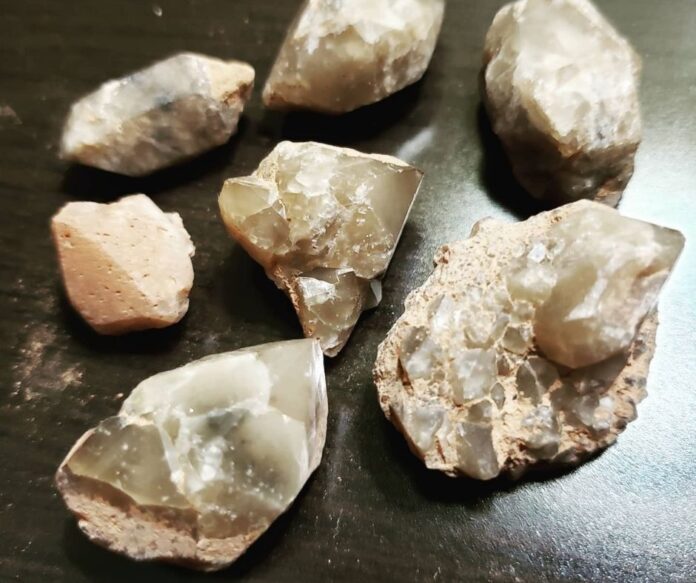
Pecos diamonds are some of the most eye-catching quartz crystals you can find in the American Southwest. While quartz forms in many places around the world, these Pecos Valley crystals are special for their large size, bold colors, and well-formed shapes. According to geologists James L. Albright and Virgil W. Lueth of the New Mexico Bureau of Geology and Mineral Resources, Pecos Valley diamonds are a rare example of quartz that formed right where it is found, rather than being transported from elsewhere.
Like the better-known Herkimer diamonds of New York, Pecos diamonds are doubly terminated quartz crystals with points at both ends. They rate a 7 on the Mohs scale of hardness. They are not true diamonds, but their sparkle and symmetry have fascinated collectors for centuries. Spanish explorer Don Antonio de Espejo first recorded them in 1583 after encountering fields of glittering crystals scattered across the desert floor of what is now southeastern New Mexico.
Today, Pecos diamonds continue to draw rockhounds to the region, where desert landscapes and deep geologic time come together. To understand why these crystals formed here, you have to look beneath the surface to the ancient rocks of the Seven Rivers Formation.
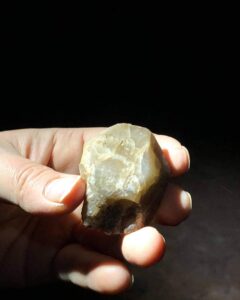
The Seven Rivers Formation: Where Pecos Diamonds Form
Like their mineralogical cousin, the Herkimer diamond of New York, Pecos diamonds are choosy about where they grow. These doubly terminated quartz crystals formed in place, a process geologists call authigenic. This means the crystals developed exactly where they are found rather than being transported by water or ice.
Pecos diamonds occur almost exclusively within the Seven Rivers Formation, a geologic unit dating back about 260 million years to the Permian period. At that time, southeastern New Mexico sat within a vast, shallow basin that repeatedly flooded and dried, creating the perfect conditions for crystal growth.
An Ancient Desert of Salt and Stone
During the Permian, the Seven Rivers area resembled a series of coastal salt flats, known as sabkhas. These low-lying desert environments experienced intense evaporation, leaving behind thick deposits of gypsum, salt, and other evaporite minerals.
According to geologists James L. Albright and Virgil W. Lueth, Pecos diamonds formed only in very specific parts of this environment—small pockets that acted like natural crystal-growing chambers. Organic material, dolomite formation, and the oxidation of sulfides all played a role in shaping the final crystals.
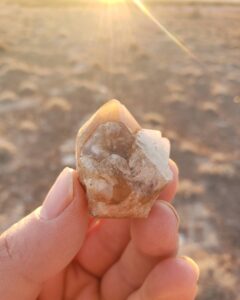
In certain lighting conditions, especially when the sun is low, exposed outcrops can appear to sparkle across the desert surface, as if paved with diamonds.
From Gypsum Cradles to Desert Finds
Pecos diamonds originally formed inside gypsum crystals. Over time, the softer gypsum weathered away, freeing the quartz crystals and leaving them scattered across the surface of the desert.
This natural process explains why Pecos diamonds are often found loose on the ground rather than embedded in rock. It also helps account for their excellent crystal faces and frequent double terminations, as they were protected during growth.
Spanish explorer Don Antonio de Espejo encountered these glittering fields in 1583, mistaking them for true diamonds. Though it would take centuries for geologists to understand their origin, the crystals’ beauty was unmistakable from the start.
A Narrow Window for a Rare Crystal
Although the Seven Rivers Formation stretches for roughly 100 miles along the Pecos Valley, Pecos diamonds appear only in limited zones within it. These crystals formed under a precise combination of chemical and environmental conditions that did not occur everywhere in the formation.
This narrow geologic window is what makes Pecos diamonds so distinctive—and why similar crystals are not found throughout the region. It also explains the remarkable variety in color and crystal shape that collectors prize today.
Understanding this ancient setting helps modern rockhounds know where to look and why Pecos diamonds remain one of New Mexico’s most intriguing mineral treasures.
Where You Can Collect Pecos DiamondsBureau of Land Management (BLM) land is okay for surface collecting rockhounds, but private land is not! New Mexico has lots of cattle ranches – a friendly request for permission to rockhound is often all it will take. Surface collecting is okay at oil and gas operations, just ask permission, don’t touch the equipment, and be mindful of signs warning of the presence of dangerous H2S gas. |
Roswell, UFOs and Pecos Diamonds
Because one of six outcrop segments to the Seven Rivers Formation is good old “Area 51” itself: Roswell.
The Roswell segment runs continuously for 47 miles in a north-south direction, with outcrops ranging from less than a quarter of a mile to more than three miles wide and disappears near the Six Mile Buckle of Kelley. Most crystals found here are confined to the top of the bluffs (closer for the UFO’s).
Pecos diamonds have also been found in the Seven Rivers segment near Dark Canyon north to the McMillan escarpment; the Artesia segment north of the Fourmile Draw and on the east side of the Pecos River; Dunnahoo Hills west of the Pecos, between Roswell and Acme; Dunlap segment north of Dunnahoo Hills and west of the Pecos River; and in the drainage valley of Salado Creek at the De Baca and Guadalupe County line, at the northernmost end of the Seven Rivers Formation.
“One of the most appealing aspects of Pecos Valley Diamonds is the immense variety,” observe Phil Simmons and Erin Delventhal at Enchanted Minerals, LLC. “Of further interest, many of the quartz crystals are fluorescent, though the source of that phenomenon has not been explored.
“They occur as doubly terminated crystals in a multitude of colors, ranging from reds, oranges and yellows, to whites, blacks, browns and even hues of purples, pinks and greens, and two equant habits, unusual in worldwide deposits is relatively common in Pecos Valley Diamonds, the pseudocubic and trigonal habit. Pecos Valley Diamonds boast an unusually high percentage of pseudocubic crystals.
“Given the tendency to be fully formed and doubly terminated, coupled with availability, it can be argued that Pecos Valley Diamonds are the world’s best source for pseudocubic quartz.”
More to See Near Pecos Diamond CountryFor all the sparkle of Pecos diamonds, there’s even more to southeast New Mexico. Two must-sees are (yes) the International UFO Museum & Research Center and Carlsbad Caverns National Park. See NewMexico.org for more Places to Visit. Carlsbad Caverns: Tucked beneath the desert floor are more than 119 known caves formed when sulfuric acid dissolved the surrounding limestone. Your visit should include a self-guided walk through the natural – but steep – entrance and the Big Room; guided tours go to the King’s Palace, Queen’s Chamber, and narrow crawl passages of the Hall of the White Giant. UFO Museum: People still come from around the world to see what the Museum has to offer and simply be in Roswell, “where it happened.” Exhibits include the Roswell Incident, crop circles, UFO sightings, Area 51, ancient astronauts and abductions. Visitors are welcome to do research in the library. |
Metaphysical Properties of Pecos Diamonds
Doubly terminated Pecos quartz is also believed to be as beneficial as it is beautiful, as a powerful healing crystal for the body, mind and spirit.
DTQ (Doubly Terminated Quartz) is especially prized for helping to release negative energy while inviting connection with higher realms; it can also amplify the energies of other crystals, making it a well-regarded addition to a crystal healing kit.
“Pecos diamond is like a diplomatic person. It brings out the best in the stones being worn at the same time. When used alone, it harmonizes the individual very quietly, very gently. It is a wonderful calmer for hysteria and anxiety, especially when induced by stress, shock or trauma,” says HealingStonesHealingCrystals.com. “These light-hearted gems work on the entire Chakra system, since they belong to the silica family and bring a sense of calmness and peace of mind.
“They also assist in motivating us to new ventures, to new ideas, or to play out an existing plan or goal.”
Pecos Diamonds: FAQ
What are Pecos diamonds?
Pecos diamonds are doubly terminated quartz crystals found in southeastern New Mexico. They are not true diamonds but have a Mohs hardness of 7 and often show well-formed crystal points.
Where are Pecos diamonds found?
Pecos diamonds are found in the Seven Rivers Formation in the Pecos Valley of New Mexico, often loose on the desert surface after surrounding gypsum erodes away.
Can you collect Pecos diamonds legally?
Yes, Pecos diamonds may be collected on Bureau of Land Management (BLM) land by surface collecting. Permission is required to collect on private property.
Why do Pecos diamonds have different colors?
Pecos diamonds show different colors due to trace elements, inclusions, and variations in growth conditions during crystal formation.
Are Pecos diamonds rare?
Pecos diamonds are uncommon because they form only under very specific geologic conditions found in limited parts of the Seven Rivers Formation.
This story about Pecos Valley Diamonds appeared in Rock & Gem magazine. Click here to subscribe. Story by L.A. Berry.